
Related videos:
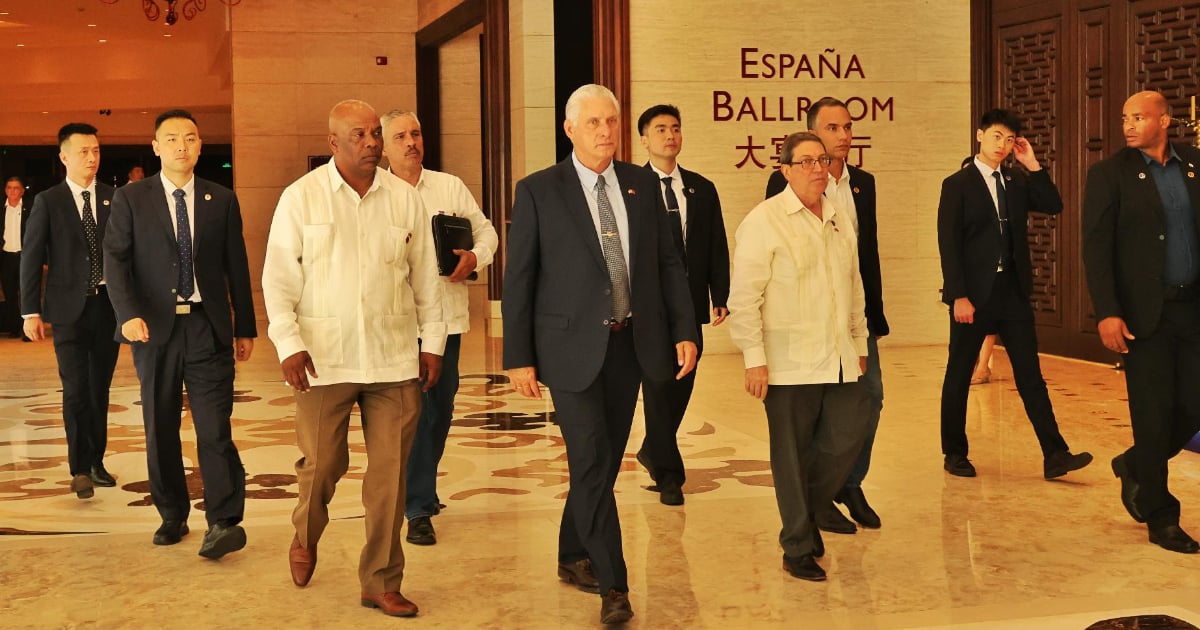
The leader Miguel Díaz-Canel met in the city of Shenzhen with more than 70 Chinese entrepreneurs, assuring them that the country is open to all proposals, in a message that systematically excludes Cubans residing on the island, who cannot invest or compete on equal terms.
The leader spoke about progress in bilateral business relations and promised more opportunities for the capital of the Asian giant in strategic sectors of the Cuban economy, amid a context of internal crisis marked by shortages, inflation, and the decline of basic services, highlighted in a thread of several tweets from the official X account of the Presidency of Cuba.
Díaz-Canel invited the Chinese business community to continue contributing to the “economic development” of Cuba in the short, medium, and long term, while reiterating the official narrative of building a “community of shared future”, a phrase that stands in contrast to the exclusion of the Cubans themselves from the business fabric of their country.
The president was accompanied by several ministers, including the chancellor Bruno Rodríguez Parrilla, the minister of Energy and Mines Vicente de la O Levy, the minister of Communications Mayra Arevich, and the president of the Central Bank Juana Lilia Delgado.
For his part, Oscar Pérez-Oliva Fraga, head of Foreign Trade and Foreign Investment, outlined the economic framework of the island and reiterated that the doors are open to foreign capital, confirming that the limitations only apply to nationals.
The meeting was part of the agenda of the leader following his visit to Beijing, where he met with his counterpart Xi Jinping and participated in the military parade for Victory Day, a tour focused on seeking external allies while internal restrictions in Cuba remain unchanged.
The regime in Havana described the meeting between Xi and Díaz-Canel as a "productive" encounter, during which several cooperation agreements were signed covering areas from agriculture and artificial intelligence to traditional medicine, infrastructure, and the cultural and media sectors.
"At the end of the meeting, the signing of eleven cooperation documents was announced. Among them are those related to the Silk Road Economic Belt, political consultations, practical cooperation, cultural exchanges, and the Global Security Initiative," said the Presidency of Cuba on X.
During the journey, on the occasion of the 80th anniversary of the victory in the Chinese people's war of resistance against Japanese aggression, both governments issued a joint declaration in which they reaffirmed their commitment to "accelerate the construction of a China-Cuba Community of Shared Future."
Likewise, the Cuban regime reaffirmed its unconditional support for Beijing's policy on Taiwan, Hong Kong, Xinjiang, and other regions under the control of the Chinese Communist Party (CCP), in yet another demonstration of alignment with a power internationally accused of systematic human rights violations.
A memorandum signed in August between the Agroforestry Business Group (GEAF) of Artemisa and the Vietnamese company Viet Royal includes the production of approximately 2,000 hectares of unused land in Alquízar, San Antonio de los Baños, and San Cristóbal for planting soybeans, green beans, peanuts, taro, potatoes, and cashews, most of which are intended for the international market.
On another note, a joint agricultural project led by the Vietnamese company Agri VMA is progressing in the municipality of Los Palacios, in the province of Pinar del Río, with the goal of planting 1,000 hectares of rice.
However, the company Agri VMA reportedly sent a letter in May to three Cuban ministers to "explain the urgent need to access their funds frozen in an account at the International Financial Bank."
According to the independent newspaper 14ymedio, which had access to the document, the Vietnamese company was attempting to transfer $300,000 to its parent company in Vietnam.
Similarly, the Asian country's chancellor, Bui Thanh Son, "urged Cuba to continue coordinating efforts to eliminate difficulties and obstacles, creating favorable conditions for investment and business for Vietnamese companies" on the island.
Boris Titov, head of the Cuban-Russian Business Committee, stated at the opening of a bilateral forum in Havana, held in May 2023, that the Cuban government had offered Russian companies the right to usufruct the land of the island for a period of 30 years.
"They are giving us preferential treatment", Titov admitted in a speech at the Hotel Nacional, adding that "the path is clear," as it is a privilege rarely granted to foreign companies in Cuba.
Frequently Asked Questions about Díaz-Canel's Meeting with Businessmen in China
What is Díaz-Canel seeking by meeting with Chinese entrepreneurs?
Díaz-Canel seeks to attract Chinese investments for strategic sectors of the Cuban economy, in a context of internal crisis marked by shortages and the deterioration of basic services. The meeting in Shenzhen is part of a broader agenda to strengthen bilateral cooperation and attract foreign capital, excluding Cubans residing on the island from this opportunity.
Why can't Cubans invest in their own country?
The Cuban regime maintains a policy that prevents Cubans residing on the island from investing or competing on equal terms with foreign capital. These limitations apply solely to nationals, reinforcing the country's dependence on external allies such as China, while economic opportunities are denied to its own population.
Which sectors will benefit from Chinese investments in Cuba?
Chinese investments are aimed at strategic sectors such as agriculture, infrastructure, artificial intelligence, and biotechnology. Additionally, cooperation agreements have been signed in areas like traditional medicine and the cultural and media spheres, seeking long-term bilateral economic development.
How does the alliance with China affect the internal situation in Cuba?
The alliance with China has not resolved the internal economic crisis in Cuba, marked by blackouts, inflation, and a shortage of basic goods. The Cuban government continues to rely on external alliances as a means of survival, without implementing substantial reforms that directly benefit the Cuban population.
Filed under: