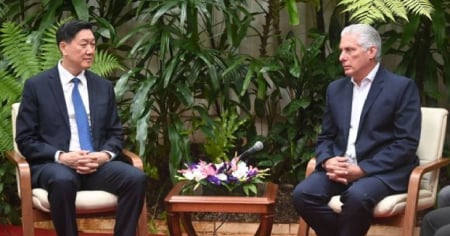
While the country endures historic blackouts, shortages, and a widespread deterioration of living conditions, the Cuban government is focusing its attention on solidifying its alliance with China, reaffirming its intention to develop a "Community of Shared Future."
The statement came after a meeting between Chancellor Bruno Rodríguez Parrilla and Qiu Xiaoqi, China's Special Representative for Latin American Affairs, who is visiting Cuba.
The presence of the representative of the Chinese Executive "is part of the agreements reached between the presidents of both countries for the development of a Shared Future Community Cuba-China,” stated the Minister of Foreign Affairs on the social media platform X, describing the exchange as “fruitful.”
This new reaffirmation adds to a series of recent gestures aligning Havana with Beijing. In May, Rodríguez participated in the V Ministerial Forum of China with the Community of Latin American and Caribbean States (CELAC).
Days earlier, the ruler Miguel Díaz-Canel traveled to Russia, where he met with Chinese President Xi Jinping. He stated that relations between Cuba and China are entering a "stronger" phase and called for "greater deepening," highlighted the agency EFE.
Xi Jinping, for his part, offered the usual support: more cooperation, more "iron friendship," and a speech of solidarity among socialist countries. He also reiterated his proposal to build a closer community between both governments, as a model of collaboration for the global South.
Díaz-Canel highlighted “the special nature of the relations between Cuba and China” and seized the opportunity to support the three Chinese global initiatives - the Global Development Initiative (GDI), the Global Security Initiative (GSI), and the Global Civilization Initiative (GCI). He also rejected “unilateralism” and “protectionism,” in line with the official narrative that blames the United States for the multiple crises facing the island.
EFE recalled that the Cuban rapprochement with China is part of a broader context of the Asian giant's strategic presence in Latin America. In the last decade, its trade and investment have expanded in key sectors such as clean energy, mining, infrastructure, and digital technology.
Bilateral trade in the region reached $427.4 billion between January and September 2024, reflecting a growth of 7.7% compared to the previous year. At the same time, Chile, Peru, Costa Rica, Ecuador, and Nicaragua have free trade agreements with the Asian giant.
In contrast to these data, the internal landscape of Cuba reflects a country trapped in a deep energy crisis, reliant on external allies and a government that continues to rely on ideological alliances while the population faces, day after day, the consequences of a system that shows no signs of recovery.
Regarding the creation of a "community of shared future," a recent article in the official newspaper Granma stated that "practical cooperation between China and Cuba continues to strengthen," and mentioned, among several examples, that the two countries jointly constructed the largest and most advanced floating dock in Cuba and the Caribbean.
He also stated that both parties "actively cooperate" in areas such as biotechnology and alternative energies, while emphasizing that domestic systems for photovoltaic solar energy generation and LED lights, "with the help of China, have alleviated the electricity deficit among residents of remote areas of Cuba."
Recent satellite images released by U.S. security experts revealed the expansion of several Chinese military installations in Cuban territory, which reinforces suspicions about a growing surveillance operation by Beijing aimed at the United States from the island.
The Cuban regime has repeatedly denied the existence of foreign military bases on its territory. However, the growing presence of Chinese military delegations on the island, including high-level visits such as that of the Chinese State Councilor and the recent meeting of Raúl Castro and Díaz-Canel with an Asian military delegation, raises concerns in Washington.
On May 30, China took an important step in its global diplomatic strategy by formalizing the creation of the Convention for the Establishment of the International Mediation Organization (IOMed), a project led by Beijing aimed at providing an alternative to traditional international arbitration mechanisms, with over 30 countries joining as founding members, including Cuba.
Twelve governments, including those of Cuba, Iran, Venezuela, North Korea, and Nicaragua, recently supported the approval of the new UN International Convention on Cybercrime, promoted by Russia, and took the opportunity to demand a digital governance focused on "state sovereignty" and free from "foreign interference."
However, there is a risk that such agreements, depending on the internal legislation of each country, may not only serve to combat cybercrime, but also to suppress dissent or censor uncomfortable content under the pretext of cybersecurity.
Also this Monday, the leader Díaz-Canel welcomed Gao Zhidan, a senior official of the Communist Party of China and president of the Olympic Committee of the Asian giant, at the Palace of the Revolution, with the aim of strengthening sports exchange between both countries, according to the official press.
Frequently Asked Questions about the alliance between Cuba and China
What is the "Community of Shared Future" between Cuba and China?
The "Community of Shared Future" is a strategic cooperation initiative between Cuba and China aimed at strengthening bilateral relations in various sectors such as biotechnology, renewable energy, and digital technology. This alliance is set against a backdrop of Cuba's reliance on international allies to try to overcome its internal crises.
How is the Cuba-China alliance affecting the internal situation in Cuba?
Despite the agreements with China, the internal situation in Cuba remains critical, with historic blackouts and a deterioration of living conditions. While the Cuban government strengthens its relationship with China, energy and economic issues continue to impact the population without any significant improvements in sight.
What role does China play in Cuba's energy crisis?
China is providing donations and technical assistance to improve the Cuban electrical system. This includes the shipment of parts for generators and the development of solar energy projects. However, these efforts have not been sufficient to resolve the energy crisis affecting the island.
Are there Chinese military bases in Cuba?
Although the Cuban regime denies the existence of foreign military bases on its territory, the presence of Chinese military delegations and the expansion of facilities have raised concerns in the United States about possible surveillance operations by Beijing from the island.
What is Cuba's position regarding the United States in the context of its alliance with China?
Cuba, in its approach to China, positions itself as a partner of the Asian giant against what it perceives as imperialist policies from the United States. The Cuban government uses its alliance with China as an alternative to the global system led by the U.S., seeking a fairer international order and resisting external pressures.
Filed under: