
Related videos:
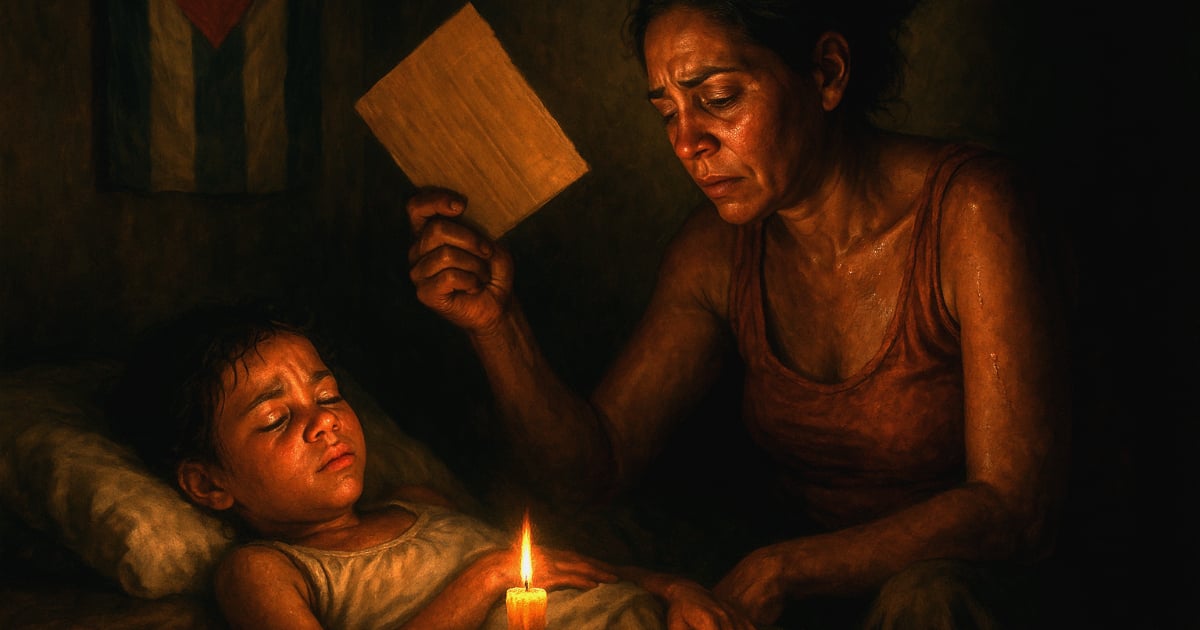
Cuba is experiencing a critical situation this Thursday: the nationwide blackout extends into a second consecutive day, with thousands of people without electricity and forced to survive in darkness, lacking food refrigeration, hospitals under pressure, and digital connectivity practically paralyzed.
In recent hours, authorities have announced minimal progress.
The latest report from the Ministry of Energy and Mines announced the commissioning of Unit 3 at the Céspedes thermoelectric plant.
Previously, it reported the reactivation of Unit 5 of Nuevitas, the Mariel engines, two blocks from Santa Cruz, Unit 8 of Mariel, and the Energas plants in Varadero and Boca de Jaruco.
In Havana, the Electric Company reported that, by 5:00 am, 18 substations and 208 distribution circuits had been restored, representing 73% of the city and a total of 628,861 customers.
It also stated that 41 hospitals and eight essential water supply systems now have power, although thousands of Cubans are still waiting.
Prime Minister Manuel Marrero Cruz attempted to convey optimism from X, stating that 500 MW had been recovered and that efforts are underway to reactivate the Antonio Guiteras power plant, as well as to strengthen the Camagüey microsystem to incorporate block 6 of Nuevitas.
At 10:00 PM on Wednesday, only just over 5% of the national demand had electricity.
The Electric Union (UNE) then revealed that at that moment, more than 200 MW were being sustained in distributed electrical microsystems across several provinces, primarily aimed at ensuring the operation of hospitals, bakeries, and water pumping.
Before the collapse, the UNE had warned in a note that the situation of the SEN was critical.
A pattern of collapses
The disaster began at 9:14 am on Wednesday, when the Antonio Guiteras thermoelectric plant, the largest in the country, unexpectedly went offline, causing a total collapse of the National Electric System (SEN).
The Electric Union (UNE) issued a brief message on Facebook: "9:14 am. Collapse of the National Electroenergetic System following the unexpected shutdown of the CTE Antonio Guiteras. We will continue to provide updates."
This is already the fifth nationwide blackout in less than a year, a number that reveals the extent of the structural crisis.
In October and December 2024, failures at the same Guiteras caused widespread blackouts; in November, Hurricane Rafael disrupted the national electrical system; and in March of this year, a failure at the Diezmero substation left the entire country without service again.
About a month ago, on September 7, a fault in the 220 kV Nuevitas-Tunas line left the entire eastern region, from Las Tunas to Guantánamo, without electricity.
Weeks before, Havana experienced two consecutive blackouts: one in August due to a malfunction at the Naranjito substation, which affected 14 out of its 15 municipalities, and another in July, allegedly caused by an electrical discharge that triggered several high-voltage substations.
A country in darkness
The tragedy is not only technical but also political. The electrical collapse exposes, once again, the absolute inability of the Cuban regime to guarantee a basic service.
Despite decades of promises and supposed investments, the country relies on an obsolete, fragile system that is on the brink of permanent collapse, dragging the entire island down every time one of its critical plants goes offline.
The result of this chain of disasters is a country plunged into darkness, where daily life becomes unbearable and the future feels increasingly uncertain.
The regime's inability to ensure electricity supply is no longer just a technical failure: it is a political and humanitarian failure that condemns millions of Cubans to the most extreme precariousness.
Filed under: