
Related videos:
The situation of the National Electric System (SEN) is still characterized today by a collapse that strikes the entire island with prolonged blackouts and without a planned rotation scheme during a day when the total impact is expected to be 1,868 megawatts (MW).
On Friday, the maximum impact from capacity deficit reached 1,939 MW at 8:40 PM, following the shutdown of unit 3 of the Carlos Manuel de Céspedes thermoelectric plant in Cienfuegos, which exceeded the planned levels, reported the statement from the Electric Union published on Saturday on the Facebook page of the Electric Company of Havana.
Throughout the day, the service was affected for 24 hours, and in the early hours of Saturday, it continued to experience widespread interruptions.
The figures from September 13 confirm the magnitude of the problem. In the morning hours, the availability of the National Electric System was 1,437 MW compared to a demand of 2,693 MW, resulting in a deficit of 1,303 MW.
By noon, an impact of 1,350 MW was expected, while the forecast for peak hours amounts to a deficit of 1,798 MW, with a total impact of 1,868 MW.
Despite the contribution of the 30 photovoltaic solar parks, which delivered 2,323 MWh with a maximum capacity of 523 MW, generation remains far below the needs.
When sharing information on his Facebook account, the state journalist Lázaro Manuel Alonso commented that “the power outages are prolonged throughout the country, including the capital. In the regions, it is not possible to plan an exact rotation system due to the significant deficit in electricity generation.”
Citizen outrage is growing on social media. Residents from various municipalities in the capital reported that in some blocks they had barely three hours of electricity throughout the day, while others claim that some areas are never affected due to "privileges."
Others claim that the official reports do not reflect the true extent of the deficit and that the rotation system is arbitrary.
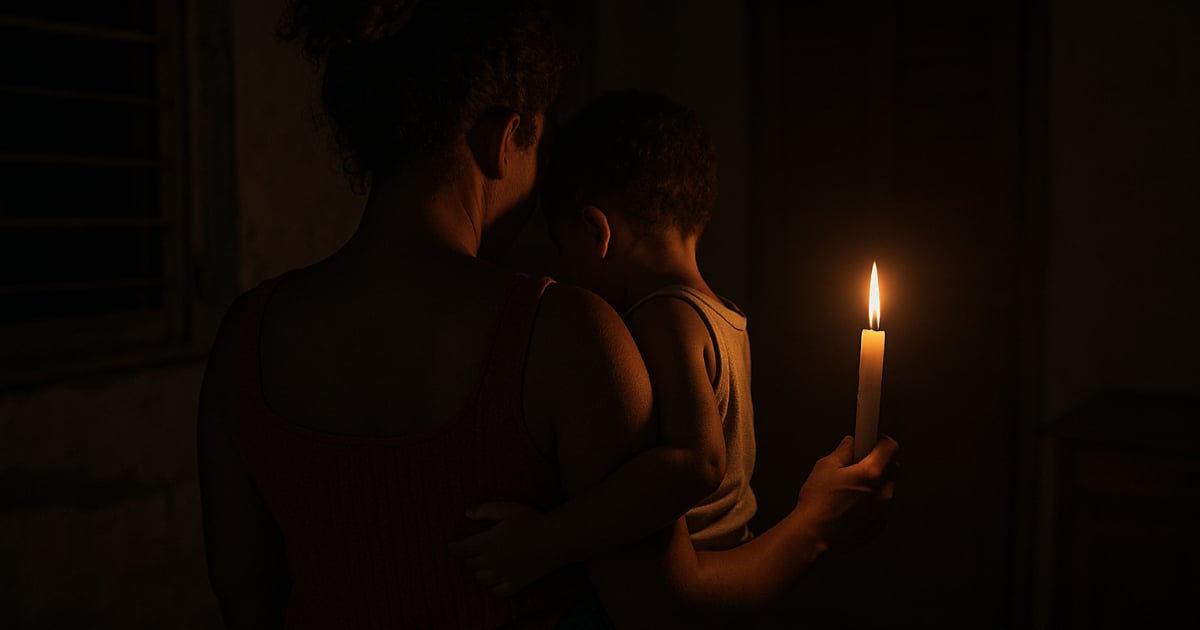
The comments point to a widespread discontent: families with children and elderly individuals endure entire days without light or water, the population demands transparency in information, and complaints about the unequal distribution of power outages are increasing.
“The SEN has collapsed and there is no stability at all,” wrote a resident of Havana, while another called the situation a “national disgrace” when comparing the electrical disaster to the reality of the poorest countries in the region.
Another commentator was more direct in addressing the Electric Company of Havana: “Just declare a state of emergency in the country. They have almost all of Cuba in the dark while keeping certain areas unaffected, not due to economic strategy, but because of privileges.”
And he demanded, additionally: "Shut down all the bars and nightclubs that are large consumers of energy and only accessible to the wealthy and privileged elite of the country. They have an entire population paying for the lavish and sweet life of a few. Wasn't this revolution started to eliminate these differences?"
The Ministry of Energy and Mines reported this Saturday that the startup process of unit 8 of the Mariel thermoelectric plant, unit 3 of the Carlos Manuel de Céspedes, and engines from Mariel is underway, with the potential to be integrated into the National Electric System “more immediately.”
Frequently Asked Questions about the Critical Electricity Situation in Cuba
What is the current electricity generation deficit in Cuba?
The electricity generation deficit in Cuba is critical, reaching 1,868 megawatts (MW), which has caused prolonged blackouts across the island. This deficit is the result of inadequate electrical infrastructure to meet national demand, compounded by breakdowns and maintenance issues in several thermoelectric units.
What measures is the Cuban government taking to address the energy crisis?
The Cuban government has announced the start-up of several thermoelectric units, such as Unit 8 of the Mariel thermoelectric plant and Unit 3 of Carlos Manuel de Céspedes, to add more megawatts to the National Electric System (SEN). Despite these efforts, the situation remains critical due to a lack of fuel and the deterioration of the electrical infrastructure.
How does the energy crisis affect the daily lives of Cubans?
The energy crisis severely affects the daily lives of Cubans, with power outages lasting more than 20 hours, impacting domestic, work, and educational activities. Complaints on social media reflect the frustration over the lack of electricity, making it difficult to preserve food, use medical equipment, and maintain comfort in homes, especially in a hot climate.
What is the contribution of solar energy to the electrical crisis in Cuba?
Although the photovoltaic solar parks in Cuba have generated 2,323 MWh with a maximum capacity of 523 MW, this contribution is insufficient to cover the structural deficit of the national electrical system. Solar energy, despite being a renewable source, does not compensate for the shortfalls in thermal generation and the collapse of the electrical system due to its dependence on thermoelectric plants.
Filed under: