
Related videos:
The government journalist Ana Teresa Badía questioned today on her Facebook account the failure to meet the government promise to reduce blackouts this summer, recalling that months ago it was assured that the situation would improve by July, and today the reality is a worsening of the energy crisis.
Badía stated that at the very least, there should be an explanation for why the announced plans were not fulfilled, highlighting the need for consistency between statements and actions.
“And no one is going to explain why the promise was not fulfilled? What happened? At least I would like to know. No, I am not pointing out the wound, but the inconsistency,” he emphasized.
His comment sparked a wave of responses where citizens and media professionals voiced direct criticisms of the authorities and their handling of information on the issue.
Journalist Osvaldo Rodríguez emphasized that the Cuban press should investigate causes, errors, and broken promises instead of merely repeating official statements from the Electric Union (UNE). In his view, the issue lies in officials making forecasts without the certainty of being able to fulfill them, which creates false expectations and fuels distrust.
Others, like the comedian Jorge Bacallao, mocked the endless list of broken government promises, pointing out that if a result benefits the people, it is almost never fulfilled, whereas if it has a negative impact, it is almost always carried out.
There were also other commentators who directly accused the authorities of lying without facing any consequences, which results in a complete loss of credibility and hope.
“It has been a while since everything was lost: credibility, trust, and shame,” opined reporter Ania Ortega.
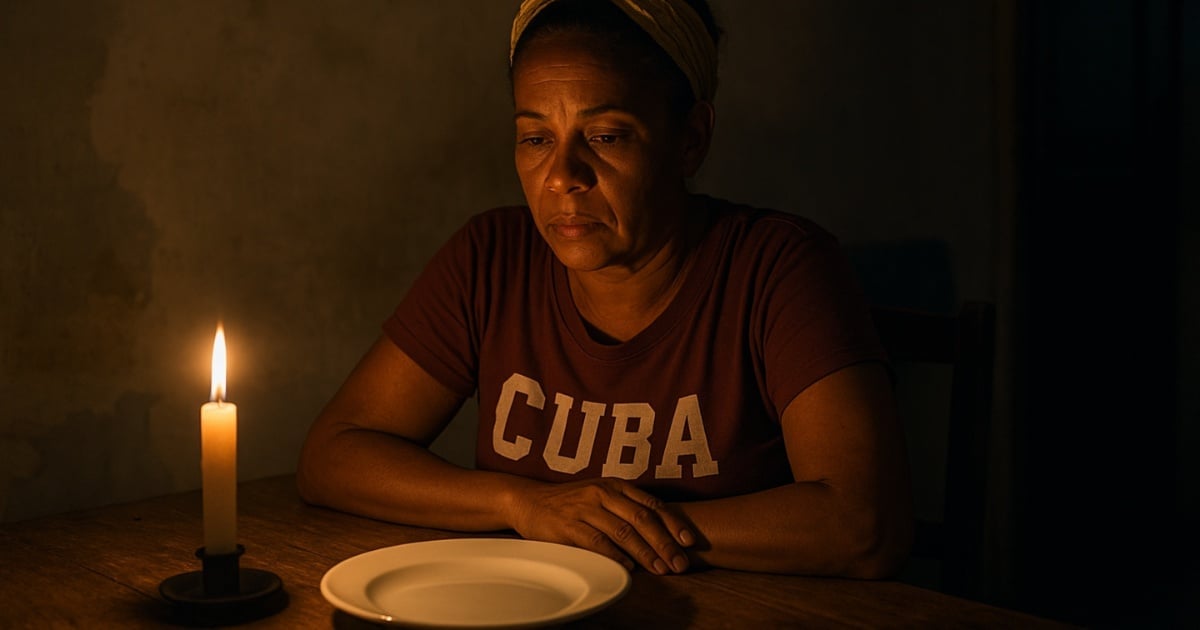
Power outages of over 30 hours reported from several provinces, a lack of official explanations, and the accumulation of simultaneous issues such as the shortage of drinking water.
Comments from Lídice Guridi Ramos in Cienfuegos and journalist Lourdes Pichs in Holguín indicate that the decline is more severe outside of Havana.
Other participants in the debate pointed out that the lack of transparency creates room for rumors and misinformation, and that the citizen's right to receive clear and timely information has been reduced to mere words on paper. Several agreed that the distrust is not new but rather the result of years of unfulfilled promises.
Badía's question encapsulates the feelings of millions of Cubans living in darkness: why are promises made that cannot be fulfilled, and why does no one take responsibility afterward?
The official response remains silence, while the population continues to bear the consequences of a collapsed electrical system.
In May 2025, the Cuban regime promised that summer blackouts would not exceed four hours per day per customer.
The statement, made by the First Deputy Minister of the Ministry of Energy and Mines (MINEM), Argelio Jesús Abad Vigoa, was published on May 21 in Granma, the official publication of the Communist Party of Cuba.
The intention was clear: to reduce social unrest on the eve of the hottest period of the year.
According to that promise, the plan was to increase generation by 13 GWh daily, recover key thermal units —such as Felton 2, Mariel 7, Nuevitas 4, and Renté 4— and control the growth of consumption.
Despite official data revealing that the available generation would be insufficient (1,120 MW compared to a demand exceeding 3,000 MW even in the early morning), the narrative of a "summer with only four hours of blackout" was maintained.
On May 27, just six days after the promise, the government began to modify its rhetoric as part of the timeline of a new failure anticipated in government management.
The official newspaper Trabajadores published a note acknowledging that power outages would continue during the months of July and August, due to a structural deficit that could not be corrected in time.
Lázaro Guerra Hernández, director of Electricity at MINEM, explained that the estimated availability would be only 1,935 MW against a potential demand of 3,500 MW. The deficit would exceed 1,500 MW, making it inevitable that the blackouts would be more extensive than initially announced.
This early admission revealed that the promise of “four hours a day” was unsustainable from the start. Nevertheless, for weeks the official narrative continued to speak of “improvements,” “gradual strategies,” and “intensive work.”
The shortage of liquefied gas pushed thousands of households to use electric stoves, which further aggravated demand spikes when electricity was restored, according to the official narrative.
The reality is that thousands of Cuban families have been compelled to use coal for cooking food due to the lack of electricity and liquefied gas.
On July 19, during a plenary session of the National Assembly of the People's Power, the Minister of Energy and Mines, Vicente de la O Levy, publicly confirmed what was already evident to millions of Cubans: the goal of reducing blackouts in summer had not been met.
"We will return to the levels of impact prior to the shutdown of the Antonio Guiteras thermoelectric plant,” he stated. The plant, which had just been synchronized with the national electricity system, had generated expectations that quickly faded.
The minister justified the failure to comply with the shortage of fuel, high international costs, and accumulated technical issues. However, he did not provide specific dates for a possible recovery nor took any responsibility for the broken promises.
The contrast between official propaganda and the real experiences of the people is reflected in hundreds of comments that Cubans share daily on social media, as well as in public spaces, which constitute a stark portrait of social fatigue in the face of decades of unfulfilled promises and a persistent energy crisis.
The recent shutdown of the Lidio Ramón Pérez thermoelectric plant in Felton, Holguín, not only further plunged the already collapsed Cuban electrical system but also sparked a wave of indignation among citizens, who report living in “inhuman” conditions due to the endless blackouts.
According to UNE, unit 1 of the plant suffered a malfunction in the transformer that will require at least 20 days of repairs, exacerbating the generation deficit.
The result is that entire families have faced power outages lasting up to 30 continuous hours, with barely any time to regain normality between blackouts.
According to the report from UNE this Sunday, the demand will reach 3,450 MW, but only 1,810 MW will be available, resulting in a deficit of 1,640 MW, which could translate to impacts of up to 1,710 MW for the population.
In August, in another critical text, Badía stated that “Havana smells like trash,” referring to the tons of waste that accumulate in the streets and corners of the Cuban capital without timely collection.
The text pointed to the ineffectiveness of nearly all government structures: “I would say there is a rampant institutional indifference. Let’s not blame everything on the blockade; there are things like empathy, work, and respect for citizens that do not depend on any blockade,” he emphasized.
Frequently Asked Questions about the Energy Crisis in Cuba
Why was the promise to reduce blackouts in Cuba during the summer not fulfilled?
The promise to reduce blackouts was not fulfilled due to a structural deficit in electricity generation. Despite the government’s promises to increase generation and reduce blackouts to four hours a day, official figures showed that the generation capacity was insufficient to meet demand, resulting in more extensive outages and intensifying the energy crisis.
What is the current situation of the Cuban electricity system?
The Cuban electrical system is facing a collapse due to multiple factors. Among them are the lack of fuel, the dependence on deteriorated thermal plants, and the authorities' inability to implement effective solutions. Prolonged and frequent blackouts have become routine, severely affecting the quality of life for Cubans.
What measures is the Cuban government taking to address the energy crisis?
The government has promised to work on the recovery of the electrical system within a three-year period. The proposed measures include the recovery of thermal units and the expansion of renewable energies. However, these promises have been met with skepticism by the population, who doubt the government's ability to fulfill them given past experiences of unfulfilled commitments.
How does the energy crisis affect daily life in Cuba?
Prolonged blackouts severely impact the daily lives of Cubans. Families are facing power outages of up to 30 hours, making it difficult to preserve food and access basic services. In addition, the lack of electricity increases the use of firewood and charcoal for cooking, which also affects the environment and public health.
Filed under: