
Related videos:
In the Salao neighborhood of Santiago de Cuba, residents no longer hope for paint or repairs for their buildings; instead, they are waiting for a miracle in the form of a water pipe.
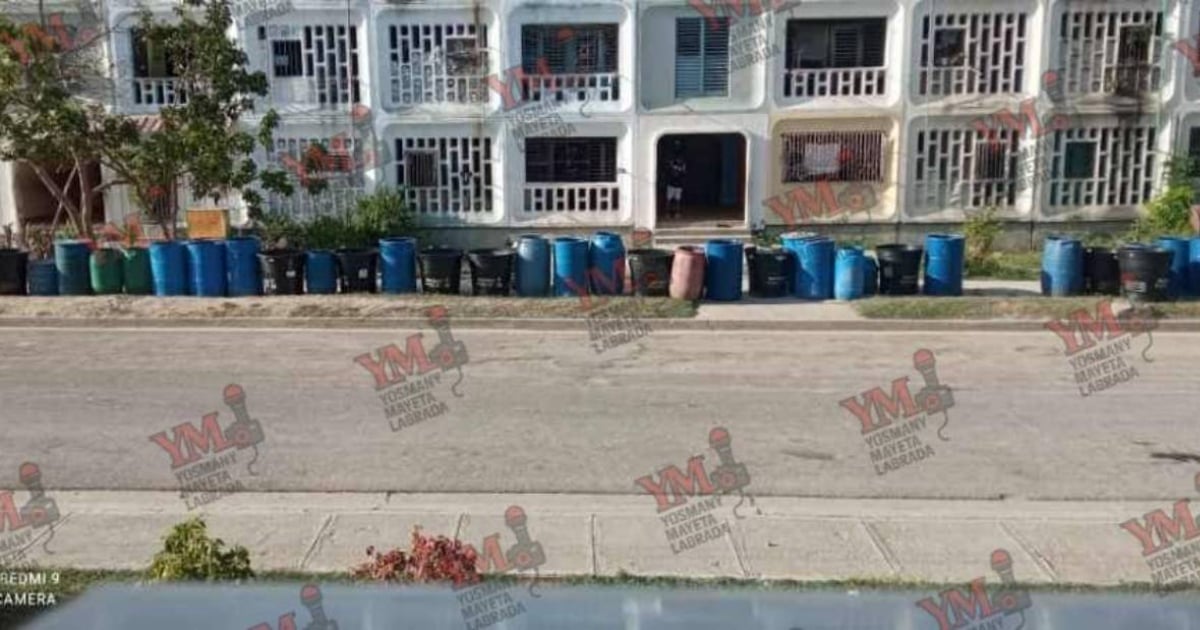
The independent journalist Yosmany Mayeta Labrada shared images and testimonies about the desperation of the residents to obtain water amid the worst drought in a decade.
The affected individuals line up their empty plastic tanks, as if they were people in a warehouse, wondering who will be the first to fill up if they are fortunate enough for a water truck to arrive.
"In Santiago, even the water comes with a waiting list," the communicator joked, portraying a city where the silence in the hallways is no longer one of rest, but rather of neighbors calculating liters, shifts, and favors.
An unprecedented crisis in the county seat
The municipality of Santiago de Cuba, with around 500,000 inhabitants, is experiencing a critical drought, the most intense in the last ten years. Authorities have described the water supply situation as “alarming” due to prolonged distribution cycles that, in many cases, exceed 30 days.
Not only has the lack of rainfall led to the collapse. The drought is compounded by unrepaired leaks, equipment breakdowns, an electrical deficit that prevents continuous water pumping, an insufficient fleet of tankers, and a shortage of fuel to distribute the liquid to the population.
Reservoirs on the brink of exhaustion
The main dams supplying the city are showing critical levels
- Charco Mono: 8.8%
- Gilbert: 13%
- Stop: 16%
- White Drop: 18.3%
- Chalons: 31.4%
To alleviate the situation, water is being transferred from the Carlos Manuel de Céspedes dam, located several kilometers away, which is currently 68.5% full, according to official figures.
Slow responses and insufficient solutions
The institutional response has been slow, and the results have not managed to alleviate the pressure in the communities. In neighborhoods like Chicharrones, residents claim they have not received service for four months and pay 400 pesos for 20 liters of water.
In other places, water is only delivered by tanker trucks, and the distribution has prioritized vulnerable families, leaving the rest unattended.
The hydraulic network cannot meet the demand. Out of the 106 pumping stations, only 19 have emergency generator sets. The poor condition of the National Electric System constantly interrupts the water re-pumping.
Despite announcements of investments in wells with solar panels and plants with new equipment, the results have yet to positively impact the population.
This situation is not exclusive to Santiago de Cuba; rather, it is occurring throughout the entire country. The crisis is so severe that this Saturday night, amid a long blackout, the people of Gibara took to the streets en masse to demand that the regime restore power and distribute water to the population.
Frequently asked questions about the water crisis in Santiago de Cuba
What is the main cause of the drought in Santiago de Cuba?
The drought in Santiago de Cuba is the most intense in the last decade and is due not only to the lack of rainfall but also to structural problems such as unrepaired leaks, equipment breakdowns, an electrical deficit that prevents continuous water pumping, and an insufficient fleet of water trucks.
How does the drought affect the inhabitants of Santiago de Cuba?
The drought has caused about 500,000 people to face water distribution cycles that exceed 30 days, forcing the population to rely on tanker trucks and pay high prices for water. This situation has created significant unrest in the community.
What measures have the authorities taken to address the water crisis?
The authorities have implemented measures such as transferring water from distant reservoirs, repairing pumping equipment and incorporating tank trucks. However, these actions have been slow and insufficient to significantly alleviate the crisis.
How are citizens responding to the water crisis in Santiago de Cuba?
In the face of water shortages, the citizens of Santiago de Cuba have resorted to desperate measures, such as standing in long lines with plastic tanks to wait for the arrival of water trucks, and even paying high prices for minimal amounts of water. This situation has led to demonstrations of discontent among the population.
Filed under: