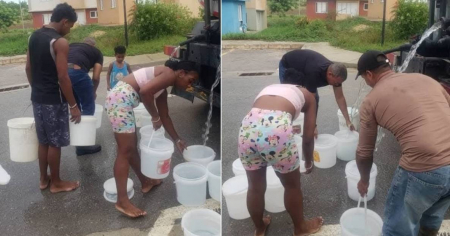
A group of residents from Havana reported in a television segment that they have been without water for more than 30 days, despite promises of delivery through tankers.
During the broadcast of the Havana Channel this Friday, residents questioned the lack of effective solutions and expressed their outrage over the service failures.
According to the testimony of those affected, while hospitals, bakeries, and schools are prioritized for liquid delivery, residential areas, especially high-rise buildings and peripheral communities, continue to lack supply.
"We are in a critical situation," expressed one of the interviewees, visibly frustrated by having to carry buckets of water under precarious conditions.
“Currently the pipe has not been sending water for more than 30 days and this is a tall building, where by the time you go up, come down with a bucket, and wait in line, what do you get?” questioned a lady.
The report itself acknowledged that only about 80 tanker trucks currently circulate each day, whereas more than 170 would be needed to meet the demand of the capital.
The shortage of tires, oil, and diesel exacerbates the crisis, leaving thousands of families waiting for a service that never arrives.
The neighbors also accused the authorities of allowing irregularities in the distribution, and reported that while they wait for weeks, private restaurants and businesses receive shipments much faster.
"How is it possible that there is a lack of water for the population, but not for the self-employed individuals who own restaurants?" asked another resident of Havana in front of the cameras.
The hydraulic authorities responded that there are control mechanisms and sanctions in place to prevent the misappropriation of trucks, but the testimonies reflect a deep distrust among the citizens.
The report, far from calming tensions, highlighted the rift between the official discourse and the daily reality of Cubans, trapped in a crisis of basic services that has already surpassed the patience of many.
On social media, complaints about the illegal sale of water and favoritism have surged, fueling widespread discontent.
Weeks ago, dozens of Cubans took to the streets of Centro Habana to demand immediate solutions to the shortage of drinking water that affects thousands of families in the capital.
The demonstration, which took place on the central Reina street, was documented by social media users with videos and images showing numerous residents blocking the road with buckets, tanks, and empty containers, as a sign of protest against the days they have gone without service.
The National Institute of Hydraulic Resources itself acknowledged that “the water supply in the country is facing a critical situation”. Its president, Antonio Rodríguez, attributed the problems to drought and failures in pumping systems, exacerbated by power outages.
According to official figures, approximately 248,000 people in Cuba lack a regular water supply, while in eastern provinces such as Santiago de Cuba, Holguín, and Ciego de Ávila, around 860,000 citizens face severe restrictions.
Frequently asked questions about the water crisis in Havana
Why have the residents of Havana been without water for over a month?
The residents of Havana have been without water for over a month due to distribution issues, a lack of sufficient tanker trucks, and critical problems in the hydraulic infrastructure. The shortage of resources such as tires, oil, and diesel for the tanker trucks, along with power outages affecting the pumping, has worsened the situation.
How does the water crisis affect the population of Havana?
The water crisis is severely affecting the population of Havana, forcing them to stand in long lines and carry buckets of water under precarious conditions. Residents of high-rise buildings and peripheral communities are particularly vulnerable. The lack of water also leads to sanitation issues and increases the risk of diseases.
What measures are the authorities taking to address the water crisis in Cuba?
Authorities have promised to seek solutions, such as increasing the number of tanker trucks and repairing pumping systems, but the population remains skeptical of what they view as empty promises. The government has also mentioned implementing technologies such as the use of solar energy to improve pumping, although the results are still not evident.
Why is there distrust towards the government regarding the distribution of water?
The distrust towards the government is due to accusations of irregularities and favoritism in the distribution of water. Residents report that while they wait weeks without service, private restaurants and businesses receive water trucks more quickly. Furthermore, the repeated promises of solutions have not materialized into real improvements.
Filed under: