
Related videos:
The energy crisis in Cuba shows no signs of letting up.
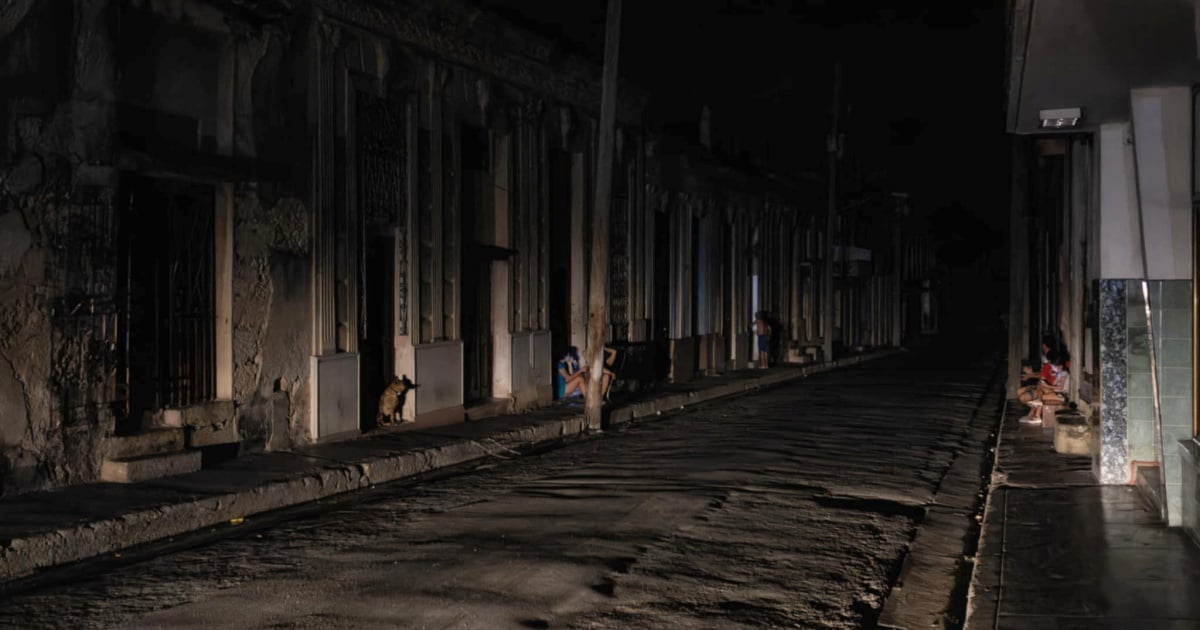
Despite the official announcements that daily repeat clichéd phrases about "extraordinary efforts," the reality is that the country remains mired in endless blackouts that keep thousands of families on edge.
The report from Unión Eléctrica (UNE) issued this Wednesday confirms what the population is experiencing firsthand: the generation deficit has exceeded 2,000 MW, a level that condemns the National Electric System (SEN) to paralysis.
According to the UNE, the impact lasted for 24 hours on Tuesday and continued even into the early hours of the following day.
At 7:00 PM, the generation capacity shortage escalated to 2,052 MW, a figure higher than what the authorities had planned.
The immediate cause: the failure to operate unit 5 of the Renté CTE and the engines of the Fuel Mariel plant, key components that remain out of action.
The situation at 6:00 am today was bleak: the availability of the national electricity system barely reached 1,400 MW, against a demand of 2,750 MW, leaving over 1,300 MW uncovered.
The outlook does not improve according to the forecast: during peak hours, when the entire country turns on lights, stoves, and equipment, the UNE acknowledges that the availability will be 1,580 MW compared to a demand of 3,500 MW, a significant shortfall of 1,920 MW, with an expected impact of 1,990 MW.
In simple terms: there is not enough electricity to cover even half of the country.
Blackouts that don't stop and promises that never come
Behind these technical figures lies the reality of an electrical system dismantled by inefficiency, neglect, and a lack of sustained investments.
The UNE speaks of "incidents" as if they were isolated accidents, when in reality they represent a chronic pattern of failures.
Currently, several thermal power units are out of order: unit 5 of the Nuevitas Thermoelectric Power Plant, units 3 and 5 of the Renté Thermoelectric Power Plant, unit 1 of Santa Cruz, and unit 2 of Felton.
This is joined by others in "maintenance" - a common excuse from the government - such as unit 5 in Mariel, unit 1 in Felton, unit 2 in Santa Cruz, and unit 4 in Cienfuegos.
The so-called "thermal limitations" account for another 301 MW, while the lack of fuel and lubricant has left 33 distributed generation plants out of operation, representing nearly 500 MW less.
In summary, every corner of the system presents a different problem, and together they create a disaster that the regime is unable to reverse.
Havana on the brink of total blackout
The capital of the country, which historically the government tries to protect to hide its darkest face from the world, can no longer escape collapse.
The Electric Company of Havana acknowledged that the city experienced power outages over the previous 24 hours, with a peak impact of 384 MW at 9:00 PM. The most alarming aspect is that by the time the official statement was finalized, the service had still not been restored.
The six blocks of the capital were affected.
The entity itself acknowledged that "it was not possible to meet the planned objectives" because the national deficit prevailed, confirming that there is no room for maneuver even in Havana.
An increasingly dark future
Meanwhile, the authorities are attempting to gloss over the disaster by highlighting specific achievements, such as the 2,723 MW generated by the 30 photovoltaic solar parks, whose maximum capacity barely covered 482 MW.
However, this production, while positive, is insignificant compared to the black hole of over 2,000 MW that suffocates the country.
The energy crisis in Cuba is no longer a temporary issue nor is it solely due to "breakdowns" or "scheduled maintenance." It is a direct result of years of improvisation, corruption, and a lack of serious investments in the electricity sector.
While the official discourse repeats that the people must resist with patience, the reality is that those most affected are households, hospitals, schools, and the youth, who see their present and future constrained by a country that cannot even guarantee electricity.
Cuba literally cannot escape from darkness.
Frequently Asked Questions about the Energy Crisis in Cuba
What is the current electric generation deficit in Cuba?
The electricity generation deficit in Cuba exceeds 2,000 MW. This figure has led to prolonged blackouts and affects millions of people across the country, according to the latest reports from the Electric Union (UNE).
What are the main causes of the energy crisis in Cuba?
The energy crisis in Cuba is the result of multiple factors, among which the lack of maintenance and investment in electrical infrastructure, failures in thermoelectric units, shortage of fuel, and technological obsolescence stand out. Additionally, the energy system relies heavily on resources that are not guaranteed by the State.
How does the energy crisis affect the daily lives of Cubans?
The energy crisis in Cuba has significantly impacted the daily lives of its citizens. The ongoing blackouts affect food refrigeration, access to water, the use of electrical equipment, and medical services. This, combined with a paralyzed economy, has created a climate of hopelessness and frustration among the population.
What measures has the Cuban government taken to address the energy crisis?
The Cuban government has attempted to alleviate the energy crisis by installing photovoltaic solar parks and contingency plans. However, these measures have been insufficient to cover the existing generation deficit. The lack of structural solutions and dependence on fossil fuels remain critical challenges.
Filed under: