The water crisis in Cuba has reached very alarming levels: More than three million people are currently suffering from a total or partial lack of this resource across the country, according to official data released this Monday by national television.
The water shortages, a persistent problem in recent years that the Cuban government continues to fail to resolve, affects over 3,100,000 residents of the island, a report from Television News acknowledged.
The figure would represent around 30 percent of the Cuban population, which totals 9,740,000 inhabitants, according to the most recent statistics published by the National Office of Statistics and Information (ONEI).
According to the news report, authorities attribute the inability to guarantee water supply to three causes: drought, energy contingency, and breakdowns of the pumping machines.
The reservoirs are recorded at 1,790 million cubic meters below the average, and although the rainfall forecasts for this September and the upcoming October predict levels above the historical average, they will not compensate for the precipitation deficits of the previous four months, warned engineer Antonio Rodríguez Rodríguez, president of the National Institute of Hydraulic Resources (INRH).
The total number of Cubans affected by the drought exceeds 900,000, according to the report. This figure does not reach a third of the total number of people who cannot access water in the country—if the data revealed in the report is considered accurate—suggesting that the rest are deprived of this vital resource due to ongoing and prolonged power outages, breakdowns of pumping equipment, and the deterioration of hydraulic networks.
According to the television report, more than 300 projects are currently being carried out “emergency-wise” to mitigate the water shortage in the provinces of Santiago de Cuba, Guantánamo, and Holguín, which are the most affected by the lack of this resource.
The president of INRH claimed that, despite all the "difficulties," there is an "effort" being made to ensure the availability of fuel and cement for carrying out hydraulic works. However, he acknowledged that the entity he leads is failing to complete (cover) those projects, causing dissatisfaction among the local population where they are taking place.
The repair of the malfunctioning pumping machines is being carried out in workshops of the hydraulic system, the Union of Military Industries, and the ministries of Energy and Mines and Industry.
The government has also resorted to the installation of technologies for pumping using photovoltaic energy, and according to the report, there are more than 800 sites of this kind.
The First Vice President of Water and Sanitation at INRH, Junior González Núñez, stated that these systems are “reliable,” “safe,” and, by not depending on fossil fuels, “provide a guarantee for water pumping and services to the population with clean and secure energy.”
Despite the critical situation faced by millions of Cubans and with no effective solutions in sight, the official stated that “as long as there is a glimmer of sunshine (…) we are guaranteed water for the population.”
However, the 30 solar parks currently operating in Cuba, which generate about 600 megawatts per day, are not an effective alternative to the energy crisis, as they do not support the collapsed National Electric System (SEN), which relies on outdated thermal power plants and an almost total dependence on imported fuel.
Meanwhile, millions of people face the daily struggle of lacking an essential resource for life, and they strive to obtain a few liters of water to meet their most urgent needs.
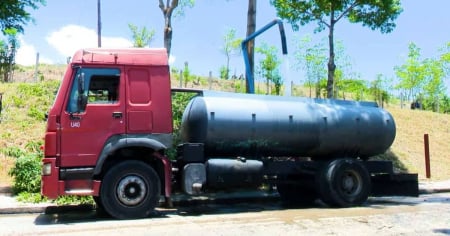
An image that has gone viral on social media in recent days symbolizes more than anything the severity of the crisis: a line of empty plastic tanks in a neighborhood of Santiago de Cuba, waiting for a water truck to arrive and fill them.
In that eastern municipality, the government implemented a new water distribution cycle for households, with a delivery frequency of 38 days, due to the reduction in flow that supplies the Quintero water treatment plant.
The desperation due to the lack of water has also led to an increase in theft and diversion of this resource, which has affected entire communities, according to the regime. In the locality of Omaja, in Las Tunas, illegal connections to the supply network were detected in private homes, irregular supply to state-owned livestock, ponds, and even an agricultural cooperative.
Breakdowns and prolonged power outages have severely complicated the water supply in Havana, even more so in the last week, marked by widespread blackouts across the country.
With the accumulated frustration from the extreme conditions in which they poorly survive - without electricity, drinking water, or gas to cook the scarce food, among other deficiencies - many Cubans are taking to the streets to demand solutions from the authorities. The most recent protest took place this past weekend in Gibara, Holguín.
The Cuban population, subjected to daily cuts in electricity and water, increasingly perceives this situation as the result of decades of neglect, poor government management, and lack of investment in the national energy system.
Frequently Asked Questions About the Water Crisis in Cuba
How many people are affected by the lack of water in Cuba?
More than three million people in Cuba suffer from a total or partial lack of water. This represents approximately 30% of the country's population, according to official data.
What are the main causes of the water crisis in Cuba?
The main causes of the water crisis in Cuba are drought, the energy crisis, and the breakdown of pumping machines. These reasons have been acknowledged by Cuban authorities, who also cite the deterioration of hydraulic networks as an aggravating factor.
What measures is the Cuban government taking to address the water crisis?
The Cuban government is urgently executing over 300 projects and has turned to the installation of photovoltaic-powered pumping technologies. However, these efforts have not effectively resolved the crisis, and the population continues to face long waits for water.
How is the water crisis affecting the daily lives of Cubans?
The lack of water severely affects the daily lives of Cubans, compromising personal hygiene, agricultural production, and everyday life. Many families have to wait in long lines to get a few liters of water, and in some areas, the supply is limited to every 38 days.
What is the response of the Cuban population to the water crisis?
The Cuban population has expressed its discontent through protests in several localities, demanding immediate and effective solutions from the government. The lack of water, along with other issues such as power outages and food shortages, has led to increasing social unrest.
Filed under: