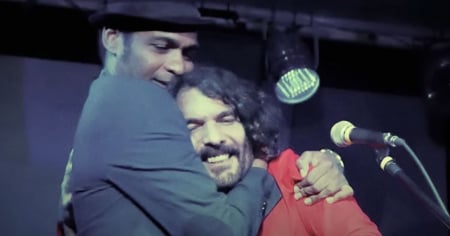
The Cuban troubadour Silvio Rodríguez announced that he will hold a concert this Friday, September 19, at 7:00 p.m. on the steps of the University of Havana (UH), dedicated to the students who led the protests against the rate hike by the Cuban Telecommunications Company (ETECSA) last June.
In a video posted on his Instagram account zurron_del_aprendiz, the singer-songwriter explained that he wanted to return to the university stage because he found in the youth a spirit of commitment that gave him hope.
"Recently, I witnessed very positive attitudes from the university youth, from the FEU (Federation of University Students), regarding the issues of telecommunications. And I saw in their spirit the spirit of the FEU that I have known all my life, that revolutionary, dynamic, committed essence with a sense of popular solidarity. That’s why we are inviting them on the 19th at 7 PM at the stairway," he said.
The gesture does not go unnoticed. The invitation arrives just three months after thousands of university students from various faculties of UH and other centers across the country staged a protest against the new ETECSA rates, which have been criticized as exclusionary and unfair.
That mobilization, characterized by assemblies, strikes, and public demands, became an unprecedented national movement that challenged not only the business decisions of the state enterprise but also the representation of the official youth structures.
In those same days, the singer-songwriter surprised many by criticizing the regime's management amid the crisis. "No one believes in that anymore," he wrote on June 3rd in his blog Segunda Cita, referring to the outdated decision-making methods. The troubadour then called for more sincerity, dialogue, and well-being for the people, supported the student statements and shared messages of encouragement for the FEU of CUJAE, evoking the combative tradition of Julio Antonio Mella, Raúl Roa, and José Antonio Echeverría.
Silvio, accustomed to starting or ending his international tours with a concert in Cuba, chose the university this time as a symbolic venue. His dedication to those who raised their voices against the tariff hike resonates with a generation that, despite the surveillance and harassment reported by several of its members, has advocated for internet access as a human right rather than a privilege for those with dollars.
With this concert, the author of Ojalá reestablishes himself at the center of public discourse. His political gesture, laden with historical resonances, acknowledges students as the protagonists of a crucial social moment, and sends a message of encouragement amidst a crisis marked by inequality and repression.
The university staircase, an emblematic stage of student struggles in the history of Cuba, will once again be filled with songs and a symbolism that transcends music.
Frequently Asked Questions about the Silvio Rodríguez Concert at the University of Havana
Why did Silvio Rodríguez dedicate his concert to the students who protested against ETECSA?
Silvio Rodríguez dedicated his concert to the students because he found in them a spirit of commitment and hope. This gesture comes after the protests by university students against the ETECSA fees, which were perceived as unfair and exclusionary. The concert dedication aims to acknowledge and encourage student mobilization in a context of social crisis and inequality.
What impact did the student protests against ETECSA have in Cuba?
Student protests against ETECSA evolved into a national movement that questioned not only the company's rates but also the official youth structures. These demonstrations marked a key social moment, challenging the regime's business decisions and exposing a generational and ideological divide.
What symbolism does the staircase of the University of Havana hold for Silvio Rodríguez's concert?
The steps of the University of Havana are an iconic setting for student struggles in the history of Cuba. Silvio Rodríguez's concert at this location is not just a musical event; it is also infused with historical and political symbolism, connecting with a tradition of commitment and resistance among Cuban youth.
Filed under: