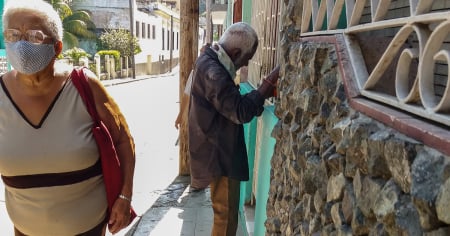
A Cuban retiree shared in a brief interview broadcasted by the Cuban Observatory of Human Rights (OCDH) the harsh reality he faces to survive on the island, where he is constantly without electricity, lacking money, and forced to sell what little he has in order to put a meal on the table.
“I go to an ATM at a bank and there’s no money. So what do I do? I go to the vendors, buy something, and resell it to get at least a sweet potato or a little rice, anything to survive,” she recounted.
The testimony reflects the extreme precariousness experienced by thousands of elderly people in Cuba, where retirement no longer guarantees a dignified old age, but rather a daily battle against hunger.
The man explained that power outages make the routine even more difficult. “It’s impossible to even cook. You have to do it with firewood or whatever you can find. Sometimes once a day, and sometimes we go days without eating,” he said.
Her words portray a drama shared by millions of Cubans, but it strikes especially hard for those who rely on a pension that barely covers the essentials.
In Cuba, where demographic aging is progressing rapidly, inflation and the collapse of public services have turned old age into a stage of extreme vulnerability.
The massive migration of young people leaves many elderly individuals alone, without family support and without the possibility of receiving remittances from abroad, one of the few lifelines that remain on the island.
Pensions turned into mirages
The government announced a increase in minimum pensions up to 4,000 Cuban pesos. However, the adjustment was quickly undermined by the informal currency market, where the exchange rate exceeds 420 pesos per dollar. That pension amounts to less than 10 dollars, barely enough for a carton of eggs or a few basic necessities.
According to calculations by the Cuban Citizen Audit Observatory, at least 30,000 CUP per month are needed to ensure basic nutrition. This means that the minimum pension barely covers one-seventh of that amount.
What is presented in official announcements as a relief, in practice, turns out to be an illusion that dissipates at the first encounter with the reality of prices.
"With an average salary of 6,000 CUP, one cannot live", acknowledged Vice President Salvador Valdés Mesa, a diagnosis that is even more devastating for retirees.
An extended drama
The case of this retiree is not an isolated one. In August, an 83-year-old man in Ciego de Ávila, Orlando Regueiro Castellano, confessed before the camera that he had gone days without eating and was surviving “on air”. His desperate plea for “a little piece of bread” went viral on social media, becoming a symbol of the neglect that the elderly face on the island.
Weeks later, the official journalist Roberto Pérez Betancourt, José Martí National Journalism Award winner, broke his silence on Facebook. At 85 years old, he reported that he had been without drinking water for months, that dengue had claimed the life of a neighbor in his block, and that he and his wife, both recovering, were unsure if they would be able to cook the following day. “I never imagined my old age like this”, he wrote, generating outrage even among colleagues in the state media.
These testimonies add to others documented in Matanzas, Santiago de Cuba, Holguín, and Havana, where elderly people survive by fishing for crabs, collecting cans, rummaging through trash, or sleeping in makeshift homes without water or electricity.
The contrast between propaganda and reality
The official narrative insists that “no one will be left behind”, but the evidence shows otherwise. After decades of effort, millions of Cubans face an old age marked by scarcity, loneliness, and uncertainty. The promise of equality fades in endless lines to collect a pension that isn’t enough to live on for even a week.
Meanwhile, the State dedicates millions in resources to the construction of empty hotels for a collapsing tourism industry. For retirees, every new blackout, every rise in the dollar, or every day without food is a reminder that the regime's priorities are far from their needs.
Filed under: