
Related videos:
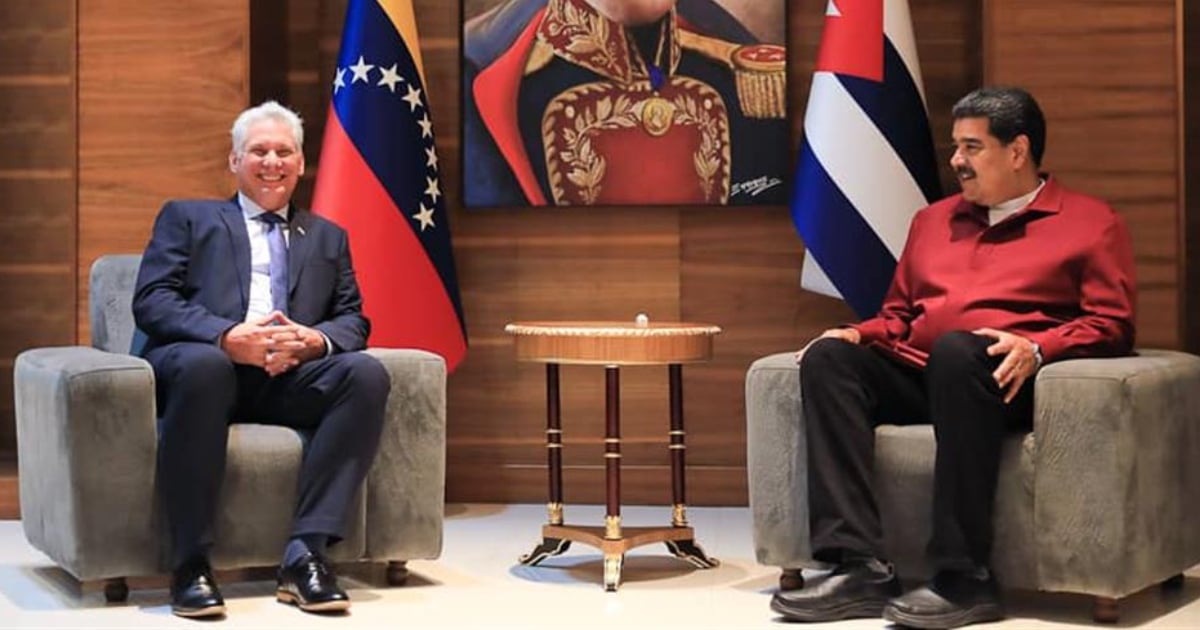
The Cuban regime announced the launch of a national campaign to collect signatures in support of Nicolás Maduro and the so-called "popular, military, and police fusion" in Venezuela, a process that will take place from September 24 to 30 in workplaces, schools, and communities across the country.
According to the official newspaper Granma, the stated objective is to support the Declaration of the Revolutionary Government titled “It is Urgent to Prevent a Military Aggression Against the Bolivarian Republic of Venezuela.”
The Secretary of Organization of the Central Committee of the Communist Party, Roberto Morales Ojeda, assured that upon completion of the process, the books with the signatures will be sent directly to the Venezuelan president, with the expectation that "millions of Cubans will endorse" the document.
The Cuban News Agency (ACN) strengthened its call on social media, urging a "massive solidarity event" and to show support for the "legitimate president" of Venezuela.
Although it is presented as a "spontaneous" gesture of solidarity, in practice these processes function as a mechanism of social control. Those who do not join the campaign risk being singled out, sanctioned in their workplace or studies, or excluded from official activities. Thus, rather than a free expression of support, the signatures ultimately become a forced demonstration of loyalty to the Party and the regime.
These types of mass mobilizations have become a constant in Cuba, where political pressure and surveillance over each citizen weigh more than individual will. The supposed "solidarity" with Maduro and the Bolivarian Revolution actually turns into a test of internal obedience.
Ideology before economy
The impetus of this campaign takes place in a context where the government is fulfilling its priorities for 2025: strengthening political-ideological work, defense, and internal order, above economic recovery.
During the last session of the National Assembly, Prime Minister Manuel Marrero made it clear that "the political is the foundation upon which all other actions must be built."
The insistence on indoctrination and control, even amidst an unprecedented economic crisis, confirms that the regime relies more on propaganda and social discipline than on providing concrete solutions to the people's problems.
This process adds to a long list of propaganda activities that, in practice, contribute little to the daily lives of Cubans, marked by scarcity, inflation, and inequality.
For many, this is a campaign without real value, whose sole objective is to show the world, and especially the Cubans themselves, that the Party maintains absolute control over the population.
Filed under: