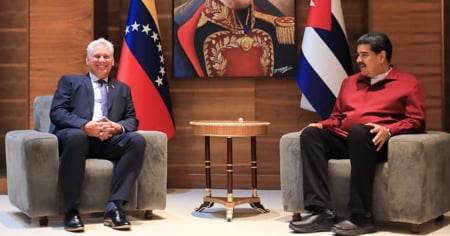
Cuba expressed "great concern" over the possibility of a military conflict between the United States and Venezuela, warning that a confrontation would have consequences for the entire continent; however, it ruled out going to war: We will provide Venezuela with all political support.
The Deputy Foreign Minister Carlos Fernández de Cossío in an exclusive interview with Mehdi Hassan from Zeteo during the United Nations General Assembly in New York, stated that Havana will provide its “full political support” to the government of Nicolás Maduro.
However, he avoided specifying whether that support could translate into military assistance, instead being cautious and labeling the question as "dangerous," while stating that "Cuba will not go to war with the United States, it will give total political support to Venezuela, solidarity support," he emphasized.
"A U.S. attack against Venezuela would be a threat to the entire region," stated the Cuban official.
When asked about the economic limitations of the island, Fernández de Cossío stated that Cuba is experiencing a critical situation due to pressures from Washington.
“United States tries to disconnect Cuba from the global economy. What country can sustain itself if the most powerful economy on the planet pressures and threatens other governments to avoid having links with Cuba?” he questioned.
During the interview, the Deputy Foreign Minister was also questioned about the human rights record in Cuba, the lack of democratic freedoms, the absence of a free press, and the accusations that the island is home to individuals labeled as “terrorists” by the administration of Donald Trump. De Cossío defended the Cuban political model and dismissed the criticisms.
The dialogue took place alongside the debates of the UN General Assembly, where another topic that dominated the agenda was the conflict in Gaza. The Cuban diplomat described the Israeli offensive as "genocide" and criticized the United Nations for its "inability to act."
"It is a source of shame for the international community and for the UN, for not having the capacity to respond," he noted, referring to the recognition of a Palestinian state by countries such as Canada, Australia, France, and the United Kingdom.
The statements from the deputy foreign minister come at a time of heightened regional tension, as Washington has announced the reallocation of millions in funds to confront the regimes of Cuba, Venezuela, and Nicaragua, while protests and repression within the island escalate.
Frequently Asked Questions About Cuba's Stance on a Possible Conflict between the U.S. and Venezuela
What is Cuba's position on a potential conflict between the U.S. and Venezuela?
Cuba has expressed its "full political support" for Venezuela in the event of a conflict with the United States, but has ruled out military participation. The Cuban regime has expressed great concern about the consequences that an armed confrontation could have for the entire region.
How does the U.S. embargo affect Cuba's economy?
Cuba argues that the U.S. embargo is the main obstacle to its economic development, affecting its access to markets, technology, and financing. According to the regime, these restrictions are part of an economic war aimed at depressing the living conditions on the island, although there are also criticisms that point to the internal management of the Cuban government as being responsible for the economic crisis.
What criticisms does the Cuban government receive regarding human rights?
The Cuban government is criticized for its record on human rights, especially for the lack of democratic freedoms and a free press, as well as for the imprisonment of political opponents. On several occasions, the regime has been accused of repressing dissenters and restricting individual freedoms, which is systematically denied by the Cuban authorities.
What measures has Cuba taken to face international pressure?
Cuba has strengthened its discourse of resistance against sanctions and international pressure, asserting that it will not be subdued by the United States. The regime has intensified its diplomatic efforts to gain international support and has maintained its medical missions program abroad, despite the criticisms and sanctions related to alleged labor violations.
Filed under: