
Related videos:
The Office of Western Hemisphere Affairs of the U.S. Department of State issued a strong statement against the Cuban regime, directly questioning its legitimacy.
In a message posted on X, the entity described the official narrative regarding the so-called "blockade" as a lie and pointed to the true core of the problem: the lack of democracy on the Island.
"The false narrative of a 'blockade' against Cuba is just one of the many lies of the failed dictatorship on the island. The Cuban people and the world can see it with their own eyes," the tweet stated.
"If the 'revolution' is doing so well, why does the dictatorship fear truly free and democratic elections so much?" he added.
A reform tailored to the power
The statement comes at a particularly sensitive time for the Cuban government, just after the National Assembly approved a constitutional reform that removes the age limit to run for president.
The change, approved without popular consultation, paves the way for trusted leaders of the Communist Party—including Miguel Díaz-Canel himself, now 65 years old—to remain in power without constitutional restrictions.
The regime presented the modification as a way to "guarantee institutional integrity" and "ensure the future of the Revolution," but in practice, it means paving the way for perpetuity in power.
The decision, proposed by Raúl Castro and supported by the Council of State and the Political Bureau, was quickly endorsed by the National Assembly and immediately published in the Official Gazette.
The measure adds to a long list of legal mechanisms designed to protect the continuity of the system and prevent any real political competition.
In Cuba, multiparty elections are prohibited, and all positions of representation are subordinate to the Communist Party, making a scenario of democratic alternation impossible.
A context of repression and political prisoners
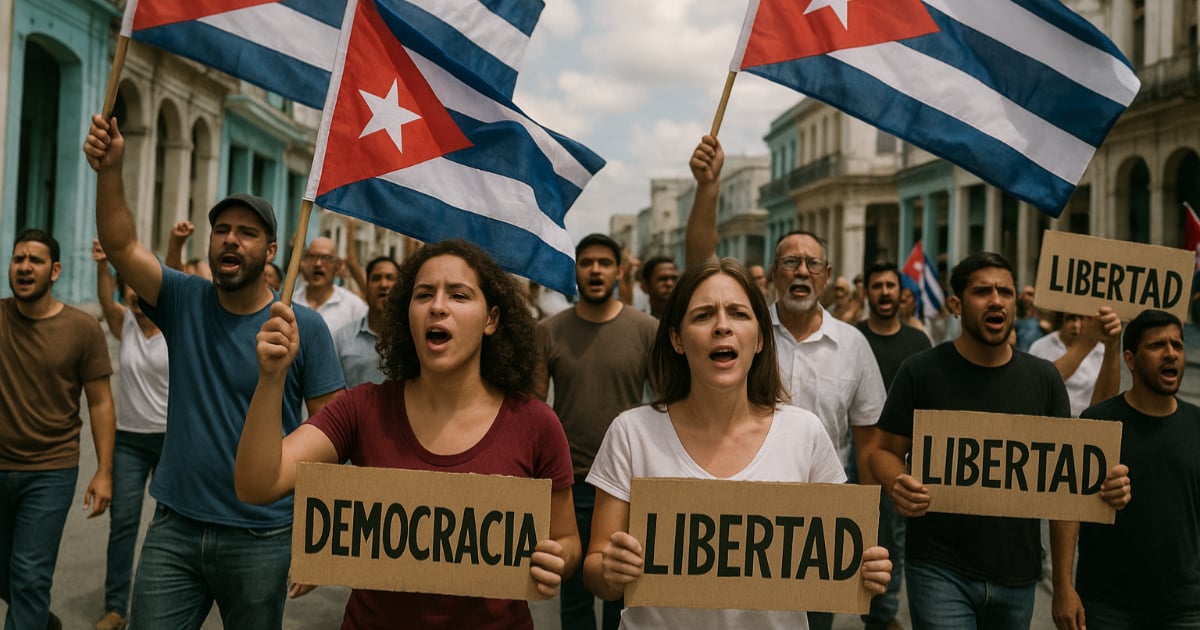
Washington's questioning comes in a context of extreme repression on the Island, with a record number of political prisoners.
According to Prisoners Defenders, Cuba ended August 2025 with 1,185 political prisoners or prisoners of conscience, the highest number recorded by the organization.
The report indicates that in the last month, 13 new prisoners were recorded, while four were removed from the lists: three for serving their full sentences and one due to forced expatriation, that of the activist Aymara Nieto Muñoz, who was released under the condition of leaving the country with her family.
This situation is further compounded by the case of the dissident artist Luis Manuel Otero Alcántara, who was sentenced in a widely questioned trial and, according to reports, is being denied medical attention in prison while his health deteriorates.
Washington has condemned this case as yet another example of the repressive nature of the system.
An increasingly isolated dictatorship
Criticism from the United States aligns with denunciations from activists and sectors of the international community, highlighting the lack of fundamental freedoms in Cuba.
The refusal to allow free elections, combined with the economic decline, censorship, and the persecution of dissenting voices, deepens the regime's isolation and highlights the contradiction between the official narrative of a "victorious revolution" and the reality of a society marked by repression and despair.
Filed under: