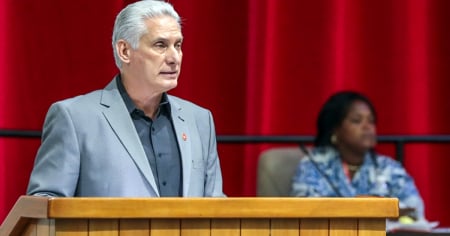
The Cuban deputy Danhiz Díaz Pereira recently argued in a statement that there should be no confrontation or conflict in the National Assembly of People's Power (ANPP), stating that this is not "the ethics" of the Cuban parliament.
According to the industrial engineer and representative for the Havana municipality of Marianao, consensus and dialogue are the foundations of legislative functioning, and he suggested that confrontational debates are unproductive "caricatures" that move away from solutions.
In his opinion, the Cuban legislative body should remain distant from resembling “those caricatures of parliaments that display confrontation” because “there is a prevailing idea in popular imagination that if there is no conflict, there is no democracy,” he emphasized during his speech, a fragment of which was shared on the Facebook profile of the musician and also legislator Arnaldo Rodríguez.
The public reaction was swift. In the publication itself, many Cubans harshly criticized the deputy's speech. They pointed out that this stance justifies the lack of critical debate within the parliament and reinforces subservience to figures of power.
Comments like those of Andy Giovel Domínguez highlight the perception that there is no genuine exchange of ideas in the ANPP, but rather automatic applause and a lack of real questioning. "There is no consensus where only the official position prevails," he stated.
Other users recalled that without debate, genuine consensus cannot exist. "Debate is not conflict," wrote Michel Roque, emphasizing that dissent is an essential part of any democratic process.
The harshest criticisms focused on the lack of concrete results from the government's strategies, and on a "non-confrontational ethics" that, rather than solving problems, perpetuates them.
Some comments were even more direct. "Of course the dictatorship doesn't like confrontation," wrote Yoendris Lambert, who accused the deputies of making empty speeches to maintain their privileges without improving the country's situation.
Alina M Menéndez was blunt: “Any proposal based on trust must be proven with results. Disagreeing is not distancing oneself from the solution.”
Several users linked the lack of debate to disastrous decisions from the past, such as the implementation of the economic restructuring, and held the ANPP responsible for applauding officials who deny the reality of the country.
Daynet Castañeda directly questioned the deputy: "You need to reconsider the concept of confrontation in Marxist thought."
Critics also questioned the legitimacy of the parliament itself. Although the deputy claimed that they are not appointed by a party but elected by the people, comments from Claudio Gaitán dismantle that narrative
"Although they are not 'formally' elected by the party, they are indeed selected and approved by structures controlled by the PCC (the so-called Candidacy Commissions), and there is no genuine electoral competition," he argued.
The speech by young Congressman Díaz, rather than calming tensions, highlighted the growing disillusionment with a legislative body that many no longer view as representative. Citizen complaints reveal a clear demand: more genuine debate, greater accountability, and less pretense of pluralism.
The Communist Party of Cuba (PCC) has attempted to defend itself against criticism of the nominations of candidates for deputies to the ANPP, arguing that democracy does not mean multipartyism.
Although the PCC insists on defending the Cuban "democracy" by pointing to an electoral system that, according to them, favors the people's access to power, their single-party system does not allow individuals not affiliated with that party to choose different representation.
In July 2024, the leader Miguel Díaz-Canel spoke in defense of the Cuban political system and the unanimous approval of its laws at the ANPP, which he described as characteristic of a "rare dictatorship" like the Cuban one, guided and "driven by the interests of the people."
In the closing speech of the third ordinary session of the X Legislature of the ANPP, the first secretary of the Communist Party of Cuba (PCC) justified the procedure for ratifying laws in the Cuban parliament, which has often faced criticism for the "unanimity" exhibited, with no open opposition or opposing votes, characteristic of the democratic farces displayed by totalitarian regimes.
Months later, in December, the leader appointed by Army General Raúl Castro reiterated that the ANPP is "the most representative in the world."
So far, the deputy Mariela Castro, daughter of Raúl Castro and niece of the dictator Fidel Castro, has been the only one to raise her hand in the Cuban parliament to vote “no” against the Labor Code project, claiming it did not sufficiently protect individuals with non-conventional gender identities or HIV.
The voting took place in December 2013 behind closed doors, but was revealed months later by activists, highlighting it as an unprecedented act, as until that time no legislator had openly rejected a norm in the ANPP, even in controversial cases such as the social security reform.
Frequently Asked Questions about the functioning of the National Assembly of People's Power in Cuba
Why does Deputy Danhiz Díaz Pereira defend the absence of confrontations in Cuba's National Assembly?
Deputy Danhiz Díaz Pereira argues that the lack of confrontations in the National Assembly is part of the "ethics" of the Cuban parliament, stating that consensus and dialogue are the foundations of legislative functioning. According to him, confrontational debates are unproductive "caricatures." However, this stance has been criticized by citizens who see the absence of critical debate as a justification for submission to power.
What is the public perception of the debate in the National Assembly of People's Power?
The public perception is that in the National Assembly of People's Power there is no genuine exchange of ideas, but rather an automatic applause for the government's decisions. Many citizens criticize the lack of real questioning and view the non-confrontational ethics as a perpetuator of problems rather than a solver.
How are the deputies selected in the National Assembly of Cuba?
Although the Cuban government maintains that the deputies are elected by the people, the reality is that they are selected and approved by structures controlled by the Communist Party of Cuba. There is no genuine electoral competition, as the Candidacy Commissions, which are controlled by the PCC, play a key role in the process.
What reactions have Díaz-Canel's statements about democracy in Cuba generated?
Miguel Díaz-Canel's statements, in which he claims that Cuba is more democratic than the United States, have been met with rejection and mockery by many Cubans. The criticisms focus on the lack of free elections and political repression, and many citizens view these claims as a blatant manipulation of reality.
Filed under: