
Related videos:
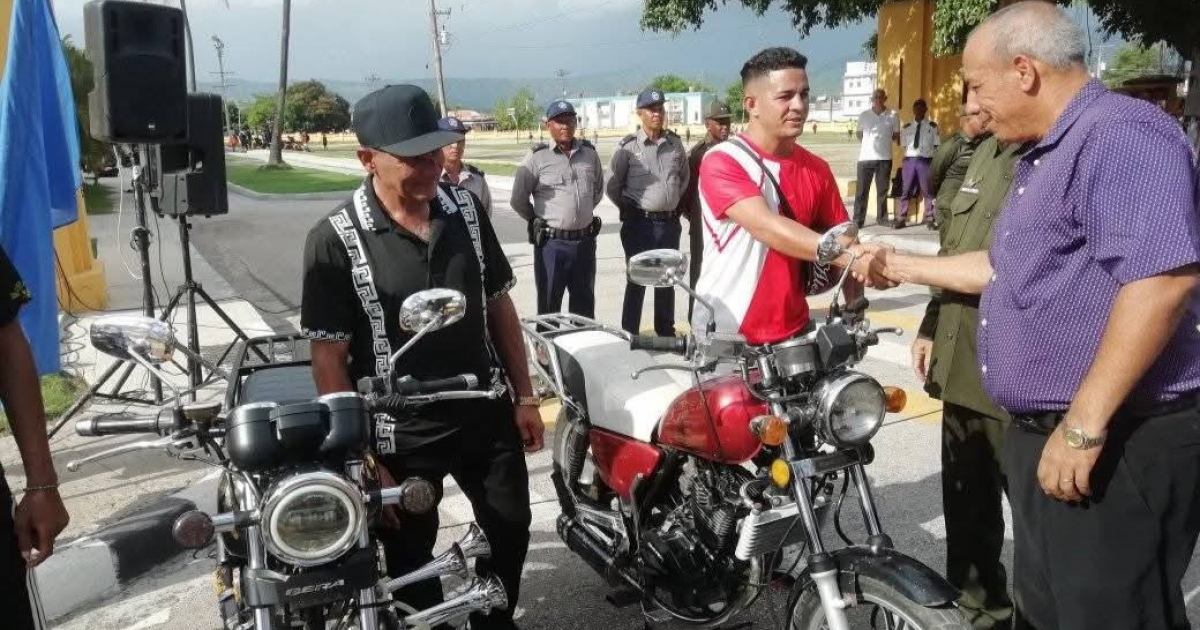
In a new attempt to showcase as an achievement what should be a basic obligation, the Police organized a political event in Santiago de Cuba to return seven motorcycles and recovered parts following an investigation into thefts in the province.
The event, framed as part of the National Day Against Crime and Illegal Activities, was shared on Facebook by the official profile Tocororo Cubano.
The author of the information celebrated the return of the vehicles as if it were an extraordinary feat, congratulating the "brave fighters" of the Ministry of the Interior (MININT) and the people who collaborated in the operation.
A wave of crime that overwhelms the police
Motorcycle thefts have become a growing problem in Santiago de Cuba and other provinces of the country.
Just a few weeks ago, MININT itself reported having dismantled a gang dedicated to stealing and dismantling motorcycles, which were then sold in parts on the black market.
According to reports, the criminals operated with impunity: they would take possession of poorly parked or unprotected vehicles, and within hours, they would dismantle them to erase any trace.
Only after multiple reports from the victims and home searches did the police manage to recover some of the stolen motorcycles.
The return of seven motorcycles in a public event cannot hide the underlying issue: cases of violent thefts and assaults in the province are on the rise.
At the end of June, a young motorist from Santiago de Cuba was assaulted at the roundabout on Morro Road and lost the motorcycle he used for work.
Three months later, there are no reports of the vehicle having been found.
Political acts instead of real solutions
Far from providing concrete answers regarding the rise in crime, the Cuban police have turned what should be a routine function—returning property to its owners—into a political spectacle.
These events include speeches, the presence of authorities, and media coverage, as part of a strategy aimed at projecting efficiency amidst growing criticism over the lack of security.
Citizens themselves have expressed their dissatisfaction on social media.
"One in a thousand appears," commented an internet user regarding the low rate of recovery for stolen goods. Another was more direct: "Is it news now that they're doing their job for once in their lives?"
These questions are not isolated.
The population perceives a contradiction: while crime rates are rising, police operations turn into propaganda ceremonies that are more useful for cleaning the regime's image than for addressing daily insecurity.
Increasing insecurity and lack of trust
The rise in thefts and violence has created an atmosphere of insecurity that particularly affects those who rely on motorcycles for work, such as informal taxi drivers and delivery workers.
The loss of a vehicle means an immediate loss of income in a country where public transportation is insufficient and collapsed.
The lack of official data on the actual number of crimes exacerbates citizens' distrust.
While reports are multiplying on social media, state media prefer to highlight events like the one in Santiago, concealing the fact that most of the stolen items are never recovered.
In this context, the return of seven motorcycles is not a cause for celebration, but rather an indication of a police system that acts in a reactive manner, without clear strategies to curb crime.
What is presented by the authorities as a success is, for many Cubans, just another indication that insecurity has become a daily routine.
Frequently Asked Questions About Insecurity and Political Acts in Santiago de Cuba
Why did the return of motorcycles in Santiago de Cuba become a political act?
The Police in Santiago de Cuba organized a political event to return stolen motorcycles as part of the National Campaign Against Crime, aiming to project efficiency amid growing criticism over rising insecurity. However, the public perceives these events more as propaganda than as solutions to crime.
What is the situation of crime in Santiago de Cuba?
Crime in Santiago de Cuba has significantly increased, with a rise in motorcycle thefts and other offenses. Motorcycle thefts have become a growing problem, and insecurity impacts those who rely on these vehicles for work, such as informal taxi drivers and delivery personnel.
How does the population perceive the Cuban government's response to insecurity?
The Cuban population displays skepticism and distrust towards the authorities due to the lack of official data on crime and the perception of inefficiency in the police system. Citizens criticize that more focus is placed on propaganda acts than on solving daily insecurity.
What impact does insecurity have on informal transportation in Cuba?
Insecurity severely affects informal transportation in Cuba, a crucial source of income for many due to the shortage of public transport. Motorcycle thefts and violence limit the ability of informal workers to operate safely and sustainably.
Filed under: