
Related videos:
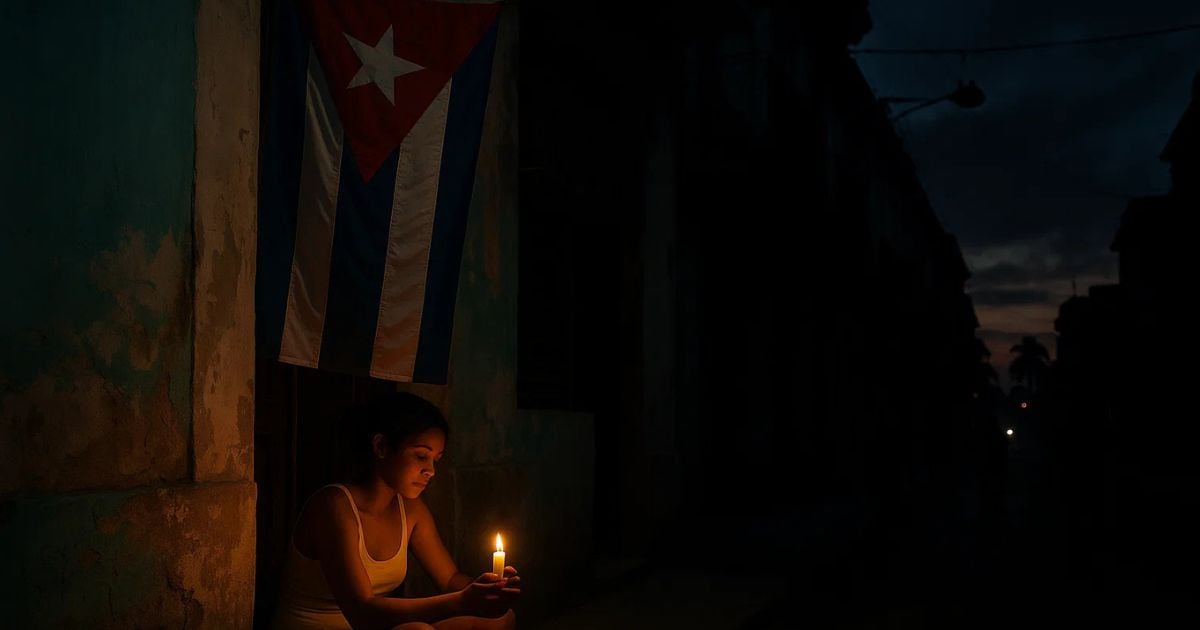
Cuba woke up this Saturday immersed in another day of widespread and massive blackouts, with power outages leaving a large part of the population without electricity for most of the day.
The situation, rather than improving, is worsening due to the government's inability to provide sustainable solutions to a crisis that has become structural and combines a lack of fuel, technological obsolescence, and poor state management.
Deficit in the SEN
According to the latest report from the Electric Union (UNE), the National Electric System (SEN) ended Friday with disruptions lasting 24 hours, a situation that also continued into the early hours of Saturday.
At 6:00 am today, availability was only 1,505 MW compared to a demand of 2,685 MW, resulting in a deficit of over 1,200 MW. By noon, an impact of 1,150 MW is expected.
For the evening peak hours, a deficit of 1,695 MW is projected, with estimated impacts of up to 1,765 MW.
A collapsed thermoelectric power plant
The UNE acknowledged multiple breakdowns that have taken several key units out of service: Unit 2 of Felton, Unit 8 of Mariel, Unit 5 of Nuevitas, and Blocks 3, 5, and 6 of Renté, in addition to maintenance work in Santa Cruz del Norte and Cienfuegos.
This means that none of the Renté units are operational, while Nuevitas is operating partially due to issues with the external water systems.
The accumulation of technical failures, along with the aging of the plants and the lack of replacement parts, reflects a decommissioned electrical system that is being held together with temporary fixes.
Insufficient fuel
In addition to the technical problems, there is a chronic fuel shortage, which has halted more than 600 MW of distributed generation across the country.
The Minister of Energy and Mines, Vicente de la O Levy, admitted that the fuel shipment distributed this week in Havana, Matanzas, and Santiago de Cuba is only enough for a few days.
"The fuel is not enough for the entire month of October," he acknowledged, highlighting the improvisation and lack of foresight in the government's management.
The scarcity affects not only the electrical system but also other sectors of the economy, such as public transportation and fuel supply, which continue to experience interruptions.
A night "on the brink of collapse"
The minister himself acknowledged on national television that Friday night was "very tense" after three plants went offline simultaneously, resulting in an additional loss of 270 MW.
According to their words, the country was on the verge of a national blackout. The emergency was resolved "with immediate measures," but the SEN remains in an extremely fragile situation.
Havana without a stable schedule
The Electric Company of Havana reported that on Friday, the capital experienced power outages of up to 17 hours and 55 minutes continuously, with a peak impact of 210 MW at 9:30 PM.
It was also not possible to adhere to the planned rotation schedules, leaving the neighborhoods without information on when the service would return.
In a second note, the company announced that there will be no reserved blocks in the city, which means that all areas will be subject to interruptions of at least four hours, according to the demands of the SEN.
The frustration of the population
Although De la O Levy insisted that efforts are being made to adhere to the scheduled power outages, the repeated failures and lack of transparency have heightened public outrage.
"The blackout is frustrating, but if the rotation is followed and people know when the power will go out and when it will return, the discomfort is reduced," said the leader, without taking political responsibility for a collapse that is the result of years of underinvestment and neglect.
A crisis with no short-term solution
The SEN relies on an aging infrastructure, with thermoelectric plants operating beyond their useful life and without sufficient fuel to sustain generation.
Neither the announced investments nor the supposed import agreements have prevented the country from being trapped in a cycle of breakdowns, endless maintenance, and never-ending outages.
With prolonged blackouts lasting over 20 hours a day in many areas, Cubans find themselves caught between resignation and frustration, while the government continues to blame "unforeseen circumstances" and conceals its direct responsibility for the most severe energy crisis in decades.
Frequently Asked Questions about the Electric Crisis in Cuba
What is the main problem with the electrical system in Cuba?
The main problem of the electrical system in Cuba is the generation deficit, which exceeds 1,200 MW and can reach up to 1,800 MW during critical moments. This deficit results from the obsolescence of thermal power plants, inadequate maintenance, and the scarcity of fuel that affects both larger plants and distributed generation.
What measures has the Cuban government taken to address the electrical crisis?
Despite promises of improvement, the measures taken by the Cuban government have been insufficient. A few photovoltaic solar parks have been installed, but their contribution is minimal in light of the magnitude of the crisis. Additionally, the government has attempted to schedule blackouts for maintenance purposes, but lack of foresight and resources has hindered an effective long-term solution.
How does the electricity crisis affect the daily lives of Cubans?
The electrical crisis severely impacts the daily lives of Cubans. Prolonged blackouts, lasting over 20 hours, affect access to drinking water, food preservation, and overall quality of life. Interruptions in the electrical supply also impact public transportation and other essential services, creating an atmosphere of frustration and uncertainty.
What is the short-term outlook for the energy crisis in Cuba?
The short-term outlook is discouraging, as there are no immediate solutions in sight for the energy crisis in Cuba. Constant breakdowns, a lack of fuel, and the aging electrical infrastructure make the situation increasingly critical. Without significant changes in management and investment, it is unlikely that there will be substantial improvements in electrical supply in the near future.
Filed under: