
Related videos:
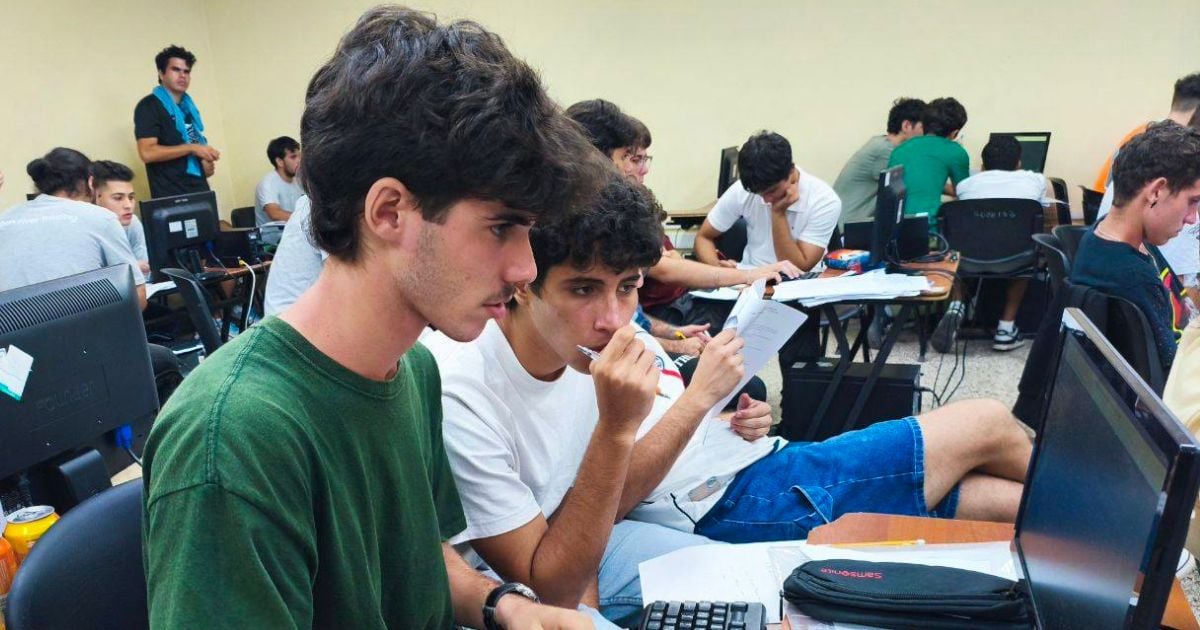
The laboratories of the Faculty of Mathematics and Computing at the University of Havana hosted the beginning of the qualifying round for the Caribbean Final of the International Collegiate Programming Contest (ICPC), marking the start of the 2025–2026 competitive cycle.
The information was disclosed by the University of Havana itself through a post on its official Facebook account, where it celebrated the enthusiasm and preparation of its students, highlighting that “the passion for programming” fills the faculty's laboratories once again.
The ICPC brings together hundreds of university teams from around the world each year, competing in challenges involving logic, algorithms, and problem-solving for a spot in the grand international final scheduled for 2026.
In this qualifying round, students from various Cuban universities tested their skills against the clock and the complexity of the challenges posed, aiming to secure a spot in the upcoming Caribbean Final, which serves as a prelude to the global competition.
The publication highlighted the atmosphere of cooperation, strategy, and high academic standards, as well as the commitment of the island's future engineers and programmers to technological excellence.
"The UH joins with talent, passion, and strategy, demonstrating the high level of its students in the world of algorithms, logic, and problem-solving," noted the institution.
The event not only serves as a filter for the subsequent phases but also as a training and exhibition space for the new generations of IT talents, who aim to position Cuba within the international competitive circuit.
The ICPC is one of the most prestigious academic competitions in the world, where teams of three students and a coach represent their universities in challenges involving algorithms, mathematics, and programming.
Founded in 1970 at Texas A&M University, the event today brings together thousands of young people from over a hundred countries and has established itself as a key platform for discovering talent and promoting global technological innovation.
The Caribbean Final, held for the first time in 2011, is part of the Latin American circuit and aims to enhance the skills of Caribbean programmers in a competitive and international environment.
The teams compete not only for medals but also for a spot in the Latin American Final, the semifinal stage that leads to the World Final of the ICPC.
This year, Cuba will host the event at the University of Holguín, alongside venues in the Dominican Republic, Puerto Rico, Trinidad and Tobago, and Antigua and Barbuda.
The 2025 edition of the regional competition will take place between October 6 and November 10, with practices and the official competition scheduled for November 7 and 8.
During the event, teams will be able to submit their solutions in C++, Java, or Python through the BOCA system, under strict conditions of time and accuracy. In addition to the main prizes —gold, silver, and bronze— special recognitions will be awarded for speed, accuracy, and originality to Caribbean teams that succeed in standing out among the best in the continent.
The participation of Cuban teams in the competition has a recognized history within the regional academic sphere. Over the years, students from the University of Havana have managed to stand out among the best on the continent, enhancing the visibility of the island’s computing talent on international stages.
In 2024, the group , a recognition granted for their sustained performance and achievements in previous competitions.
This distinction allowed university students from Havana to advance directly to the regional phase, solidifying their standing among the leading institutions in the Caribbean in computer sciences.
In previous editions, such as in 2021, Cuba ranked among the top ten in Latin America within the ICPC circuit, a feat achieved thanks to the collaborative efforts of students and mentors from the Faculty of Mathematics and Computer Science at the University of Havana. That performance was considered a milestone for the country, competing against prestigious universities on the continent.
Since 2018, when Cuban teams began to participate systematically in the competition, interest in competitive programming has grown among university students.
Frequently Asked Questions about Programming Competitions and the University Context in Cuba
What is the International Collegiate Programming Contest (ICPC) and what is its significance?
The ICPC is a global programming competition for university students that challenges participants to solve complex problems involving logic, algorithms, and programming. It is a platform where students can showcase their skills and compete for a spot in the international finals, fostering the development of critical thinking and technological capabilities.
What is the impact of the new measures from ETECSA on the students of the University of Havana?
The measures taken by ETECSA, which limit national top-ups and increase internet tariffs, directly impact students' access to educational resources and digital tools. This has generated a climate of discontent and protests within universities, as it restricts equitable access to information and hinders academic development in an increasingly digital environment.
How has the University of Havana responded to the student protests regarding ETECSA's measures?
The University of Havana has issued a statement asserting that it will not tolerate interruptions in the teaching processes due to protests and reaffirming its loyalty to the Communist Party of Cuba. This stance has been criticized for not adequately addressing student demands and prioritizing institutional stability over the needs of its university community.
What role does the Academic Freedom Observatory play in the context of student protests in Cuba?
The Academic Freedom Observatory (OLA) has expressed its support for student demands, defending their right to peacefully protest and warning about potential reprisals from the Cuban regime. OLA criticizes ETECSA's restrictions for violating the right to education and access to information, which are essential for academic development.
Filed under: