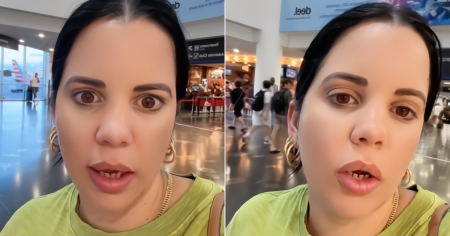
A Cuban woman in El Salvador expressed her astonishment on social media by showcasing what she considers a sign of abundance: the ease with which she obtained over-the-counter medications, something that contrasted sharply with the scarcity she faced in Cuba.
In a video posted on her TikTok account @das6825, the user known as La cubanísima SV showcased two versions of the medication Virogrip—one for daytime and one for nighttime—and commented: “Folks, it’s not to brag or anything, but I’m living in a country that’s super abundant, at least for me. You know what it’s like to have medicine for both day and night, I mean, hello, what abundance in El Salvador, please send medicine to Cuba, this is the Virogrip, but this one is for daytime and this one is for nighttime, so please explain to me in the comments how it works.”
The young woman's cheerful tone reflected, more than surprise at the composition of the medication, a deep impression of the accessibility and availability of basic products, in stark contrast to the healthcare situation she left behind in Cuba.
Dozens of Salvadoran users reacted to the video, expressing congratulations, doubts, and comments. Some celebrated that a foreigner appreciates what many take for granted. Others questioned whether the perception was representative of the country as a whole: “Friend, do they serve you at the public hospital in El Salvador?” asked one user. Another replied, “They give it to you for free at the health unit,” while someone else responded, “Go visit the general women's hospital and you’ll see the reality—there are no medications, there are no doctors.”
It’s not the first time that La cubanísima SV has expressed her astonishment at what she finds in her new country. In another video where she toured a hardware store, she stated that “my eyes still aren’t accustomed to so much beauty, to so much abundance that there is here in El Salvador”. She also spoke about her plans to open a bakery.
Other Cubans abroad have shared similar experiences. In Mexico, a young woman praised the attention to detail in a private laboratory and explained how they showed her the new needle, identified her sample, and put a band-aid on her after the analysis. In Peru, a young man expressed that for the first time he was able to receive medical attention with supplies and organization, and he stated, “How they lied to us!”.
From Spain, another Cuban recalled her first visit to public healthcare, where she compared the hospitals to "five-star hotels" and highlighted the professionalism of the doctors. In Uruguay, a Cuban creator visited a public hospital in Maldonado and concluded that “Uruguayans have no idea what a hospital in terrible condition is like”.
Meanwhile, in Cuba, the shortage of medications is severely affecting chronic patients. A young epileptic stated that he had to choose between buying his medicine or feeding himself, claiming that “the pills cost me 9,000 pesos, but I don’t know whether to eat or buy the pills, because it’s already too expensive”.
The testimony of this young man adds to that of other Cubans who report that even going to a hospital is not free because you have to bring everything: from syringes and gloves to the most basic medications. The authorities themselves have acknowledged that the country only guarantees 30% of the essential medicines.
The testimonies of Cubans inside and outside the island reflect an increasingly deep divide in access to essential services, particularly in terms of healthcare.
Frequently asked questions about the shortage of medications in Cuba and the experiences of Cubans abroad
Why do Cubans face a shortage of medications?
The shortage of medication in Cuba is a persistent problem due to poor management by the socialist regime, a lack of resources, and economic sanctions. The Cuban government has acknowledged that it can only guarantee 30% of the basic medication list, profoundly affecting chronic patients and the general population.
What is the experience of Cubans in El Salvador regarding the availability of products?
Cubans in El Salvador have expressed their astonishment at the abundance and accessibility of basic products, including medications, food, and cleaning supplies. This contrasts with the Cuban reality, where scarcity is the norm. Many Cubans in El Salvador emphasize the ease with which they can acquire essential goods and appreciate the improvement in their quality of life.
How do Cubans react when comparing the healthcare systems of other countries to that of Cuba?
Cubans who have emigrated to other countries often express surprise at the quality and accessibility of foreign healthcare systems. Testimonials from Mexico, Spain, and other countries highlight the organization, professionalism of medical staff, and availability of supplies, in contrast to the shortcomings of the Cuban system, where infrastructure is deteriorating and resources are limited.
What solutions have been proposed to improve the health situation in Cuba?
The improvement of the health situation in Cuba requires a restructuring of the healthcare system, an increase in local medicine production, and greater openness to international donations. However, the lack of political will and the resistance to meaningful reforms by the Cuban regime pose significant obstacles to any substantial change.
Filed under: