The Cuban government assured that it is carrying out more than 300 infrastructure projects to improve the water supply in the country, with an investment amounting to five billion pesos. However, the specific investments and the exact territories that will benefit are not detailed.
Canal Caribe interviewed engineer Antonio Rodríguez Rodríguez, president of the National Institute of Water Resources (INRH), who acknowledged that more than 400,000 people are still affected by the drought in Cuba, particularly in the provinces of Holguín, Ciego de Ávila, Las Tunas, and Camagüey.
The recent rains helped to increase the volume in some key dams such as Gilbert and Gota Blanca, in Santiago de Cuba, as well as Faustino Pérez and La Yaya, in Guantánamo. However, the impact of these rains has not been enough to reverse the crisis.
In Santiago de Cuba, authorities are working on the Quintero Water Treatment Plant, which supplies 80% of the urban population. Ongoing tasks include replacing shut-off valves, eliminating leaks of up to 25 liters per second, and maintaining the Quintero-Ciudad and Micro 9 water lines.
In Havana, where more than 184,000 residents continue to be affected by water scarcity, an emergency program has been launched for water distribution by tankers. There are 119 water trucks providing service.
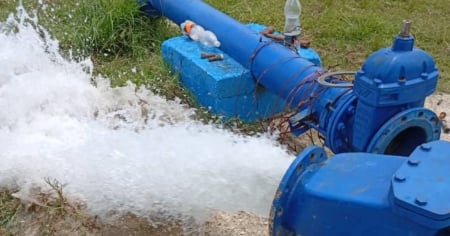
The engineer Leonardo Soto Romero, delegate of the INRH in the capital, explained that they are currently working with 11 intake points and 13 dispensers, but they hope to reach 30 charging points to improve the supply to the water tankers.
The supply issues are attributed, according to official sources, to malfunctions in the pumping systems, many of which were caused by electrical surges.
The regime also reported alleged "illegal acts" against the main host of the El Gato system in Mayabeque. They provided no details about this matter, but insist that it impacts the supply to the population.
During a recent meeting in Havana, Vice Prime Minister Inés María Chapman acknowledged the seriousness of the situation and called for better coordination between the hydraulic system and the Electric Union.
The official acknowledged that the water supply relies on between 4 and 24 hours of electrical energy to reach all users, which further complicates distribution amidst an energy crisis.
The director of the Electric Union, Alfredo López Valdés, assured that the aqueduct system is being monitored continuously.
The Cuban government claims to have a strategy, but it still has not provided data on the investments promoted by the INRH. It is unclear how the five billion pesos are being used, nor have they offered specific timelines to resolve a situation that generates citizen protests and deepens the dissatisfaction of Cubans.
Frequently asked questions about the water crisis in Cuba
How many hydraulic works is the Cuban government carrying out to improve water supply?
The Cuban government claims that it is carrying out over 300 hydraulic works to enhance water supply in the country, with an investment of five billion pesos. However, no details have been specified regarding the investments or the regions that will benefit.
What are the main causes of the water crisis in Cuba?
The main causes of the water crisis in Cuba are the intense drought, equipment breakdowns, and energy deficits. These challenges have severely impacted the supply of drinking water in several provinces, particularly in Santiago de Cuba, Holguín, Las Tunas, and Guantánamo.
What measures are being taken to mitigate the water crisis in Santiago de Cuba?
In Santiago de Cuba, authorities are working on the Water Treatment Plant of the Northwest System (Quintero), where tasks such as replacing shut-off valves and eliminating leaks are being carried out. Tank trucks have been activated to supply water to the most affected communities, although resources continue to be insufficient in the face of demand.
What impact does the energy crisis have on water supply in Cuba?
The energy crisis in Cuba complicates water distribution, as the supply relies on between 4 and 24 hours of daily electricity. This especially affects the pumping stations, which are left without power for extended periods, delaying the delivery of water to the population.
What is the current situation of the water supply in Havana?
In Havana, more than 184,000 residents continue to be affected by the water shortage. An emergency program has been initiated with water distribution via trucks, although currently only 17 of the 19 necessary pumping units are operational. The water deficit exceeds 2,000 liters per second, primarily affecting the higher areas of the capital.
Filed under: