
Related videos:
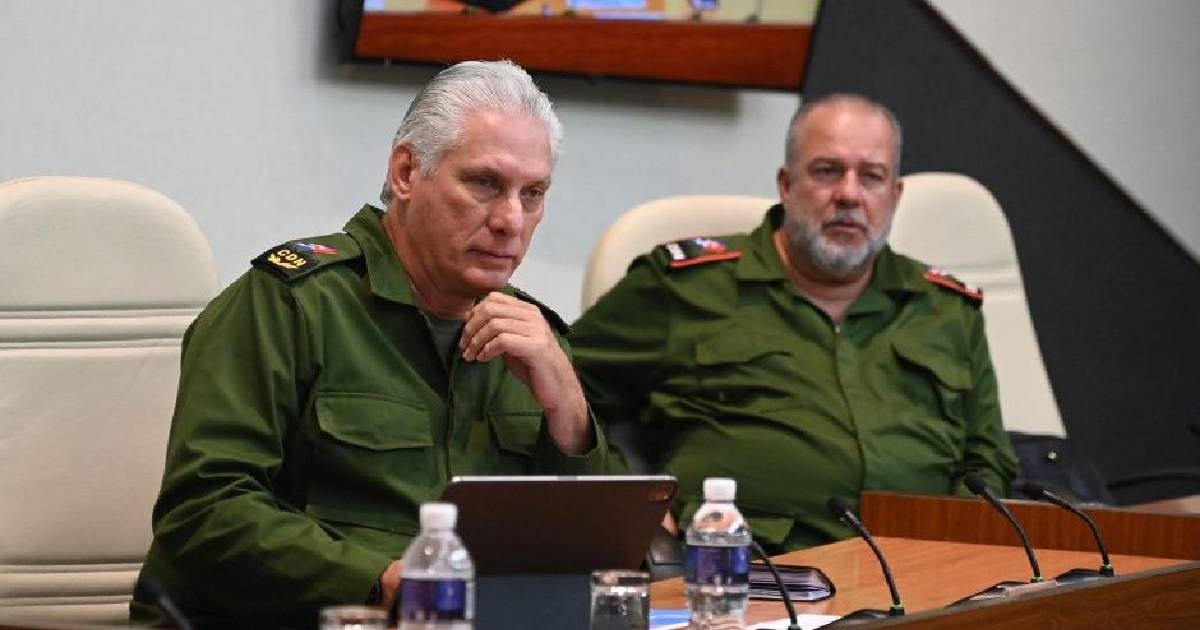
The First Secretary of the Communist Party of Cuba (PCC) Miguel Díaz-Canel chaired an extraordinary meeting this Friday at the Provincial Committee of the PCC in Havana, accompanied by ministers, military leaders, and senior officials of the Political Bureau, following the protests and saucepan banging that shook the capital the day before.
In the meeting, the increasing citizen complaints about power outages, the accumulation of trash, and water supply issues were addressed, topics that have sparked public outrage in recent days, reported the digital site of the PCC.
The ruler announced the formation of work teams that will include local authorities and mass organizations to "directly address" community demands.
However, it also mobilized resources and forces from the Revolutionary Armed Forces (FAR) and the Ministry of the Interior (Minint), reinforcing the military presence in managing the crisis.
At the meeting, attended by Prime Minister Manuel Marrero Cruz, Minister of the Revolutionary Armed Forces Álvaro López Miera, Secretary of Organization of the PCC Roberto Morales Ojeda, and Secretary of the Council of Ministers José Amado Ricardo Guerra, among other leaders, it was a gesture of unity in response to the social upheaval.
The government reiterated that communities must take on an active role under the leadership of youth and mass organizations, as part of what it termed an "integrated system" to address the issues facing the capital.
On the night of Thursday, October 2, protests were recorded in Centro Habana, where residents took to the streets with pots and pans, chanting “Freedom!” and even lighting bonfires in the middle of the street.
Several intersections were blocked during a peaceful protest, including the participation of minors.
The events took place after one of the most critical days in electrical supply, with outages lasting over 12 hours that affected a large part of the capital.
Citizen discontent is directly pointing to inadequate government management due to a lack of fumigation, medicine, and drinking water, as diseases proliferate and food spoils due to the absence of refrigeration.
Residents in municipalities such as Regla and Centro Habana have staged a protest in the middle of the street after several weeks without water supply.
Recently, the Minister of Science, Technology, and Environment (CITMA), Armando Rodríguez Batista, publicly acknowledged the severity of the health crisis in the capital by admitting that “that trash is not contained: it is spread all over Havana”.
In this regard, the official journalist Ana Teresa Badía was emphatic in stating that “Havana smells like garbage,” through a post on her Facebook account in which she criticized the accumulation of tons of waste in streets and corners without timely collection.
In his brief reflection, Badía stated that “there is a rampant institutional indifference. Let’s not blame only the blockade; there are things like empathy, hard work, and respect for citizens that do not depend on any blockade.”
Weeks ago, torrential rains turned the streets of Centro Habana, Diez de Octubre, and El Vedado into rivers of garbage carried away by the currents, while a widespread blackout plunged the city into darkness.
Residents shared images showing containers floating adrift and contaminated waters entering doorways and homes, reflecting that the issue of trash is not just a matter of urban appearance, but a direct threat to the health and safety of hundreds of thousands of Havana residents.
Frequently Asked Questions about the Protests and the Crisis in Cuba
Why are protests taking place in Havana?
The protests in Havana are due to prolonged blackouts, water shortages, and the general deterioration of basic services. These issues have led to increasing discontent among citizens, who are denouncing the insufficient government management and the lack of effective solutions to improve the situation.
How has the Cuban government responded to the protests?
The government of Cuba has responded to the protests by mobilizing military forces and calling meetings with high officials to address the crisis. Miguel Díaz-Canel has presided over meetings with ministers and military leaders to discuss citizens' grievances and has announced the formation of task forces to address community demands, although he has also strengthened the military presence on the streets.
What are the main causes of the energy crisis in Cuba?
The energy crisis in Cuba is due to the obsolescence of the National Electric System (SEN) and the lack of investments in infrastructure. The country has faced the shutdown of several generating plants, leading to prolonged blackouts. The issues have been exacerbated by a lack of maintenance and the absence of resources to carry out significant structural repairs.
What measures has the government taken to address the water crisis in Havana?
The Cuban government has acknowledged the issues with water supply, but so far, it has not provided concrete short-term solutions. Currently, the lack of electricity is affecting water supply, and the government has implemented emergency measures such as the distribution of water trucks in the most affected areas, although these actions have not been sufficient to meet the demand.
Filed under: