
Related videos:
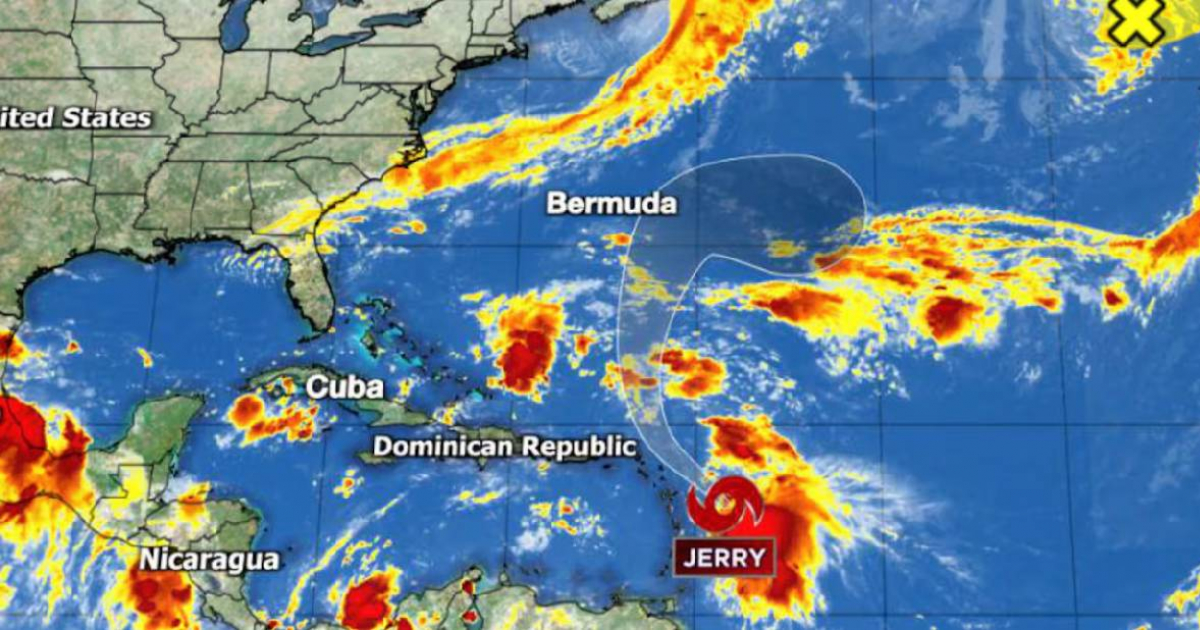
Despite its disorganized appearance, tropical storm Jerry has gained strength and is expected to approach hurricane status as its center moves north towards the Lesser Antilles, on the northeastern edge of the Caribbean, this Thursday.
According to the weather models, most strong winds are located east of the center of the system, so sustained tropical storm conditions (winds of more than 63 km/h) are not expected in the southwestern part, which includes most of the islands.
However, Jerry's passage will not be harmless, warned the National Hurricane Center.
Its southeast tail, loaded with humidity and gusts, will bring adverse conditions from tonight until Saturday in areas such as Antigua and Barbuda, St. Martin, St. Kitts, Nevis, Montserrat, and Guadeloupe, all under tropical storm watch due to winds that could exceed 63 km/h.
In addition, the pull of rain bands associated with the system could lead to significant accumulations of water and trigger flash floods, especially in mountainous areas of both the Windward Islands and the Virgin Islands, the weather report emphasized.
An anticipated cold front that will cross Florida this weekend will be responsible for pushing Jerry out to sea.
According to forecasts, the system does not pose a threat to the United States or to Bermuda, an island that is still recovering from the recent effects of Imelda.
Instead, the weather focus is on a developing non-tropical coastal storm off the Carolinas, which could evolve into a quasi-nor’easter between Saturday and Monday, impacting areas from the Carolinas to the northeastern United States with winds exceeding 70 km/h and heavy rainfall.
Charleston and other locations along the Atlantic coast have already started to experience coastal flooding, which will intensify with the high tide on Friday morning. Several cycles of moderate to severe flooding are expected over the weekend.
Although the coastal system is of non-tropical origin, it is not ruled out that it may evolve into a subtropical cyclone early next week. If it does, it would be named Karen, although this potential change will not affect the adverse conditions expected for the east coast of the U.S.
Meanwhile, a non-tropical low pressure system —designated as Invest 96L— is causing storm conditions northwest of the Azores Islands. This system, at an unusual latitude for tropical cyclones, is trying to generate convection near its center, but it only has a narrow window for development.
If it were to briefly become a tropical or subtropical cyclone, it would be an unusual event with no impact on land and of short duration.
Frequently Asked Questions about Hurricane Jerry and Its Impact on the Caribbean
What is the expected path of Hurricane Jerry?
Hurricane Jerry is expected to approach hurricane category as its center moves north of the Leeward Islands on the northeastern edge of the Caribbean. Jerry poses no threat to the United States or Bermuda. A cold front will steer Jerry offshore, distancing it from the North American continent.
What areas are under warning due to the passage of Jerry?
The areas under tropical storm watch include Antigua and Barbuda, Saint Martin, Saint Kitts, Nevis, Montserrat, and Guadeloupe. Winds are expected to exceed 63 km/h and adverse conditions are anticipated from tonight until Saturday in these areas.
What risks does Hurricane Jerry pose to the Caribbean islands?
Hurricane Jerry could trigger flash flooding due to significant water accumulation, especially in the mountainous areas of the Leeward Islands and the Virgin Islands. The rain bands associated with the system are responsible for this risk.
What other weather phenomena are occurring alongside Jerry?
In addition to Hurricane Jerry, a non-tropical coastal system off the Carolinas could transform into a quasi-nor’easter, impacting the East Coast of the U.S. with winds exceeding 70 km/h and heavy rainfall. This system could evolve into a subtropical cyclone and would be named Karen if it does.
Filed under: