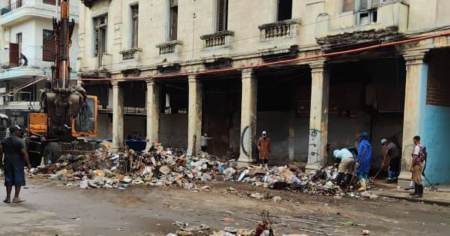
Cuban Prime Minister Manuel Marrero Cruz stated this Saturday that the actions taken for waste collection in Havana "mark a before and after," despite the fact that more than half of the popular councils in the capital continue to accumulate waste in their streets.
According to a report by the official Cuban Television, the statements were made during a meeting led by Miguel Díaz-Canel, which included high-ranking government officials and members of the Communist Party, where the results of a week of interventions to tackle longstanding issues such as garbage and water supply in the capital were evaluated.
According to the figures presented at the meeting, only 52 out of the 106 popular councils in Havana have been cleaned.
The municipalities of Diez de Octubre, Marianao, Habana del Este, and La Lisa remain among the most affected, despite the operations and official appeals.
This is compounded by the ongoing water crisis in areas such as Arroyo Naranjo, San Miguel del Padrón, and Boyeros, where thousands of residents continue to wait for solutions.
Marrero insisted on the need to keep workplaces and their immediate surroundings clean and called for the involvement of the population in hygiene tasks.
However, it did not address the causes that have led to this critical situation, nor did it provide explanations regarding the chronic lack of resources, the inefficiency of communal services, or the accumulation of garbage over the years in many areas of the city.
In his words, he stated that a new phase of work is opening that should focus on recovering what has been lost and moving towards sustainability in services.
But that sustainability, as citizens have pointed out on social media and as the regime has acknowledged, is a long-standing and unfinished task.
For his part, Roberto Morales Ojeda, Secretary of Organization of the Central Committee of the PCC, acknowledged that there are still many deficiencies, but focused his remarks on praising the response of party and government officials, highlighting that areas filled with accumulated garbage "from years" have been cleared.
The official discourse once again relied on appeals for discipline, control, and popular mobilization, without taking institutional responsibility for the deterioration of services and the serious hygienic-epidemiological situation facing the city.
Meanwhile, citizen discontent continues to grow, fueled by the feeling that solutions still depend on "exceptional moments," rather than being the result of efficient and consistent public management.
Parallely, this dire sanitary situation has led the Cuban population to currently face an increase in arboviral diseases that, although the regime denies it, has already claimed lives.
Frequently asked questions about the garbage collection crisis in Havana
What has Manuel Marrero said about garbage collection in Havana?
Manuel Marrero stated that the actions for garbage collection "mark a before and after" in Havana, although more than half of the popular councils in the capital continue to have accumulated waste in their streets. Marrero emphasized the need to keep workplaces clean and to involve the population in hygiene tasks, but he did not provide explanations regarding the causes of the critical situation nor concrete proposals for a sustainable solution.
What is the current situation of garbage collection in Havana?
The situation is critical, as only 52 out of the 106 popular councils in Havana have been cleaned. Municipalities such as Diez de Octubre, Marianao, Habana del Este, and La Lisa are among the most affected, and the problem persists despite official operations and calls for action. Moreover, the collapse in waste collection has been reported by citizens and experts, who warn about the health risks in a city with over two million inhabitants.
Are there sustainable plans for waste collection in Havana?
According to Miguel Díaz-Canel himself, there is no sustainable plan for waste collection in the capital. The current actions are based on isolated efforts, without a long-term strategy, and there is a call for the systematization of operations as a temporary solution. This lack of structural planning has resulted in solutions being dependent on "exceptional moments" rather than efficient and consistent public management.
How has the garbage crisis impacted public health in Havana?
The poor waste management in Havana has led to an increase in arboviral diseases, with reports of fatalities. The accumulation of waste has created favorable conditions for the proliferation of mosquitoes and other vectors, raising the risk of diseases such as dengue. This health crisis is exacerbated by the collapse in waste collection and the lack of proper fumigation.
Filed under: