
Related videos:
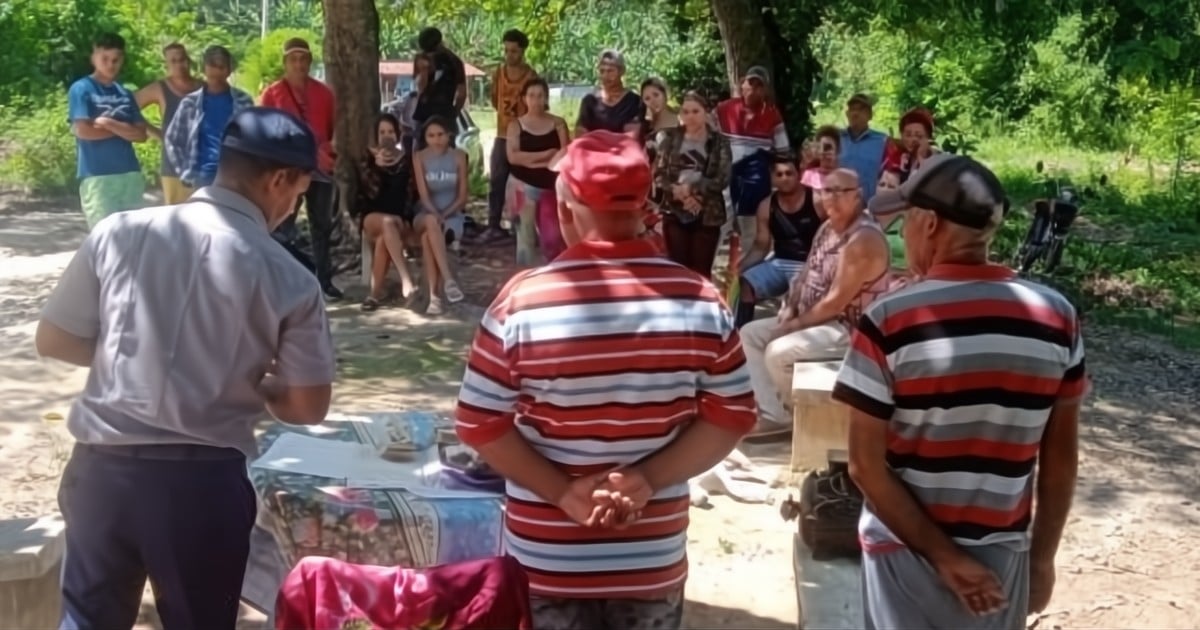
The Ministry of the Interior (Minint) organized a public event to return over 500,000 pesos to a citizen from the town of La Nenita, in the municipality of Guisa, Granma province, in what appeared to be more of a propaganda operation than a simple act of justice.
The refund was reported this Sunday by the official profile Entérate con Aytana Alama, a regular spokesperson for the regime and the Minint, who celebrated the event as an exceptional achievement.
"What happiness for the resident of Guisa who received over 500,000 pesos that had been stolen from him in recent days," he wrote, along with images of the moment, which turned into a propaganda show.
In the event, details were not provided regarding how the case was resolved or who was responsible for the theft, as the most important message was that “the regime resolves.” Local residents participated, seemingly summoned as part of the event.
The circulated photos show officials and civilians witnessing the handover of money, as if it were a ceremonial act.
Beyond the case itself, the episode reveals an increasingly visible trend in the narrative of the Cuban regime: to turn basic state actions—such as investigating a crime and returning stolen property—into social media content to reinforce the image of institutional effectiveness.
What should be a minimal obligation of the authorities ends up being presented as an achievement worthy of public applause, which stands in stark contrast to the government's usual inaction.
The staging, with neighbors as spectators and celebratory publications in supportive media, demonstrates the eagerness to capitalize on any event that can be portrayed as a victory for the system.
However, there are more cases that the regime does not resolve with its repressive apparatus than those that manage to have a "happy ending." Nonetheless, the latter provide good material for a Cuban detective novel.
On social media, some users reacted with skepticism and irony to the public event organized by the Minint in Guisa.
"That's just an average. Is it really necessary to make such a fuss to return that? For God's sake…" commented Yoli Rosales, referring to the unnecessary display in fulfilling a basic obligation.
Others took the opportunity to point out that not all cases receive the same "media treatment."
"It is necessary for them to come to Río Cauto to see if they can find the batteries that were stolen from the hospital plant," wrote Aymara García Reyna, pointing to the neglect of other complaints.
For his part, José Luis Marañón Rodríguez made a wry comment with a popular phrase: “You’ve reminded me of the saying 'a thief who robs a thief has a hundred years of forgiveness,’” referring to the double standard that many Cubans perceive when actions are celebrated that should not require applause.
The use of public events like the one organized by Minint in Guisa is not new. In Cuba, the return of stolen items has already been turned into propaganda stages, where the priority is not justice but the narrative.
In September, the police organized a political rally to return a bicycle and a mobile phone in Villa Clara, complete with flags, slogans, and speeches, as if capturing a thief were an epic achievement.
Meanwhile, most crimes remain unsolved. The organization Cubalex recently reported that children and adolescents in Cuba are victims of arbitrary detentions, institutional violence, and neglect, without access to justice or support, highlighting the disconnect between the official narrative and the reality faced by the most vulnerable.
Even symbolic acts like sweeping leaves at the Palace of the Revolution have been used to create images of approachability and humility.
Díaz-Canel was photographed sweeping in the government gardens, a trivial gesture amplified in official media while Cubans stand in line for hours to obtain a piece of bread or basic medicine.
In parallel, the anniversary of the CDR was celebrated with a bicycle called "Patria", presented as a symbol of resilience, in a country where public transportation has collapsed and commuting is a daily ordeal for millions.
These staged productions reinforce a propaganda strategy that aims to mask institutional decay with superficial gestures.
Frequently Asked Questions about the Propaganda Acts of MININT in Cuba
Why does the MININT organize public events to return stolen goods?
The MININT organizes these events as a propaganda strategy to demonstrate effectiveness and control to the public, turning basic state functions into public display events. These acts aim to strengthen the image of the Cuban government, despite widespread criticism that many of these actions are more about propaganda than real solutions to citizen security issues.
How does the Cuban population react to these acts of returning goods?
The Cuban population tends to express criticism and skepticism towards these actions, believing that they are used more as political propaganda than as real solutions to the increasing insecurity and crime in the country. On social media, many people express discontent, pointing out that these events do not address the structural problems that generate criminality and a lack of safety.
What other examples are there of similar acts organized by the MININT?
In addition to the event in Granma, the MININT has organized similar events in various provinces. For example, in Santiago de Cuba, stolen motorcycles were returned, and in Sancti Spíritus, a ceremony was held to return stolen equipment to an elderly woman. These events are marked by the presence of local residents and state media and are promoted as achievements of the system, despite being basic functions of any security system.
What is the general perception of security in Cuba?
The general perception of security in Cuba is one of increasing insecurity, with a rise in thefts and criminal acts. Despite the regime's efforts to demonstrate effectiveness through public actions, many citizens believe that the root causes of criminality are not being addressed and that the measures taken are more about social control than effective protection.
Filed under: