
Related videos:
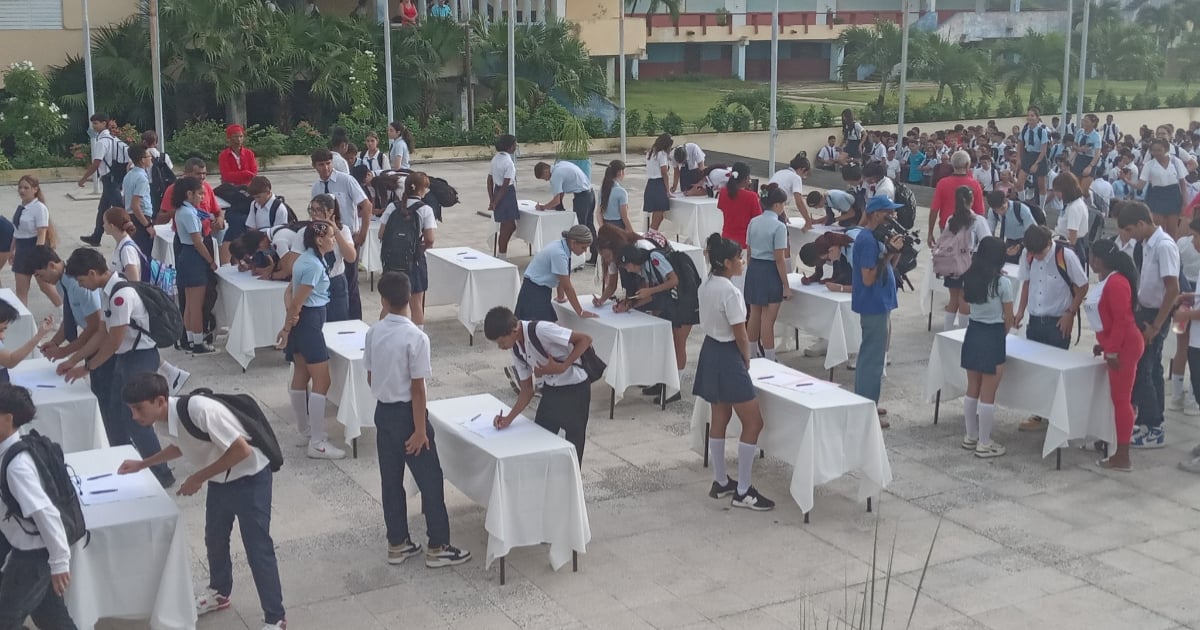
The human rights organization Cubalex reported that children and adolescents were used by the Cuban regime to sign a political declaration in support of the Venezuelan government as part of a national campaign held in September. According to the organization, this practice constitutes a violation of fundamental rights such as the best interest of the child, the right to express opinions, and the right to an education free from political pressures.
Cubalex documented that in several schools across the country, students were asked to sign a document promoted by the Cuban regime in support of President Nicolás Maduro. In many cases, the minors did not understand the content, yet they were still pressured to sign.
The organization warned that “adolescents were threatened: if they did not sign, they could be labeled as counter-revolutionaries, a label that in Cuba is not merely a nickname, but a stigma that entails discrimination, loss of the right to study, and even political persecution or imprisonment.”
In a series of social media posts, Cubalex warned that the Cuban school system has been turned into a "political control instrument," and that the signature campaigns reflect a "pattern of indoctrination." The images shared include messages such as: "Girls, boys, and adolescents are used as instruments of propaganda. The State prioritizes its political interests over their fundamental rights."
According to the organization, forcing minors to participate in these campaigns constitutes a form of psychological violence. “It affects their confidence, their freedom of thought, and their right to develop as free individuals,” states the report. Furthermore, it is noted that these actions expose minors to political conflicts that are not part of their reality, demonstrating that the goal is not educational, but rather political.
Cubalex explains that the best interests of the child involve protecting their well-being above all other considerations, and that the right to express opinions is recognized by international treaties. Forcing them to sign a document they do not understand, they say, denies them their voice.
The signature collection campaign, promoted between September 24 and 30, was initiated by the Communist Party as part of a national mobilization to support Nicolás Maduro. The initiative was presented as a gesture of solidarity but has been criticized as a mechanism of social control and political propaganda.
Citizen outrage became evident on social media when it was revealed that the Minister of Energy and Mines participated in signing events while the country is facing a severe energy crisis. The public questioned the disconnect between the regime's priorities and the real needs of the people.
Meanwhile, the regime has reiterated its support for Caracas through official statements. In a recent interview, Deputy Minister Carlos Fernández de Cossío stated that Cuba will provide “full political support” to Venezuela in the event of a conflict with the United States, although he ruled out any military involvement.
With this statement, Cubalex reiterates its call for the right of girls, boys, and adolescents to receive an education free from indoctrination, where critical thinking is encouraged rather than ideological obedience. "The education system should not be a channel for propaganda. Teaching should promote free thought, not political obedience," the organization concludes.
Filed under: