
Related videos:
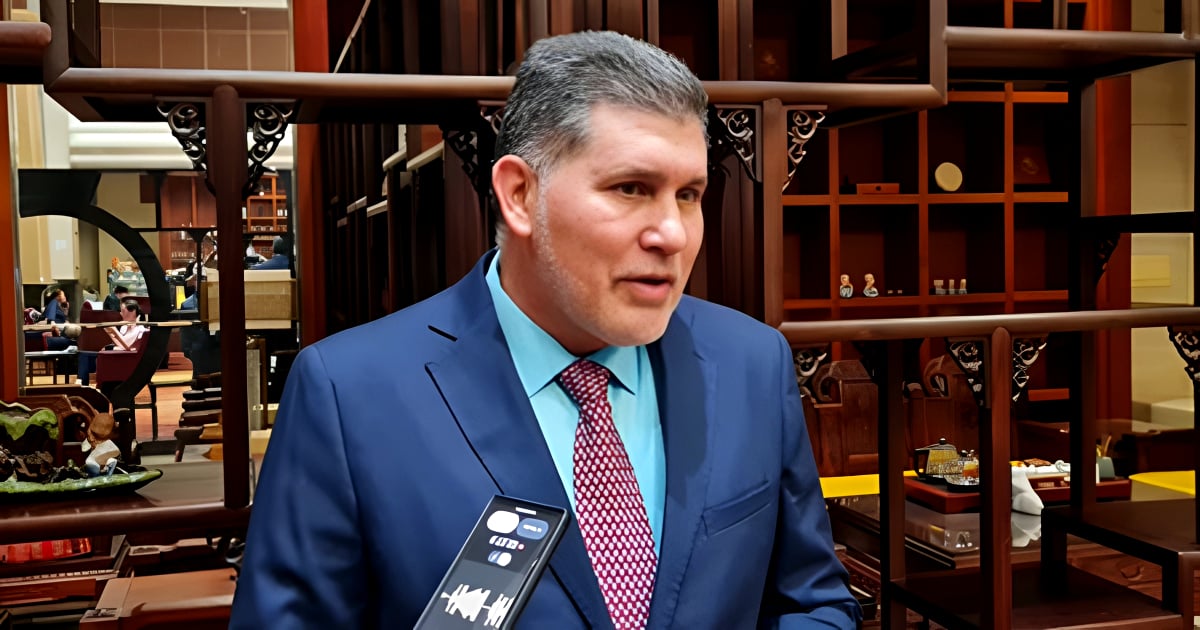
Oscar Pérez-Oliva Fraga, an electronics engineer and the great-nephew of Fidel and Raúl Castro, has been promoted to vice prime minister of Cuba, according to an agreement by the Council of State ratified this week.
The designation confirms the growing influence of the family clan and the "heirs" of the Castro family in the highest levels of political and economic power of the so-called "continuity" government, which is apparently led by Miguel Díaz-Canel, whom many observers view as a puppet of the "famiglia," increasingly close to being replaced by the regime's hardline core.
From coach to minister
In addition to his new responsibilities, Pérez-Oliva Fraga remains the Minister of Foreign Trade and Foreign Investment (MINCEX), a position he took on in May 2024 after a career of more than 15 years related to foreign trade and the Mariel Special Development Zone (ZED Mariel).
Previously, he served as the director of state-run companies and first deputy minister of MINCEX. As the director of Business Evaluation at the Mariel Special Economic Zone, the new vice prime minister of Cuba worked under the authority of the czar of GAESA, the late General Luis Alberto Rodríguez López-Calleja, former son-in-law of Raúl Castro and a key figure in the opaque finances and corruption of a family that has controlled the country for over 60 years.
Graduated from the Technological University of Havana (CUJAE), he is officially described as a “disciplined individual with a strong grasp of international economic relations,” although his political rise has been meteoric even by the standards of the Cuban bureaucracy.
The family footprint
The genealogy of Pérez-Oliva Fraga carries as much weight as his service record. He is the son of Mirsa Fraga Castro, grandson of Ángela Castro, sister of the dictator, and the nonagenarian retired army general.
In other words, he belongs to the third direct generation of the Castro-Ruz lineage, a name that continues to signify the hierarchy of the Cuban regime's elite more than six decades after the triumph of the so-called "revolution."
With its promotion, the power of the family now extends to the country's most strategic economic sphere: foreign investments, international trade, and currency management, a vital area in the structural crisis that Cuba is undergoing.
Continuity, more than renewal
The rise of Pérez-Oliva Fraga is framed within the discourse of "generational change" promoted by Díaz-Canel, a propaganda operation that in practice reinforces the continuity of family and military power.
The promotion coincides with a government attempt to revive foreign investment, although the results have so far been insignificant: the country remains trapped in a combination of liquidity shortages, international distrust, skepticism towards national entrepreneurs and investors, and a paralyzing bureaucracy.
Shadows and more shadows of his management
In the year that he has led MINCEX, Pérez-Oliva Fraga has promoted an optimistic narrative about the "portfolio of opportunities" for investors, without providing concrete figures on actualized projects.
Business sources consulted by independent media describe a ministry that is more focused on attracting foreign currency, but is still opaque in its execution and ineffective in managing and attracting foreign direct investment.
The new vice-prime minister bears the task of attracting investment to an economy in recession, doing so without altering the tenets of the socialist system. His political future hangs in the balance: a technocrat of “old lineage” who must convince foreign investors that Cuba can provide guarantees… without ceasing to be the Cuba of the Castros.
The stain of a surname that won't wash away, even with bleach
With this designation, the shadow of the Castros reappears visibly in the governmental structure of the totalitarian regime.
Although Raúl Castro is officially retired, his influence persists in key appointments, and the promotion of a great-nephew reinforces the idea of a political dynasty that resists stepping aside.
Pérez-Oliva Fraga represents, therefore, the new face of an old system: young, technical, and modern in appearance, but tied by blood and loyalty to a decrepit elite that has ruled Cuba with a dictatorial fist for over half a century.
Filed under: