
Related videos:
Amid the wave of indignation over images of several children sleeping in the gardens of the Muthu hotel in Havana, the official musician Arnaldo Rodríguez Romero reemerged on social media with a post that many interpret as an attempt at “image laundering” by the regime.
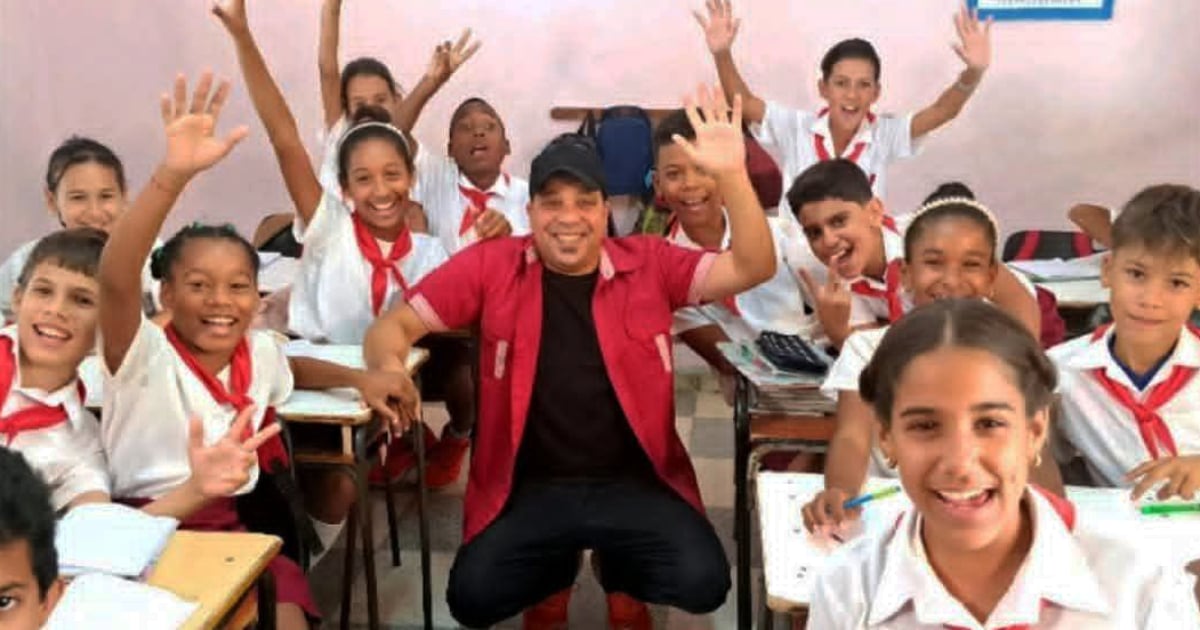
The artist, known for his ardent support of the Cuban government, shared photos in which he appeared surrounded by schoolchildren wearing red scarves in a classroom of acceptable appearance, with smiling and uniformed children, accompanied by a text in which he thanked the “government” for allowing him to study for free.
"Thank you so much, my Mother, for everything. Thank you, Government, for granting me the right to attend school for free, regardless of my skin color, economic status, or religious affiliation," Rodríguez Romero wrote on his Facebook account, in a message that concluded with the word “Moraleja.”
The publication emerges just as independent media and Cuban citizens were denouncing child neglect and extreme poverty following the release of the images of six minors sleeping on the ground in front of the Muthu hotel, located at the intersection of 1st and 70, in the Playa municipality of Havana.
The event prompted an unusual acknowledgment of institutional failures by an officialist deputy and even a reaction from the press chief of Miguel Díaz-Canel, the institutional guardian Leticia Martínez Hernández, positioned at the Palace to attempt to halt any complaints and revelations that would add to the extensive tally of the regime's injustices.
However, while broad sectors of the population express concern over the deterioration of the child protection system, the musician chose to highlight the regime's "achievements" in education, in a speech aligned with state propaganda.
Carefully chosen images
In the photos published by Rodríguez, he is seen surrounded by smiling children in a primary school classroom. The images, featuring the Cuban flag in the shape of a heart, project an atmosphere of harmony and optimism that stands in stark contrast to the reality reported by journalists and residents of the capital.
For many internet users, the artist's post is not coincidental, but rather part of a counter-propaganda strategy designed to divert attention from the Muthu case and to reinforce the narrative that "no child is left without support in Cuba."
The official discourse
In his text, the musician attempted to separate family responsibility from state responsibility by recounting anecdotes from his childhood in the 1980s: how his mother made him attend classes, scolded him for not studying, or encouraged him to strive for better.
“'My mother sent me, it wasn't the government,'” the mouthpiece of the dictatorship repeated several times, to emphasize the families' responsibility for the well-being of Cuban children and to absolve the regime for the terrible reality of the increasing vulnerability of minors on the Island. He concluded: “Thank you, Government, for granting me the right to attend school for free…”.
The contradiction of the message—thanking the State after insisting that it was his mother who raised him—did not seem to raise the attention of hundreds of submissive individuals who applauded his post, repeating the same mental framework of the indoctrinated: exonerating the government for the plight of many young people and minors in Cuba, placing the families as the ultimate responsibility for their well-being, and at the same time thanking the "revolution" for its alleged social and equality policies.
Context and contradictions
The artist's message was set against a backdrop of deep social crisis. According to figures from the Cuban Observatory of Human Rights, 89% of households live in extreme poverty, and 9% of children suffer from food insecurity. International organizations warn that an increasing number of minors are begging, searching for food, or living on the streets.
In this context, Rodríguez Romero's publication seems to represent a new gesture of disconnection and political opportunism, typical of his recent trajectory.
The musician, businessman, and deputy to the National Assembly of People's Power (ANPP) —who has received honors from the Ministry of the Armed Forces and has been awarded for his "commitment to the Revolution"— has taken on a role as a propagandistic spokesperson for the regime in recent years, celebrating official events while avoiding addressing the real problems of the country.
While the images of the children from the Muthu hotel continue to generate shock and complaints, Rodríguez Romero insists on painting an ideal Cuba, where all children attend school and no one is left behind, except for those who are victims of neglect and the "debauchery" of disorganized families that are not integrated into the communist and revolutionary society.
However, their post seems to have achieved the opposite effect: to remind us of the gap between official propaganda and the real lives of Cuban children.
Filed under: