
Related videos:
The Electric Union of Cuba (UNE) announced for this Monday an impact of 1840 MW during peak hours after last week's blackouts had provided a slight relief.
The daily report from UNE informed that this Monday during peak hours, a capacity of 1680 MW is estimated with a maximum demand of 3450 MW, resulting in a deficit of 1770 MW. Therefore, if the predicted conditions persist, a shortfall of 1840 MW is anticipated.
Furthermore, the availability of the SEN at 06:00 hours is 1635 MW, while the demand is 2552 MW, resulting in a deficit of 893 MW.
At half past the hour, an impact of 980 MW is expected, the note specifies.
On Sunday, the 24-hour service was disrupted and remained affected throughout the early hours of today.
Similarly, the maximum impact due to a generation capacity deficit on that day was 1582 MW at 7:00 PM, exceeding the planned capacity due to demand surpassing the forecast.
They also reported that the 32 new photovoltaic solar parks, which the regime hopes will reverse the crisis, delivered an average of 2,891 MWh, with a maximum power output of 680 MW during peak hours.
This Monday, the following units remain out of service: Unit 2 of the Felton Thermal Power Plant, Units 1 and 3 of the Santa Cruz Thermal Power Plant, Unit 8 of Mariel, and Unit 3 of the Renté Thermal Power Plant; under maintenance are Unit 2 of the Santa Cruz Thermal Power Plant and Unit 4 of the Carlos Manuel de Céspedes Thermal Power Plant in Cienfuegos. Additionally, due to limitations in thermal generation, 395 MW are currently offline.
Due to a lack of fuel, 54 distributed generation plants are offline, amounting to 485 MW; and 166 MW are unavailable due to a lack of lubricant, resulting in a total of 651 MW affected by this issue.
This Monday, during peak hours, the entry of Unit 3 of the Santa Cruz CTE is estimated at 45 MW.
Situation in Havana
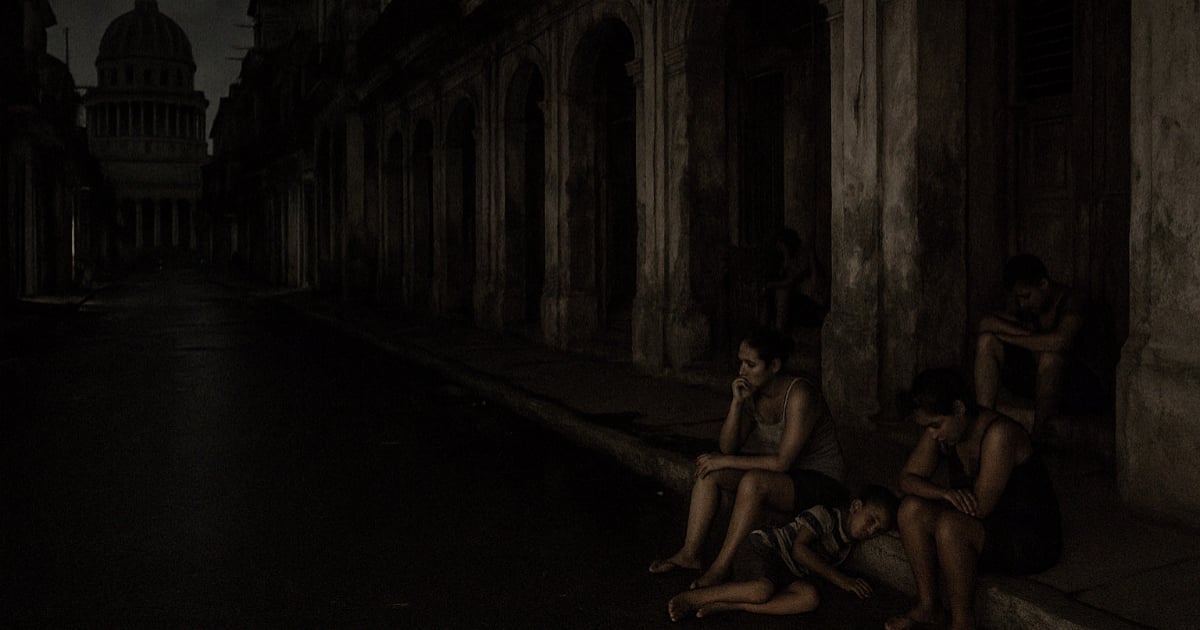
In the Cuban capital, the electric service was disrupted this Sunday at 9:16 AM.
The maximum outage was 50MW at 7:00 PM and service was restored at 7:16 PM.
Unplanned, Blocks 6 and 4 were shut down between 7:00 PM and 11:00 PM, Blocks 1 and 3 between 11:00 PM and 2:00 AM, and Blocks 5, 2, and 6 between 2:00 AM and 8:00 AM.
The prolonged power outages combined with the scarcity of food and drinking water triggered protests on Thursday night in Baire, in the municipality of Contramaestre in Santiago, reflecting the general dissatisfaction felt by Cubans.
Frequently Asked Questions about the Energy Crisis in Cuba
What is the current electricity deficit in Cuba?
The current electrical deficit in Cuba exceeds 1,800 MW, according to the latest report from the Unión Eléctrica de Cuba (UNE). This significant deficit is causing prolonged blackouts throughout the country, affecting the daily lives of Cubans.
How does the lack of fuel affect electricity generation in Cuba?
The lack of fuel has paralyzed 54 distributed generation plants, significantly contributing to the electricity deficit in Cuba. Furthermore, the shortage of lubricants has also rendered an additional 166 MW unavailable, worsening the energy crisis on the island.
What measures is the Cuban government taking to address the electricity crisis?
The Cuban government has attempted to reverse the electricity crisis by installing new photovoltaic solar parks, which have delivered an average of 2,891 MWh. However, these measures have proven insufficient to meet the country's energy demand, highlighting the lack of an effective strategy by the regime to address the issue.
What has been the population's response to the blackouts in Cuba?
Prolonged power outages combined with the scarcity of food and drinking water have generated social dissatisfaction. In places like Baire, in the Santiago municipality of Contramaestre, protests have been reported in response to the energy crisis, reflecting the widespread discontent among Cubans regarding government management.
Filed under: