
Related videos:
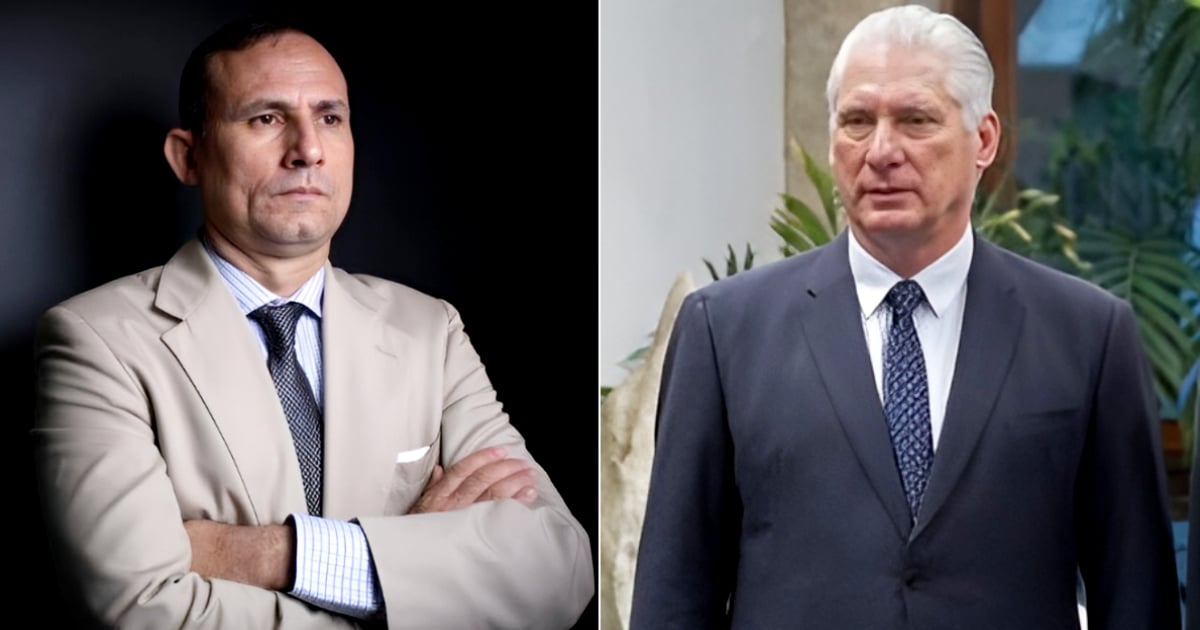
The Cuban opposition leader José Daniel Ferrer García, recently arrived in Miami after years of imprisonment and repression in Cuba, delivered a strong message against Miguel Díaz-Canel and the web of power that still controls the island.
In a message shared on his , the founder of the Patriotic Union of Cuba (UNPACU) stated that the current occupant of the Palace "did not receive the presidency due to a detachment from power" on the part of Raúl Castro, but as part of a maneuver intended to make him the visible face of the ultimate failure of Castroism.
"Without a doubt, Raúl Castro did not hand the presidency to Díaz-Canel out of a detachment from power. No, no, no. He passed it on so that he will be remembered in history as worse than Fidel and Raúl himself; as more cruel and incompetent, as responsible for the collapse of the nation, and as the one who imprisoned and tortured the most opponents, dissenters, and dissatisfied citizens," wrote Ferrer.
With these words, the opposition figure described what he considers a “political trap” set by the Castro brothers to secure their legacy and shift the historical burden of the system's collapse onto Díaz-Canel. “The Castros have ensnared him big time,” he concludes.
"The Face of Collapse"
Since his arrival in exile, Ferrer has intensified his public statements, directly targeting those who maintain political and economic control of the island. His recent message fits into that critical framework.
The opposition leader believes that the current Cuban ruler, officially presented as a civilian continuator of Castroism, is actually "a sacrificial piece" within the power structure controlled by Raúl Castro and the generals of GAESA.
According to Ferrer, the regime designed the transition in such a way that the responsibility for the crisis—economic, political, and social—would fall on Díaz-Canel, while the true wielders of power stepped back into the background.
"When the people say: 'ENOUGH!', the only option left is to fly far away, to Moscow or Beijing," Ferrer warned, suggesting that the Castro puppet could end up fleeing like other communist leaders when their systems collapsed.
A parallel with the Soviet collapse
The opposition figure drew a direct parallel between the current Cuban situation and the Soviet Union of the late 1980s. “I, like him, gathered all possible courage and acted like Gorbachev in Russia. There is no better option,” Ferrer remarked, comparing the Cuban leader to the last leader of the USSR, whose willingness to reform ultimately led to the dissolution of the communist system.
The reference to Gorbachev is not coincidental. For Ferrer, only a real opening—economic, political, and social—could prevent a greater explosion on the island. However, he questioned whether Díaz-Canel has the independence or courage needed to embark on that path.
Critique of the Continuity of Castroism
In multiple messages, Ferrer has insisted that real power in Cuba remains concentrated in the old military guard and in the business interests of the GAESA conglomerate, which is controlled by the Castro family.
In recent statements from Miami, he reiterated that “Raúl Castro has not withdrawn” and that Díaz-Canel “only executes orders, trying to maintain an unviable system.”
The dissident, who was one of the most emblematic political prisoners of the "Black Spring" of 2003 and a founder of UNPACU, lived for years under persecution, harassment, and torture. His release in 2025 came with the condition of accepting exile, a practice that the regime uses to silence critical voices within the country.
Nevertheless, Ferrer has made it clear that his exile does not mean a renunciation of the struggle: “The battle for Cuba's freedom continues, both inside and outside the island,” he has repeated on several occasions.
Message to the Cubans and to the world
The new message directed at Díaz-Canel is part of a broader communication strategy by the opposition, aiming to reinvigorate the debate about the nature of power in Cuba and the role played by the presidential figure in a system still dominated by the Castro family.
Ferrer appeals to both the Cuban people and the international community to "not be fooled by superficial changes" and to recognize that repression remains the same, even if the faces change.
A voice that resurfaces from exile
After years of forced silence, José Daniel Ferrer's media comeback confirms that exile has reignited his activism. From Miami, he continues to articulate messages towards the island and maintains contact with UNPACU networks and other opposition groups and organizations.
His analysis of Díaz-Canel's role within Castroism offers a stark view: the regime has not undergone a power transition, but rather a transfer of responsibilities. In that scenario, Ferrer argued, the outcome is inevitable.
"The Castros have taken him on a grand voyage. They have left him in charge of a ship that is already sinking," wrote the opposition figure, summarizing in one sentence what could be his final interpretation of the Cuban political moment.
Filed under: