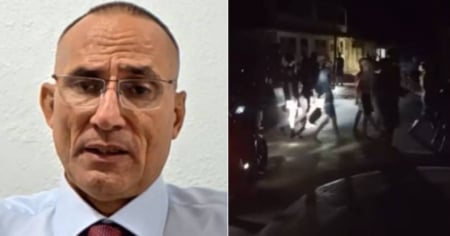
The Cuban opposition leader José Daniel Ferrer argued in an interview with CiberCuba that peaceful struggle remains a viable path to bring down the Cuban regime, although he acknowledged that a profound transformation in its execution is needed: more creativity, secrecy, and mass participation.
“I stated upon my arrival that it was not non-violence that had failed, but rather we who were failing those effective methods of struggle,” he affirmed.
For Ferrer, the strategy must adapt to the current repressive context, without abandoning the principles of non-violence, but using new tactics that evade repression and create a change in public opinion. "You have to change your strategy, you have to change the tactic. The non-violent struggle must now be clandestine", he explained.
During the conversation, the opposition figure drew historical parallels with figures such as Martí and Maceo, recalling that both independence leaders went into exile to prepare, from abroad, for their return to the struggle. “Even Maceo had to leave, and he spent almost 17 years in exile. And if Martí —and I am not comparing myself to Martí, God forbid I commit that sin!— was convincing them... that conditions needed to be created from exile and within to return, and they did return,” he recounted.
Ferrer explained that his personal transformation towards nonviolent resistance was gradual, influenced by reading Gandhi's philosophy and by the example of those who resisted without using force. “I ended up becoming a nonviolent fighter,” he said.
He also shared an anecdote about his father, who was a fighter in the July 26 Movement under the command of Hubert Matos, and who initially rejected his children's decision to resist without striking back. “My father told me that we could not be his children, that we were fools and something he didn’t say explicitly. Six months later, my father apologized and asked me why I wanted to learn,” he recalled.
He insisted that the peaceful struggle must be creative, able to adapt to the current conditions of repression. "Nonviolent struggle has to be super creative," he emphasized.
Among the actions proposed are flash protests with pots during blackouts, nighttime graffiti, distribution of printed propaganda by Cubans traveling from abroad, and symbolic gestures capable of provoking reflection and eliminating fear. “As I mentioned earlier, you can fill, streets, sidewalks, walls, barriers, the police sector, the police unit in the midst of the blackout with graffiti,” he suggested.
Ferrer even suggested that if a significant number of Cubans abroad distributed flyers during their trips to the island, it could create a real impact: “Can you imagine if we convince 30% of the people traveling to Cuba... to carry a certain amount of flyers made here in their luggage and they distribute them themselves while touring around Cuba?”
He also shared how political satire was used as a tool for raising awareness within UNPACU. "I bought a bottle of quality rum... I put a label of Cuba Decide on the good rum. And I put an image of Raúl Castro on the bad rum. I would say, 'Take a sip of this, what do you think?'... Everyone laughed," he recounted.
"With the collective effort of so many details carried out en masse throughout Cuba, the mood is created, the public sentiment that topples the dictatorship," he stated.
A forced exile and a new phase
Ferrer went into exile on October 13 following an agreement with the regime, although he reported that several conditions imposed by him were not met. Among them, the transfer of the UNPACU houses and the legalization of his wife's title.
"I told them I wouldn't leave if they didn't respect that. In the end, they took my house," he reported. The confiscated property was supposedly designated, according to the regime, for "social purposes," but Ferrer claimed it is now occupied by a relative of a lieutenant colonel from MININT.
A leaked video from State Security showed his departure from the country under strict surveillance. He only saw his family moments before boarding the flight at Santiago de Cuba airport. “I jokingly told them that I was going to name them Ministers of the Interior, because they looked different,” he commented about the officials who escorted him. The departure, according to his family, was a forced exile, not voluntary.
Commitment from Exile and Call for Unity
From Miami, Ferrer has demonstrated his unwavering commitment to actively participating in the opposition movement and contributing to the end of the dictatorship. In an interview with Telemundo 51, he acknowledged that “there is no cohesion, coordination, or discipline” within the Cuban opposition and urged for unity in their efforts. He also confirmed his involvement in the Council for Democratic Transition in Cuba and his commitment to collaborate with any serious and honest group working for the island's freedom.
During a press conference after his arrival in the U.S., Ferrer promised to return to Cuba "before the dictatorship falls." According to him, he will do so by boat, carrying a white rose and the verses of Martí. "I will take a satellite phone with me to say: 'I am arriving at the Malecón in Havana. If you don’t hear from me after that, I am either in jail or I have been murdered.'"
Ferrer also reported physical and psychological torture endured during his time in prison. "They inserted a tube into my mouth and forced me to ingest rotten food under threat. Lying on the floor, they made me defecate and poured almost a liter of putrid soup into me with a plastic funnel," he recounted.
Despite this, he assured that his commitment remains unchanged: “I left to reorganize the struggle, not to rest. I will return before the tyranny falls, even if it's just a week before, to see my people free.”
This Friday, Ferrer called for support of the protests that took place in Baire, Santiago de Cuba, where citizens took to the streets to denounce blackouts and repression, urging to amplify these demands: “Santiago de Cuba, tired of oppression and misery, takes to the streets to protest against the dictatorship. There, the historic Grito de Baire occurred on February 24, 1895. All of Cuba must amplify these cries for freedom.”
He warned that new arrests could occur and called for support for those facing reprisals. “There will be new political prisoners; they and their families will need all our support. Down with tyranny!” he stated.
Frequently Asked Questions about José Daniel Ferrer and His Fight Against the Cuban Regime
Why does José Daniel Ferrer advocate for nonviolent struggle to overthrow the Cuban regime?
José Daniel Ferrer asserts that nonviolent struggle remains an effective method for bringing down the Cuban regime, but it requires a transformation in its execution. He proposes creative, clandestine, and mass tactics to evade repression and change public opinion, drawing inspiration from historical figures like Gandhi.
What tactics does Ferrer propose for nonviolent struggle in Cuba?
Ferrer suggests actions such as flash protests, nighttime graffiti, and the distribution of printed propaganda by Cubans from abroad. These actions aim to create impact and provoke reflection among the population, removing fear and promoting social mobilization without resorting to violence.
Why was José Daniel Ferrer exiled from Cuba?
Ferrer was exiled from Cuba under pressure from the regime, after years of torture and confinement. The regime tried to portray it as a legal act, but Ferrer and his family describe it as a forced exile. Despite his departure, Ferrer remains committed to the fight for Cuba's freedom.
How does José Daniel Ferrer plan to return to Cuba?
Ferrer has promised to return to Cuba on a small boat, carrying with him a white rose and the verses of Martí. Although he has been exiled, his intention is to return before the dictatorship falls, reaffirming his determination to see a free Cuba.
What is Ferrer's commitment from exile?
From exile, Ferrer commits to remaining active in the opposition movement and in the Council for Democratic Transition in Cuba. He calls for the unity and coordination of Cubans both inside and outside the island to end the dictatorship as soon as possible, emphasizing the importance of cohesion and discipline within the opposition.
Filed under: