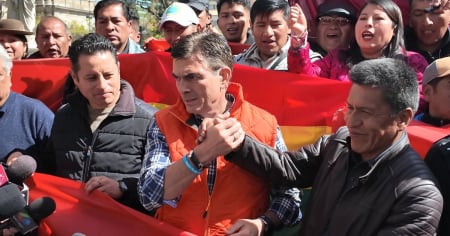
The elected president of Bolivia, Rodrigo Paz Pereira, confirmed that his government will not invite the rulers of Cuba, Venezuela, and Nicaragua to the inauguration ceremony scheduled for next November 8, marking a radical shift in the country's foreign policy after two decades of close ties with the regimes of the so-called 21st-century socialism.
In an exclusive interview with CNN, Paz was unequivocal in stating that his administration "will not introduce ideology, but rather solutions to the problems of the people."
The leader of the Christian Democratic Party (PDC) stated that his priority will be to rebuild the Bolivian economy and to open a new phase of cooperation with the United States and international organizations dedicated to the fight against drug trafficking and financial crimes.
Our relationship condition is based on democracy, Paz stated. None of those three are democratic [Cuba, Venezuela, and Nicaragua]. Clearly, they are not, and I would not want my country to be like any of those three, he said, referring to the governments of Miguel Díaz-Canel, Nicolás Maduro, and Daniel Ortega.
The elected president, son of former president Jaime Paz Zamora, stated that Bolivia will honor existing trade agreements with China, Russia, and Iran, but emphasized that his administration will pursue a pragmatic diplomacy focused on trade, investment, and job creation.
"I need people to eat, get moving, produce, and generate commerce. I am not going to introduce ideology; I am going to introduce solutions." he emphasized.
During the conversation with journalist Fernando del Rincón, Paz also confirmed his intention to reopen the United States embassy in La Paz, which has been closed since 2008 during the government of Evo Morales.
"Throughout the campaign, they asked me about it, and yes, we are going to open the embassy. And I want more commercial attachés than diplomats; I need people who will bring business to Bolivia," he declared.
The elected leader also announced that he will invite the DEA and other international institutions to collaborate in the fight against illegal activities, breaking away from the confrontational stance that characterized the governments of the Movement for Socialism (MAS).
Paz Pereira's diplomatic shift marks the end of Bolivia's alignment with Havana, Caracas, and Managua, and opens a new phase of relations with Washington and its regional allies.
His message is clear: Bolivia seeks to move beyond ideology and embrace economic pragmatism and democratic institutionalism.
Filed under: