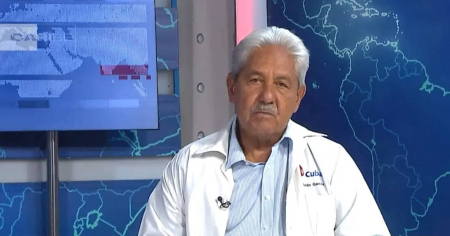
The Brazilian Ministry of Health reported on Thursday that the Mais Médicos health program, which has recently faced sanctions from the United States, currently has the participation of 2,659 Cuban doctors.
Created in 2013 to ensure healthcare in remote areas and peripheral neighborhoods, Mais Médicos integrates professionals from 55 countries.
Cuban nationals make up 10% of the 26,414 active doctors, of which 1,064 have revalidated their degrees in Brazil and 1,593 obtained their credentials abroad, although all practice under the same conditions as local professionals, reported the news agency EFE.
After Cuba, the countries with the most representation are Bolivia (188 doctors), Venezuela (82), Paraguay (55), Peru (42), Argentina (30), Colombia (27), Ecuador (13), Uruguay (12), and Haiti (12). The remaining participants (60%) are from Brazil.
The information comes to light following the sanctions announced by the U.S. Secretary of State, Marco Rubio, which include the revocation of visas for the current Minister of Health, Mozart Sales, and former official Alberto Kleiman, whom he accuses of facilitating the “export of coercive labor” through this program.
Rubio described the initiative as "an inconceivable diplomatic blow" and requested that doctors be paid directly, without the intervention of the Cuban government.
The Minister of Health of Brazil, Alexandre Padilha, rejected the sanctions and defended the program as a policy that "saves lives."
He recalled that, during its establishment under the government of Dilma Rousseff, the salaries of Cuban doctors were channeled through the Pan American Health Organization (PAHO), with the Havana government retaining part of the payment, but currently the professionals receive their full salary directly from the Brazilian government.
In 2018, the program faced a setback when then-President Jair Bolsonaro harshly criticized the hiring of Cuban doctors, leading to the withdrawal of around 8,000 professionals.
However, with the return of Luiz Inácio Lula da Silva to power in 2023, cooperation resumed, despite the shortage of doctors that the island itself is experiencing.
The Chancellor Bruno Rodríguez assured that Cuba will not renounce these missions, which currently employ over 24,000 workers in 56 countries, and defended them as "supportive" and "life-saving."
But the reality on the island is different. In 2023 alone, Cuba lost 13,303 doctors, according to the Statistical Yearbook on Public Health and Social Assistance, published by the National Office of Statistics and Information (ONEI).
The number of doctors in Cuba fell from 94,066 in 2022 to 80,763 in 2023, highlighting a concerning exodus of healthcare professionals.
This phenomenon affects healthcare on the island, where thousands of Cubans complain about the shortage of professionals and specialists available to assist them when they arrive at a hospital.
Frequently Asked Questions about the Mais Médicos Program and the Participation of Cuban Doctors
How many Cuban doctors participate in the Mais Médicos program in Brazil?
The Mais Médicos program in Brazil currently has 2,659 Cuban doctors. These professionals represent 10% of the 26,414 active doctors in the program, working on equal terms with their local colleagues.
Why has the United States imposed sanctions related to the Mais Médicos program?
The United States has imposed sanctions because it believes that the Mais Médicos program employs a scheme of forced labor with Cuban doctors. The sanctions include visa restrictions for Brazilian officials and those from the PAHO, accused of facilitating the "export of coercive labor" by the Cuban regime.
How does the Mais Médicos program affect Cuban doctors in terms of labor rights?
Cuban doctors have denounced restrictive working conditions and the retention of a significant portion of their salaries by the Cuban government. Testimonials from former collaborators and international organizations have described these conditions as forms of forced labor and labor exploitation.
What is the Cuban government's stance on medical missions abroad?
The Cuban government defends medical missions as "supportive" and "life-saving". Despite international sanctions and criticism, Cuba has stated that it will continue sending medical brigades abroad, viewing these missions as legitimate and necessary.
Filed under: