
Related videos:
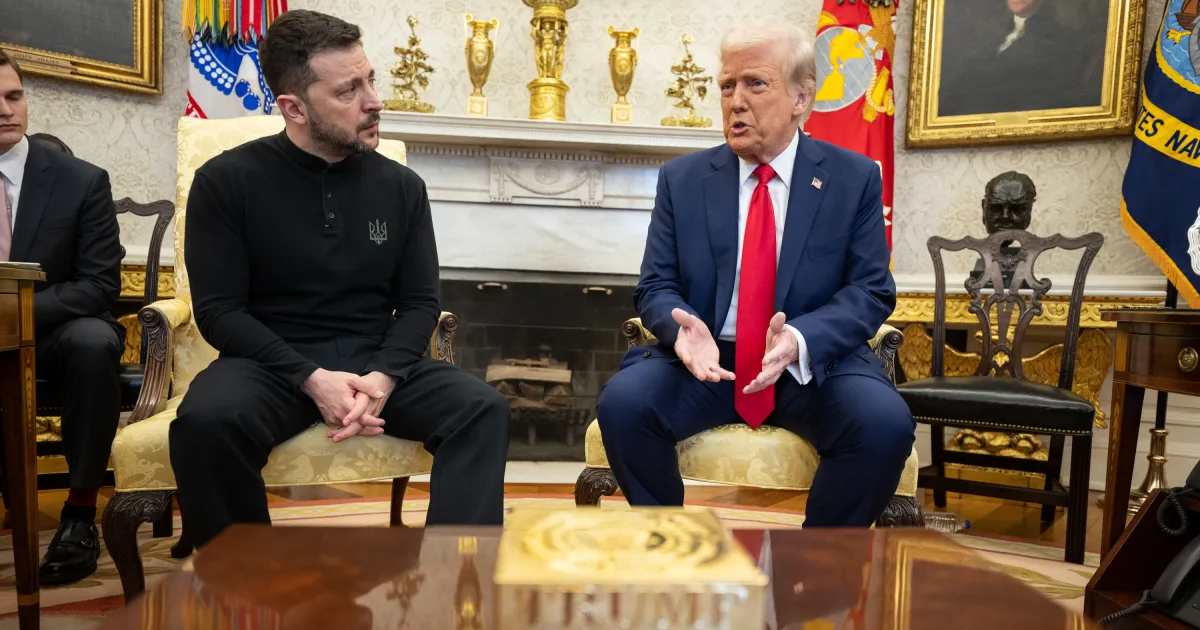
Donald Trump has once again shaken the international landscape following the tense and chaotic meeting with Volodimir Zelenski at the White House, where he urged the Ukrainian president to accept Vladimir Putin's terms to end the war.
According to information revealed by the Financial Times, the American president warned that the Kremlin leader had assured him that he would “destroy” Ukraine if he did not yield total control of Donbas.
European and American sources cited by the British newspaper described the meeting – held on Friday, October 17 – as a “shouting match,” with Trump “cursing all the time,” swatting away maps of the front and repeating Putin's own arguments.
At one point during the meeting, the U.S. president threw the intelligence documents on the table and exclaimed, "This red line... I don’t even know where it is. I've never been there."
Zelensky arrived in Washington with the hope of securing long-range Tomahawk missiles and a renewed commitment to military support. However, he left empty-handed and with the feeling that the White House has decisively shifted towards a position that favors the Kremlin's demands.
Trump not only denied the provision of weaponry but insisted that Kiev should "accept reality" and hand over the Donbas "to save what remains of the country."
Over the past year, Trump has maintained erratic rhetoric regarding the conflict, alternating between calculated empathy and strategic indifference.
He first blamed Kiev for the Russian invasion with statements like “you don’t start a war you can’t win” and claimed that Ukraine “could have avoided all of this with an early agreement with Putin.”
Shortly after, he dismissed the issue with a disdain that scandalized his European allies: "It's not my concern."
Between those statements and his later praise for the "strength" of the Russian economy, the American president has been signaling a discourse that seems to be shaped more by his interlocutor—Zelensky or Putin—than by a coherent foreign policy.
According to consulted European officials, Trump stated that the Russian economy "is doing very well," contradicting his recent claims that Moscow was on the verge of collapse.
His change in tone confirms the fluctuation in his discourse: just a few weeks ago, he stated on his Truth Social network that Ukraine "could regain all its territory," before calling for "both sides to stop where they are," effectively freezing the Russian occupation.
The meeting with Zelensky took place just after Putin proposed a new negotiation framework to Trump: Ukraine would cede the eastern regions of Donetsk and Luhansk in exchange for small areas of Kherson and Zaporizhia under Russian control.
Ukrainian government sources deemed the proposal "unacceptable" and warned that it violates the fundamental principles of International Law and legitimizes the occupation of territories that Moscow has been unable to fully conquer since 2022.
“El Donbas is not a bargaining chip; surrendering it without a fight would be a betrayal to our society,” said Oleksandr Merezhko, president of the Ukrainian Parliament's foreign affairs committee, who warned that Putin is trying to “destroy Ukraine from within by sowing division.”
Zelenski, por su parte, trató de mantener una postura diplomática tras el encuentro. “El presidente Trump quiere una victoria rápida, un fin de la guerra. Putin, en cambio, quiere la ocupación total de Ucrania”, declaró en Kiev.
Nevertheless, he acknowledged that the dialogue was "difficult" and that "Ukraine's position remains unchanged: we will not cede territory."
In statements to Fox News, Trump expressed confidence in reaching an agreement with Putin and suggested that the Russian leader "will take something, he has gained certain properties," which many interpreted as a tacit acceptance of a territorial concession.
The meeting with Zelensky once again highlighted Putin's growing influence over the discourse of the American president. According to European diplomatic sources, Trump has almost verbatim adopted the Kremlin's justifications: that the war is a "special operation" and that Ukraine cannot win.
The frustration among Western allies is palpable. "We expected Trump to bolster support for Kiev; now he seems determined to impose a peace tailored to Moscow," said a European diplomat quoted by the Financial Times.
Nevertheless, Zelenski chose to remain optimistic. “We have come closer to a possible end to the war,” he declared, although he acknowledged that there is no clear offer from Russia. “President Trump accomplished a lot in the Middle East and now wants to leverage that momentum to end this war. But Putin is not seeking peace; he aims to subjugate Ukraine.”
Meanwhile, in Kiev, analysts and parliamentarians interpret the meeting as a troubling sign: Putin's new ally is no longer in Moscow, but in the White House.
Filed under: