
Related videos:
The Cuban Electric Union (UNE) reported this Thursday that the impact caused by the event in the National Electric System (SEN) has been restored, which left a large part of the country without electricity for several hours in the morning.
16:35 hours. The disruption associated with the event has been restored, the entity reported on its official account on X (Twitter), confirming the resumption of service in much of the national territory.
Minutes earlier, the Ministry of Energy and Mines (MINEM) had stated that the SEN was “operating in a stable and sound manner,” with 60% of the affected circuits already restored and that the restoration process was still ongoing.
The incident, officially described as a "oscillation" of the system, caused widespread blackouts in several provinces and triggered a flood of criticism on social media due to the lack of clear information regarding the causes of the collapse.
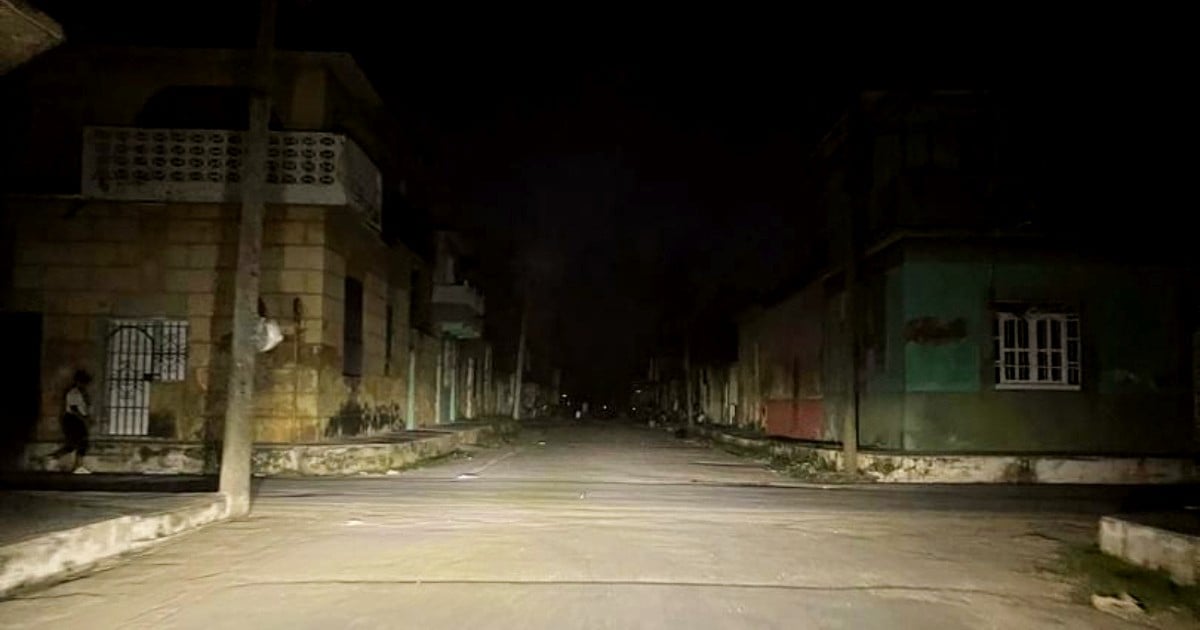
Since early this morning, Cubans reported widespread power outages in many areas of the country. The UNE acknowledged a "partial disconnection of the SEN," but its brief and ambiguous statement only increased the outrage.
"Leave it like that, since there's never electricity anyway," one user quipped. Another wrote: "They're already rehearsing before the cyclone hits."
The comments multiplied, reflecting the social fatigue and lack of trust in the energy authorities. “Oscillation of what and partial for whom… you have not a shred of shame,” posted one user, while another warned: “Now it’s partial, then it becomes complicated, and bam, three days without power.”
According to data released by UNE itself, the generation deficit reached 1,818 MW against a national demand of 2,526 MW, with only 1,550 MW available.
The main causes remain the lack of fuel, breakdowns in thermal power plants —including Felton, Mariel, Renté, and Santa Cruz— and the shutdown of more than 70 distributed generation units.
Power outages, which have become a daily reality for Cubans, impact both homes and hospitals, as well as businesses and industries. On social media, users conveyed feelings of exhaustion and resignation in the face of an energy crisis that shows no signs of improvement.
The system's collapse coincides with the approach of tropical storm Melissa, which is moving over central Caribbean with sustained winds of 85 km/h.
The Cuban Institute of Meteorology (INSMET) and the National Hurricane Center (NHC) warned that the phenomenon could intensify and lead to heavy rains and flooding in the eastern part of the country.
Amid the weather threat, the interruption of the SEN worsened the vulnerability situation, leaving thousands of homes without electricity just when they need it most to access information and communication services.
The lack of government transparency and the repeated message "the causes are being investigated" have eroded the credibility of the UNE and the Ministry of Energy.
"The fresh air messes up the SEN," joked one user, while another pointed out with irony that "the lights never go out in the leaders' circuit."
With the promise that "the system operates with stability," the government tries to project normality, but in Cuban households, the return of electricity is celebrated with caution: they know that, within hours, it could go off again.
Filed under: