
Related videos:
I read the text by Michel E. Torres Corona with the same mix of curiosity and disgust that one feels when watching a Cubans TV news broadcast: the words change, but the melody remains the same. A lot of blue, a lot of green, a lot of homeland and flag... and underneath, the same old litany: to resist, to endure, to suffer with pride.
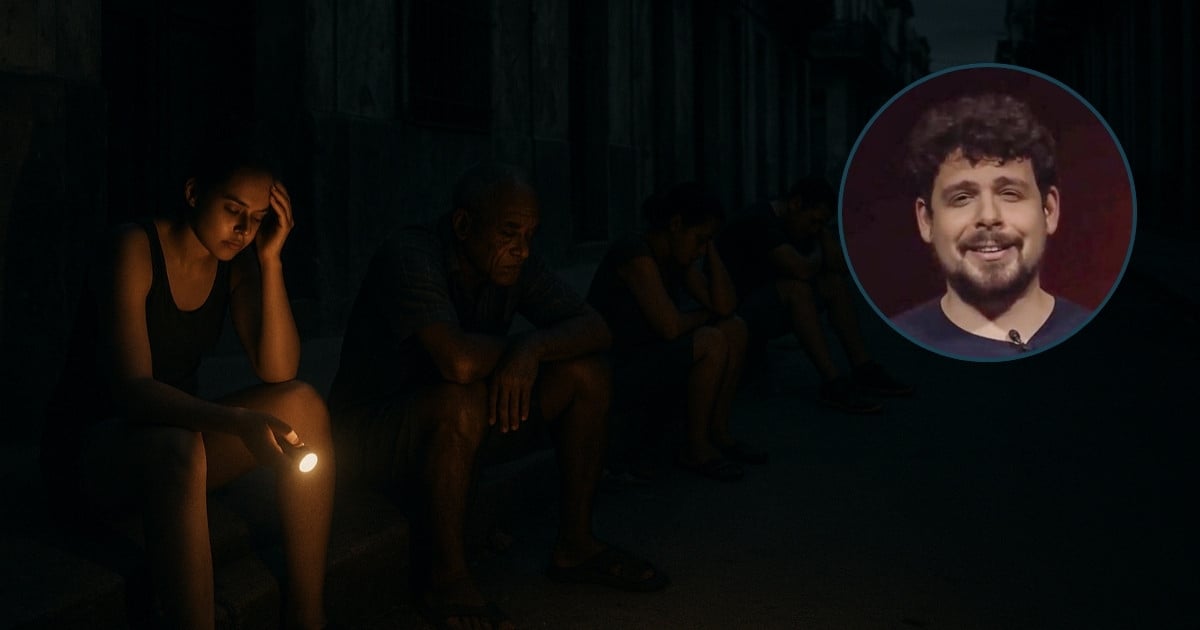
Yes, it may sound nice. It is a well-written text, full of imagery, referencing Martí, Benedetti, and culture. But in reality, it merely beautifies misery with poetry. It disguises resignation as virtue. It speaks of the blackout as if it were a heroic act, when in truth it is a daily condemnation.
Cuba doesn't need more verses about blackouts; it needs light, food, and freedom.
Those of us who are outside did not leave out of cowardice. We left because in Cuba there are only two options: misery or exile. And I say this with the weight of someone who understands the cost of that decision. We left at an enormous cost—familial, emotional, economic. There is nothing heroic about starting over, about not having your loved ones with you, about knowing that your children will speak another language and love another land.
My family and lifelong friends are now in Miami, New York, Madrid, Asturias, London, etc. No one is where they used to be. When I talk to them on the phone, it feels like centuries separate us, not kilometers.
That is not betrayal to the homeland; it is an open wound. And it hurts because they caused it: the Castros, their regime, and those, like Torres Corona, who defend it and try to make us believe that poverty is purity, that blackout is dignity, that imposed sacrifice is virtue.
The text by Torres Corona conceals a toxic idea: that those who stay are more Cuban than those who leave. That the emigrants "renounce" and "will not be happy" because we are not "a grain of that sand." That is a lie. Staying does not make you more Cuban, and leaving does not make you a coward.
Martí wrote: "There is no spectacle, truly more odious, than that of servile talents." And we are witnessing exactly that, an "intellectual" using his talent to justify power. To turn the scarcity into poetry, to convert the blackout into a symbol, while millions of Cubans live the real darkness of despair.
Being Cuban is not a postal address; it is a way of feeling, a shared memory. It is continuing to call the supermarket “the bodega,” or looking at the sea with the same mix of nostalgia and anger. I am still Cuban even though I live in Valencia and my children are Spanish. And neither the language nor the distance can take that away from me, much less a bureaucrat with a poetic pen.
Staying does not make you more Cuban, and leaving does not make you a coward.
Continuing with Martí: “Tyranny is the same in its various forms, even if some of them are cloaked in beautiful names and great deeds.” This is precisely what Torres Corona's text does: it dresses tyranny in beautiful words. It speaks of culture, duty, and homeland, but what it is actually defending is the continuity of a system that oppresses, censors, and impoverishes.
Martí also wrote: “When a people emigrates, their rulers are unnecessary.” And therein lies the truth that the regime cannot bear: the Cuban exodus is not just an escape, it is a continuous critique and condemnation of the system. Every Cuban who leaves is a living testament to the regime's failure. And every Cuban who survives abroad, who works, who raises free children, who continues to say “asere” or “my brother,” is proof that the homeland is not in the territory, but in dignity.
Happiness is not found in enduring, but in living independently. Martí made it clear: “The general happiness of a people rests on the individual independence of its inhabitants.” That’s why we who left will be no less happy. We are the ones who chose to live without a master, without fear, without slogans. We love Cuba, but not its executioners.
I do not renounce my country. I renounce the regime that has sunk it and the "poets" who justify it.
Cuba doesn't need more verses about power outages. Cuba needs light.
Filed under:
Opinion article: Las declaraciones y opiniones expresadas en este artículo son de exclusiva responsabilidad de su autor y no representan necesariamente el punto de vista de CiberCuba.