
Related videos:
The U.S. State Department accused the Cuban regime on Thursday of structural corruption and of hiding billions of dollars in secret accounts, while the population faces the worst economic crisis in three decades.
Through the official account of the Office of Western Hemisphere Affairs, Washington directly held the elites of the Communist Party of Cuba (PCC) and the military apparatus responsible for the impoverishment of the island.
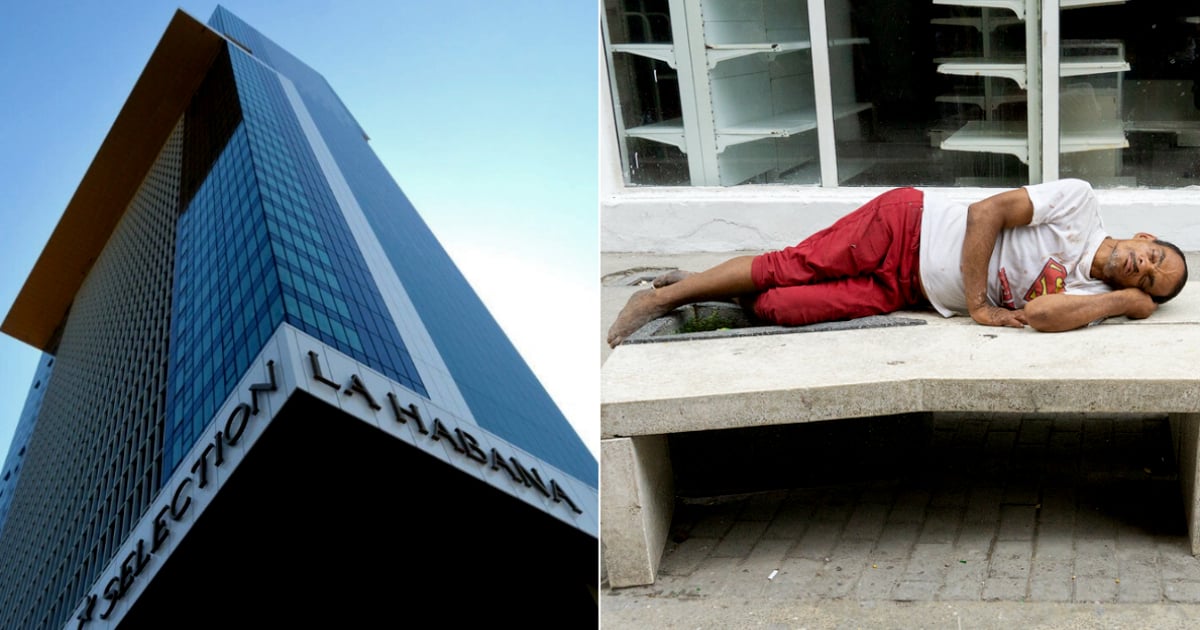
“The elites of the Cuban regime are hoarding billions in secret accounts while Cuban families are facing shortages of food, water, and electricity. This is not a blockade: it is a corrupt regime that robs its own people. Countries should not be complicit in the regime's corruption. Silence and indifference are complicity,” stated the Office on X (formerly Twitter).
The message comes after an investigation by the Miami Herald revealed at the beginning of August that the military conglomerate GAESA (Grupo de Administración Empresarial S.A.) controls over $18 billion in liquid assets, making this entity “the secret bank of the Cuban military power.”
GAESA: The Hidden Bank of Castroism
According to the documents leaked to the American media, GAESA —a network of about 25 companies controlled by the Revolutionary Armed Forces— manages strategic sectors such as tourism, remittances, retail, and logistics.
Among its subsidiaries are Gaviota, CIMEX, TRD Caribe, and Almacenes Universales, all of which operate with millions in foreign currency.
The internal documents for the years 2023 and 2024 revealed that GAESA accumulated deposits of 14.467 billion dollars in international banks, equivalent to 76% of its total liquidity.
In addition, the entity receives direct subsidies from the state budget—more than 9,000 million Cuban pesos in 2024—but does not pay taxes in foreign currency.
According to Cuban economist Pavel Vidal, who reviewed the balances at the request of the Miami Herald, GAESA operates as a "parallel central bank," accumulating foreign exchange reserves while other state-owned enterprises are struggling.
Meanwhile, the regime continues to blame the U.S. embargo for the shortages, despite having sufficient funds to stabilize the electrical system or restock hospitals and pharmacies.
According to activists' calculations, only 293 million dollars would be enough to cover both goals for one year — 43 million for essential medicines and 250 million for the electrical system — a minimal amount compared to the 18 billion withheld by the military conglomerate.
Institutional corruption and extreme inequality
The State Department has repeatedly pointed to GAESA as "the financial backbone of the Cuban regime," a conglomerate that operates outside of civil scrutiny and whose wealth stands in stark contrast to the widespread poverty in the country.
A recent report from the Office of Western Hemisphere Affairs highlighted that the Cuban government allocates more than 37% of its investment to hotel construction, eleven times more than to the combined sectors of health and education.
The journalistic investigation from August confirmed that even with empty hotels and a plummeting tourism industry, GAESA continued to expand its tourism infrastructure, prioritizing currency control over citizen welfare.
The activist Carolina Barrero described these revelations as "the definitive proof of the regime's hypocrisy":
"The Castro tyranny, owner of GAESA, pretends to be a victim of the embargo before the world when it is the predator. It demands resistance while draining us of our last drop of blood."
Washington: "The problem is not the embargo, it's the looting."
Washington's indictment reinforces the narrative that the State Department has maintained in recent months: the Cuban crisis is not a result of external sanctions, but of internal corruption and a lack of transparency.
In its July warning to foreign investors, the U.S. government characterized the Cuban economic environment as "rigged to benefit the regime and its associates," cautioning that any business dealings with military or state-owned enterprises pose the risk of financing human rights violations.
The new revelations about GAESA confirm those warnings.
While the regime demands an end to the "blockade," its generals and high-ranking government officials manage fortunes greater than the international reserves of Panama or Uruguay, and maintain multimillion-dollar accounts abroad, with no oversight, audit, or social benefit.
The tweet from the Office of Western Hemisphere Affairs, in this context, was not an isolated reaction but a direct political response to the regime's propaganda campaign ahead of the United Nations vote.
Your message summarizes the U.S. position: “There is no blockade, there is kleptocracy”.
Filed under: