
Related videos:
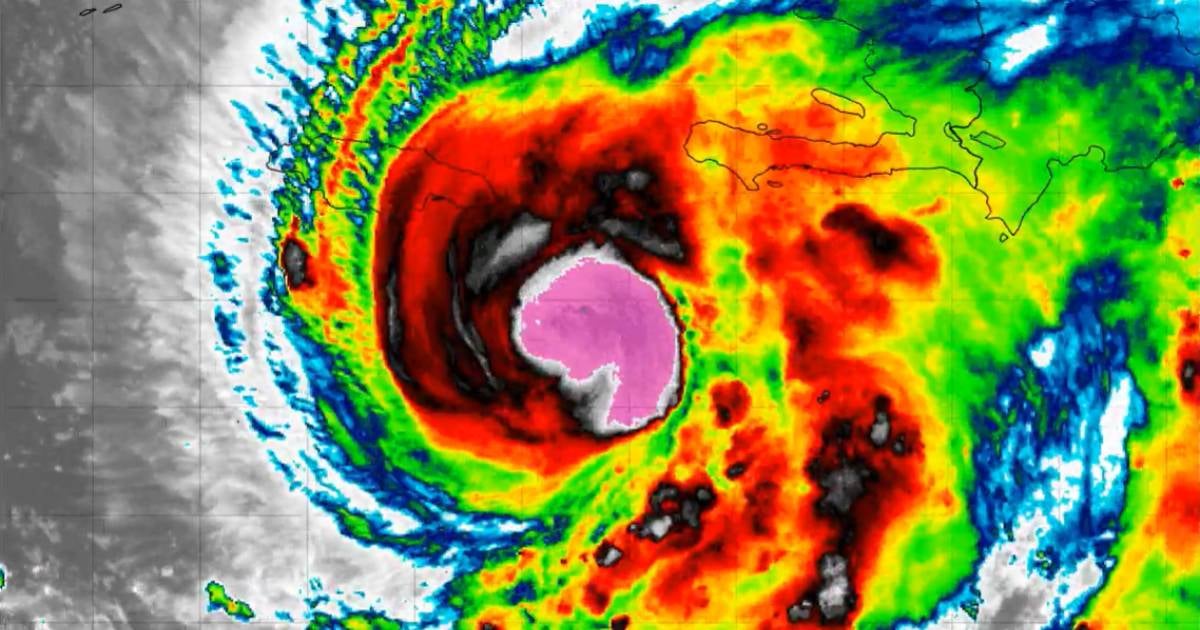
The hurricane Melissa continues to gain strength in the central Caribbean and has now reached maximum sustained winds of 155 km/h, according to the latest update from the National Hurricane Center (NHC) of the United States.
The agency reported that the cyclone is located about 210 kilometers southeast of Kingston, Jamaica, and could develop into a major hurricane (Category 3 or higher) in the coming hours.
Melissa is moving slowly westward at a speed of only 6 km/h, a condition that worsens the risks of prolonged flooding and landslides in the mountainous and coastal areas of Jamaica and southern Haiti.
The NHC warned that the phenomenon will cause torrential rains of up to 1,000 millimeters in some areas, swells between 9 and 13 feet, and destructive winds that could persist over Jamaica for several days.
"Melissa is rapidly strengthening. It poses a serious threat and could be a catastrophic event for Jamaica and the southern part of Hispaniola," stated the Miami-based meteorological center.
Rubiera: "A danger for the eastern part of Cuba"
The Cuban meteorologist José Rubiera warned this Saturday that the hurricane shows clear signs of internal organization and that the sea conditions in the region —with ocean temperatures of up to 31 °C and a warm layer over 100 meters deep— favor a rapid intensification of the system.
“Melissa is now a hurricane, and in a few hours it could become one of great intensity. Although it is not completely vertical yet, it will be very soon. It poses a danger to the eastern part of Cuba,” warned Rubiera on his YouTube RubieraTiempo channel.
The specialist located the center of the system approximately 200 kilometers southeast of Kingston and emphasized that the immediate greatest risk is the extreme rain affecting the south of the Dominican Republic and Haiti, where severe flooding, mass evacuations, and at least four fatalities have already been reported, according to international media outlets.
Rubiera also noted that the hurricane could approach the eastern part of Cuba between Tuesday and Wednesday, bringing intense winds, torrential rains, and dangerous swells to provinces such as Santiago de Cuba, Guantánamo, and Holguín.
"The hurricane should not be viewed as a single point. Its effects cover a very wide area, and the impacts could be felt even before the arrival of the center," the expert urged, asking to follow the information "step by step."
Jamaica and Hispaniola, under threat
Meanwhile, Jamaica is bracing for the direct impact of Melissa with hurricane alerts across the territory. Authorities have urged the population to seek safe shelter in the face of what they describe as “an unprecedented threat.”
In the Dominican Republic, the rains on Friday and Saturday turned the streets of Herrera and San Cristóbal into rivers, leaving vehicles trapped and families displaced.
More than a thousand people have been evacuated and 12 provinces remain under maximum alert due to the risk of new flash floods.
"The slow movement of Melissa exacerbates the risks, as rain accumulates over the same regions for days," explained meteorologist Chris Dolce to CNN Weather, warning that the cyclone could reach category 4 in the next 48 hours.
The Caribbean, once again in the eye of the storm
Melissa is the thirteenth named system of the 2025 Atlantic hurricane season, which has been particularly active.
According to NOAA, the warming of ocean waters and the slowing of tropical cyclones are intensifying the duration and severity of rainfall across the Caribbean basin.
As the hurricane continues its advance, the Caribbean looks up at the sky with concern once again.
In Cuba, many remember other devastating cyclones that have marked recent history, and now they watch with anxiety as Melissa approaches, a phenomenon that—beyond meteorology—puts the resilience of Caribbean peoples to the test once again in the face of increasingly extreme weather.
Filed under: