
Related videos:
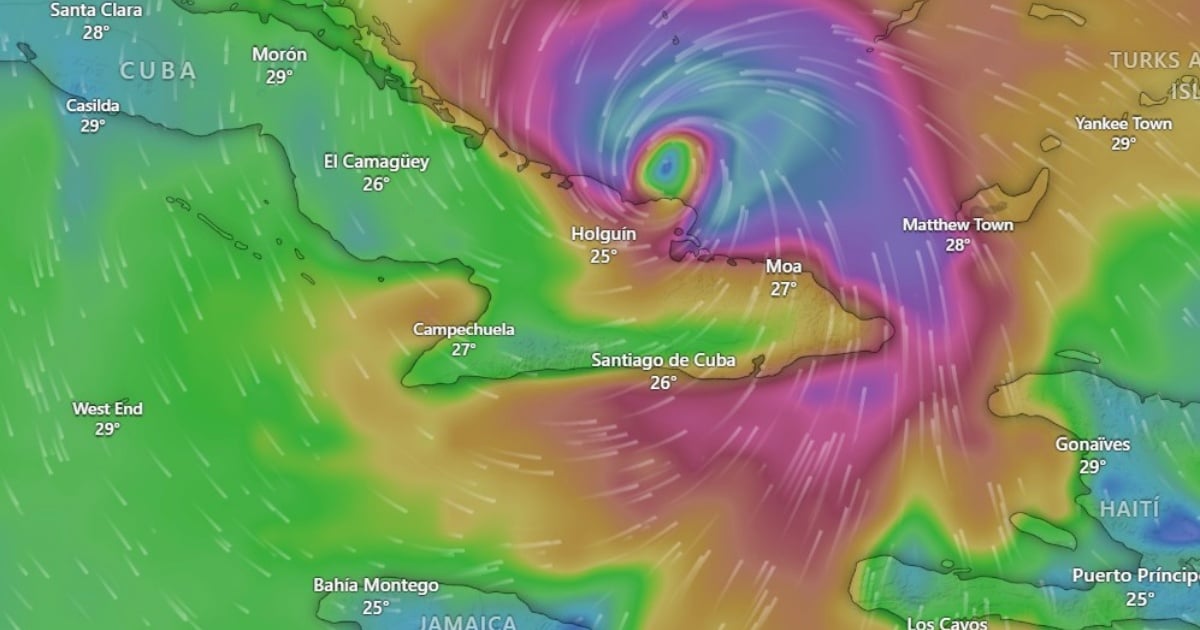
After crossing the eastern region of Cuba with destructive force, Hurricane Melissa begins to move away from the national territory, leaving behind a trail of flooding, damaged homes, and isolated communities.
On the morning of this Wednesday, the Institute of Meteorology of Cuba (INSMET) confirmed in its Tropical Cyclone Warning No. 25 that Hurricane Melissa "is beginning to leave the national territory", moving out to sea near Banes, in the province of Holguín.
The trajectory of the phenomenon led it to move over that province in recent hours, after having made a strong impact since entering from the southeastern part of the country, specifically through the province of Santiago de Cuba.
Northeast movement and active surveillance
At 9:00 a.m. (local time), Melissa's center was located by Cuban radars at 20.7 degrees North latitude and 75.4 degrees West longitude, approximately 45 kilometers southeast of Banes.
Its movement to the north-northeast at 22 km/h is taking it away from Cuba, but its bands of rain are still affecting the eastern part of the country.
The U.S. National Hurricane Center (NHC) also confirmed the departure of Hurricane Melissa out to sea.
Impact in Holguín: intense rains and devastating winds
Melissa's passage through Holguín brought intense rains and hurricane-force winds that struck communities such as Cueto, Mayarí, and Banes, where a momentary calm was reported as they found themselves in the center of the hurricane.
However, the consequences were severe: rainfall accumulations of up to 335.2 millimeters at the Meteorological Center of Holguín and 268.4 millimeters in Guaro, also in Holguín, according to notification number 25 from INSMET.
These figures greatly exceed normal averages and have caused sudden flooding, overflowing rivers, and dangerous rises, especially in mountainous areas, where an additional accumulation of between 200 and 350 millimeters is still expected in the next 24 hours.
Hurricane-force winds and extreme wave conditions
Melissa, which previously reached category 3, has fallen to category 2 on the Saffir-Simpson scale, with maximum sustained winds of 165 km/h and gusts higher, after interacting with the Sierra Maestra mountain range.
This interaction also caused an increase in the system's central pressure to 968 hectoPascals, a sign of progressive weakening.
Nevertheless, the hurricane maintained its threat as it passed over land.
Wind gusts of up to 126 km/h were reported in Guaro, and 110 km/h in Puerto Padre, Las Tunas province, as confirmed by INSMET.
These winds, combined with the strong waves, have caused serious damage along the coastlines.
"There will be strong swells on both eastern coasts, as well as on the northern coast of Camagüey, with waves between 4.0 and 6.0 meters, reaching up to 7.0 meters on the northern coast of Holguín and Las Tunas," warns the Institute.
Authorities also warned of moderate to severe flooding in low-lying areas, which could persist even after the system has moved away, due to soil saturation and coastal surges.
INSMET is maintaining "close monitoring of the evolution and future trajectory of this highly intense hurricane," considering the possibility of new indirect impacts or a reactivation of the system's external circulation.
Preliminary damage assessment
Although official figures regarding material and human damages have not yet been released, reports from the ground confirm flooded homes, torn-off roofs, devastated crops, and roads blocked by fallen trees and poles.
The provinces most affected, especially Santiago de Cuba, Holguín, Las Tunas, and Granma, are now facing a complex recovery phase.
Civil defense organizations are engaged in evacuation efforts, damage assessment, and the restoration of basic services, while the country remains vigilant regarding the meteorological developments.
Filed under: