
Related videos:
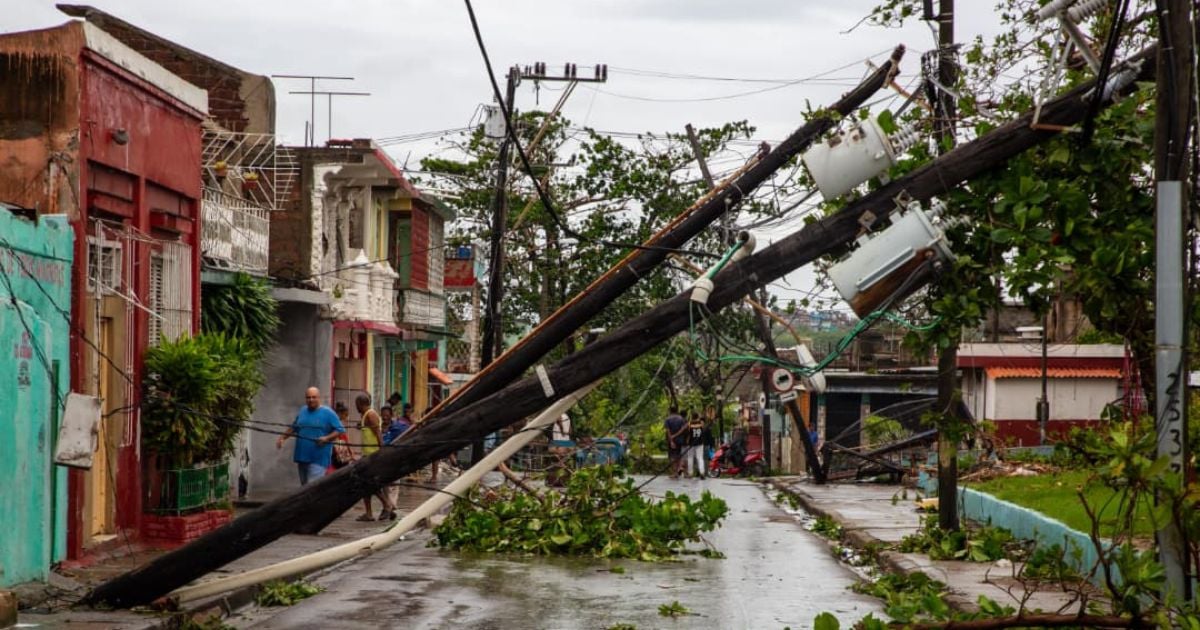
The passage of Hurricane Melissa caused severe damage to the telecommunications network in eastern Cuba, where over 40% of landline services remain disrupted, according to the state-owned company ETECSA.
On its official Facebook account, the entity that controls the telecommunications monopoly in Cuba highlighted that, in Las Tunas, 25% of landlines remain out of service, while in Holguín the disruption reaches 23%.
In Granma, the impact reaches 49%, with fiber optic cuts leaving municipalities such as Yara, Campechuela, Pilón, Niquero, Bartolomé Masó, and Media Luna without communication.
45% of the lines remain down in Santiago de Cuba, as well as in Guantánamo, where the interruption of the two fiber optic cables only allowed for partial communication restoration through radio link.
With a closure at 7:00 PM, the report highlighted that the situation is even more critical in the mobile network, with damages exceeding 70% in some provinces.
Granma reports that 88% of the radio base stations are out of service, with Santiago at 87%, Guantánamo at 85%, Holguín at 73%, and Las Tunas at 59%.
The company attributed most of the interruptions to power outages, which prevent the operation of transmission equipment and cabinets.
ETECSA acknowledged that the conditions of the terrain — swollen rivers and blocked roads — complicate the assessment of the damage.
According to the company, technical brigades have been sent from other provinces to support the restoration of services.
On its part, the official newspaper Granma reported that Hurricane Melissa impacted telecommunications supports through fiber optics and electricity, stated Mayra Arevich Marín, Minister of Communications. Damages included 31.4% of landline connections and 75.21% of mobile connections.
Some RadioCuba towers were also affected, and repair work will begin when ground conditions allow. However, the minister explained that the main cause of the interruptions is linked to the damage to the electrical service, and she specified that "when one improves, so will the other."
Arevich added that the diagnosis of poles, cables, and downspouts is still pending before moving on to the recovery phase, although several teams are already working on network cleanup. "If residents can collect these resources, they should preserve them," he urged.
He indicated that some fiber optics run through bridges and were affected by wind speed and water. In Guantánamo, a tense situation arose when the province became isolated after the failure of its two main connection routes: one via Moa, Baracoa, and La Mulata, and another from Santiago, which was submerged due to rising river waters. Currently, there is only landline service available with 19 operational radio bases, designated for voice service.
In the province of Granma, the fiber was damaged between Manzanillo, Yara, Campechuela, Media Luna, and Pilón, as well as another in Buey Arriba, which has already been resolved. “If we manage to restore Yara, we will be able to reach Pilón,” the minister explained.
Arevich Marín added that in the municipalities of Segundo and Tercer Frente, in Santiago de Cuba, the brigades are facing areas separated by rivers, although they are working to reconnect the affected municipalities. The construction, communication, and electrical brigades will work together to prevent further damage to the infrastructure and to expedite recovery efforts.
It was also reported that information nodes have been created in the communities, and coordination is in place with amateur radio operators and defense areas, where communication exercises using new technologies are being conducted. "We will fulfill the mission of establishing communication," he stated.
Filed under: