
Related videos:
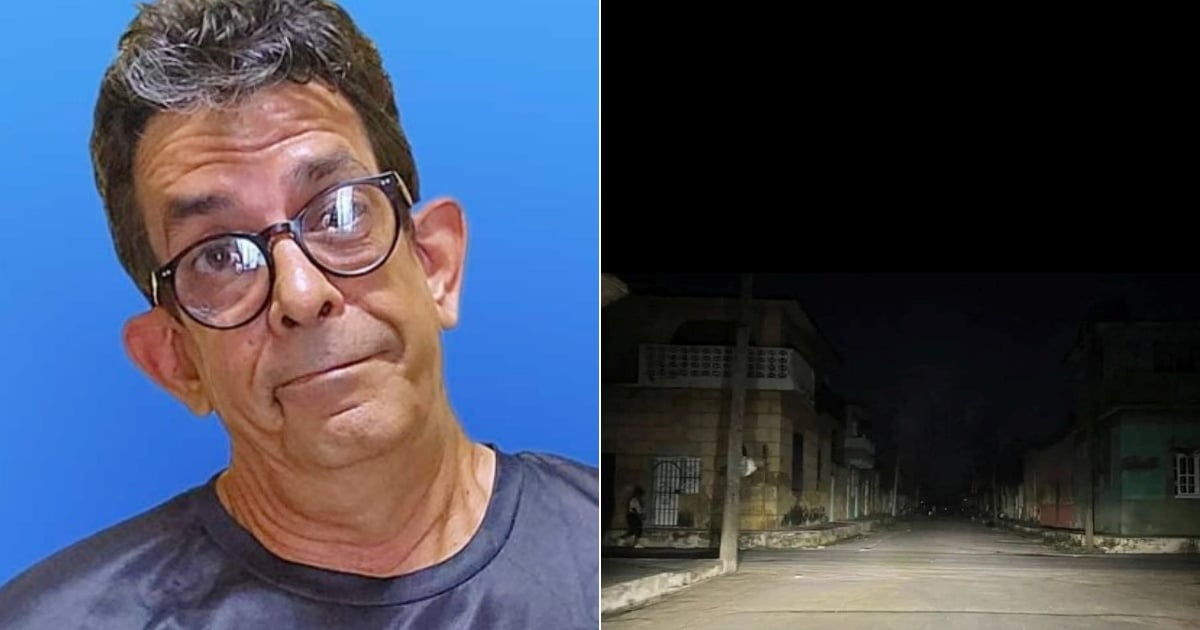
The renowned comedian Ulises Toirac has published a text that, rather than an opinion, sounds like a warning.
In the midst of the prolonged power outages that have defined the Cuban summer, Toirac described the situation in the country as "a knife to walk on", and warned that social exhaustion has reached a dangerous point.
“The logical thing is not that I endure. The simply human thing is that I explode”, he wrote in a lengthy reflection on Facebook where he combined his usual irony with a portrait of the despair that overwhelms an entire country.
From humor to warning
Toirac did not speak out of anger, but from the clarity of someone who has spent years observing how the country is dimming, and from the perspective that is also informed by his degree in electrical engineering.
"Months before summer, observing what was happening and applying a merchant's logic... I predicted a tough summer regarding the electricity situation," he recalled.
He insists that it was not a prophecy, but a simple calculation: “In that field, 2+2=4. Neither four point two, nor three point eight.”
With that phrase, the comedian made it clear that power outages are neither a surprise nor a fatality, but rather the predictable result of an obsolete and poorly maintained system.
“The system doesn’t need much ‘cranking’ to misbehave because it’s been around since the stone age and doesn’t receive the maintenance outlined in the manual,” she wrote in her usual sarcastic tone.
What began as an observation about the SEN (National Electro-Energetic System) turned into a political diagnosis: Cuba operates like its electrical grid, characterized by patches, improvisations, and accumulated breakdowns.
"People see mosquitoes and spoiled food."
Toirac explained that Cubans no longer listen to justifications or accept technical explanations.
"People don't see the processes or the decisions, nor the blockade or embargo, nor whether the oil comes from Timbuktu or is trading high in New York. People see mosquitoes and spoiled food," he asserted.
That description, as graphic as it is real, shows how the energy crisis has shifted from a technical level to a human one. People feel the blackouts in their bodies: in the stifling heat, in the disrupted sleep, in the milk that spoils, or in the chicken that rots.
"And they also see that instead of improving, things are getting worse. Obviously, they are not subnormal," he added, in a message directed both at the authorities and at those who underestimate the people's exhaustion.
The comedian, who often addresses issues with irony, this time left little room for jokes. His tone is serious and his outlook pessimistic. The current is not only absent in homes: it is lacking in the collective morality.
In his analysis, Toirac accurately describes the fragility of the electrical system: “The combination of low fuel levels and outdated facilities is a razor's edge to walk on because it forces overoperation.”
Each blackout, he explains, is not just a power cut but an assault on the system itself.
"Every time a circuit is closed and another is opened, mundane phenomena that destabilize the system occur," he noted from a technical standpoint.
That "overoperation" repeats itself on a societal scale: the entire country lives in a forced, exhausted state, improvising to survive.
Despite the expertise and hours of work of those who earn their living in that situation, a total collapse could not be avoided,” he acknowledged, emphasizing that individual ability alone is no longer sufficient to sustain a structurally broken system.
"What is human is to burst."
But it is in his final warning where Toirac reaches the rawest tone. After reviewing the lack of fuel, the deterioration of the facilities, and the system overload, the comedian highlights the aspect that hurts the most: the people.
"The jaw does not kill mosquitoes nor does it preserve the few foods that cost a fortune to the average Cuban,” he stated, making it clear that political rhetoric no longer eases hunger or frustration.
Nationally, the comedian warned that "Havana does not behave like a province", and pointed out "it is a bit more explosive than the rest."
With that warning, he suggested that the capital, where power outages are experienced as an affront, could become the epicenter of social unrest.
"What makes sense is not that I endure. What is simply human is that I explode", he concluded, warning that no people can live forever in darkness, neither literally nor symbolically.
In Toirac's text, the National Electroenergy System serves as a metaphor for the country: old, inefficient, patched up, reliant on individual effort, and doomed by a lack of investment and transparency. There is a prevailing sense that, regardless of the cause, everything continues to deteriorate.
The entire country walks on that "knife" mentioned by the comedian, and each blackout brings us one step closer to the edge.
The greater the crisis, the greater the repression
Ulises Toirac's words arrive at a time of rising social tension.
In recent days, the ruler Miguel Díaz-Canel has publicly warned that the Government “will take measures” against those who protest or block streets in Havana.
"The demands of the population are legitimate, but they must be made in the established places: at the Party, in government institutions, and at the State level. No one is authorized to block a public road... measures will be taken in this regard. Public disorder is unacceptable," he stated during a follow-up meeting on the basic services crisis.
The message, issued after several days of power outages, water shortages, and mountains of garbage in the Havana neighborhoods, marks a repressive shift in response to the increasing public discontent.
Díaz-Canel acknowledged that the problems are "significant" and that "they cannot be resolved over a weekend," but he insisted on control before finding solutions: he ordered inspections of non-state sector establishments to verify compliance with electricity consumption plans and warned that "any place that fails to comply with its plan will be closed."
The official discourse criminalizes protest—an outlet in a context of shortages—and shifts the focus away from the underlying issues: prolonged blackouts, the intermittent supply of water, and the accumulation of waste.
Alongside his warning, Díaz-Canel led an extraordinary meeting of the Provincial Committee of the Communist Party in Havana, accompanied by ministers, military leaders, and senior members of the Political Bureau.
There, he announced the integration of mixed teams with officials and mass organizations to "directly address" neighborhood demands, but he also mobilized troops from the Revolutionary Armed Forces (FAR) and the Ministry of the Interior (MININT), reinforcing military presence in crisis management.
The warning from Toirac and Díaz-Canel’s reaction together portray a country on the edge: a population worn out by blackouts and a Government that responds to desperation with threats.
Filed under: