
Related videos:
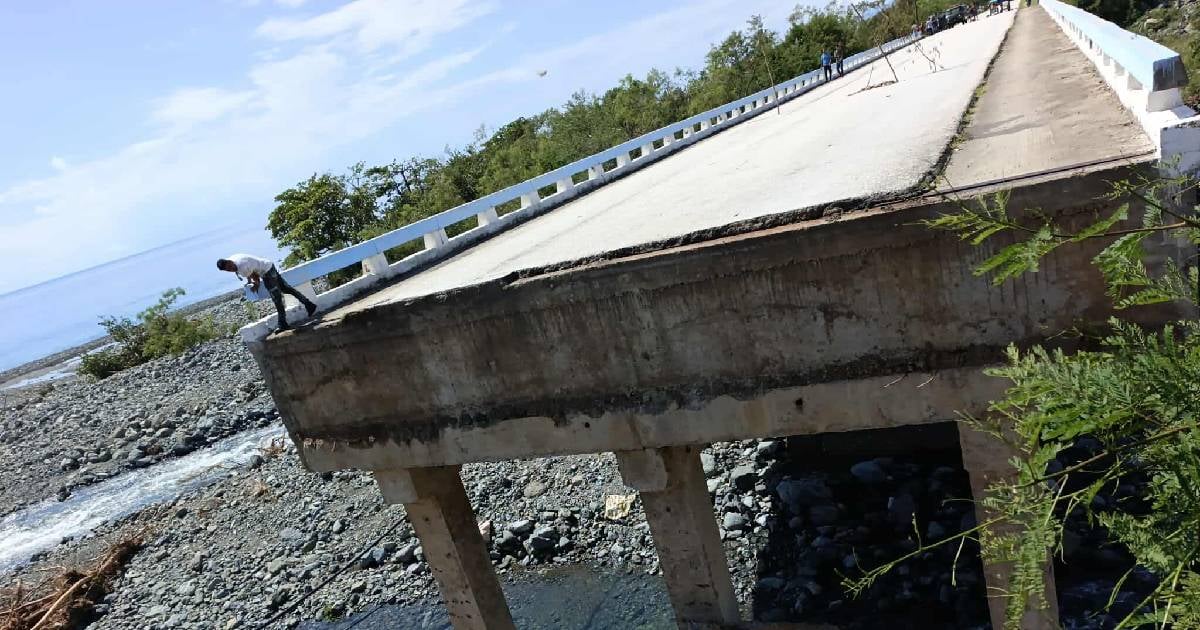
The communities of El Uvero, La Plata, Ocujal, and Palmamocha remain cut off following the passage of Hurricane Melissa, which destroyed roads and caused the collapse of the El Uvero bridge, according to the president of the Provincial Defense Council of Santiago de Cuba, Beatriz Johnson Urrutia.
Through her Facebook account, the official reported that coordinators from the Communist Party of Cuba (PCC) and the provincial government remain in the most affected communities, while amateur radio operators support communication efforts and organize actions to restore access.
Boca de Dos Ríos emerged as one of the hardest-hit areas, with complete collapses due to sea incursions. Severe damage is also reported in Cañizo and Caletón, he noted.
According to the official report, almost all individuals at risk have been evacuated, with no human losses. Electricity and communications are severely affected, and crews are working on tree trimming and clearing roads. There is partial access from Chivirico to Santiago.
The authorities also indicated that pregnant women, the elderly, and nephrotic patients were safeguarded prior to the event.
In this regard, they specified that 15 hemodialysis patients were transferred to hospitals with electrical backup, and 33 elderly individuals were evacuated to the Giraldo Aponte polyclinic.
Criticism and citizen discontent
The official statements sparked a wave of outrage among the residents and émigrés from Santiago, who denounce neglect, slow responses, and information manipulation.
"Thank you very much for your information, but don't you think it's a bit outdated?" wrote Niky Fajardo, who stated that it was private individuals—not the government—who managed to reach the isolated areas.
Other comments, like the one from Rachel GD, express frustration over the power outages and lack of communication: “How much longer will people in the East be without communication, unable to make calls even on their cell phones?”
The tone of the criticisms grew harsher with messages like that of Erike Oliva, who mocked the traditional and propagandistic official calls for resistance: “Force Santiago? Will we move forward? Really? Is that it!".
Neighbors like Yanelis Hechavarría and Lara Segura Ferrer lamented that the information arrived four days late and with images that were already circulating on social media. “They should be ashamed... None of them care about what happened in Guamá,” wrote Segura, accusing the authorities of acting only after seeing photos online.
Norlin Pérez also expressed regret over the lack of communication with his relatives: “It has been four days since the hurricane hit, and the only picture that shows is of the bridge. Guamá is extremely long, and we haven't heard anything about our families.”
Similar messages were repeated throughout the day on social media. Yaritza Palay described the official statement as a "lie" and demanded accountability.
Meanwhile, Enelida Tamayo reported that it was "motorcyclists risking their lives" who brought news and assistance to the isolated communities. "How long will this indifference continue? The martyrs of this country did not die for things like this to happen after so many years of revolution," she lamented.
Four days after the impact of Melissa, the population is demanding transparency, institutional presence, and immediate actions to restore communication and basic supplies in the municipality of Guamá, the first to directly experience the destructive force of Melissa.
The meteor, which struck the island as a category 3 on the Saffir-Simpson scale, hit in the early hours of Wednesday with winds of up to 200 kilometers per hour, intense rain, and storm surges that swept away entire communities.
The weather phenomenon caused at least 1,318 total house collapses, according to a preliminary report from the Ministry of Construction.
In addition to the total collapses, 16,464 homes were affected, of which 1,142 have partial damage. Regarding the roofs, 5,279 were completely lost and another 8,666 suffered partial destruction.
On Friday, images shared by journalist Luis de Jesús depicted a scene of destruction in Guamá, with homes demolished, uprooted trees, and roads blocked by tons of debris.
Melissa devastated Cayo Granma, the small islet at the entrance of the Santiago de Cuba bay, leaving numerous families homeless and without resources, as reflected in the testimony of young Alejandro, better known as Toti, who showed the rubble where his house once stood, amidst wet mattresses, collapsed walls, and the despair of having no food or medicine for his family.
It also happened in the Santiago neighborhood of Altamira, where many homes remain completely flooded, leaving humble individuals with the little they had either floating or buried in the mud.
A resident of the Chicharrones neighborhood, in Veguita de Galo, Santiago de Cuba, shared a video sent to CiberCuba showing how his home was devastated after the storm. In the yard, only remnants of boards, twisted zinc sheets, and fallen trees lie over the furniture and bed of the affected individual.
In Contramaestre, an entire neighborhood was left under water and mud after the overflowing of several rivers that cross the area.
Filed under: