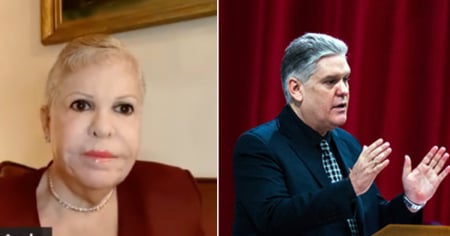
The lawyer and presenter María Victoria Gil Fernández stated that her brother, the former Minister of Economy Alejandro Gil Fernández, “has lost 50 pounds,” “has lost all his hair in a year,” and is currently “in a highly secure prison.”
In an interview granted to our editorial team, María Victoria Gil detailed that the family can see him "every 15 days" for 15 minutes, according to what her niece has told her.
He stated that he sees him as “totally destroyed” and “shocked” by the accusation against him, in which the Prosecutor's Office has requested life imprisonment for a series of offenses, including espionage.
In an interview, María Victoria recounted that for a decade, her relationship with Alejandro was minimal due to her residing in Spain, and that the process has been surrounded by “secrecy”, to the point that she did not know for sure about his detention until Cuban television broadcast the news report.
According to her testimony, her niece informed her that Gil has been imprisoned since March 7, 2024, one month after his dismissal as minister, and that family contact has been limited and monitored. “I have felt sidelined... it has been total silence”, she said.
María Victoria emphasized the seriousness of the espionage charge within the Cuban Penal Code —a crime that, she noted, could carry the maximum sentence—and pointed out that the prosecution's request is for life imprisonment.
Even so, he expressed doubts about whether his brother committed such a crime: "I don’t see him capable of that", he maintained, describing him as a "very kind person."
He insisted that the alleged facts should be clarified publicly and warned that he fears for his life in prison, beyond the judicial outcome.
The interviewee also reconstructed the initial timeline of the crisis: she stated that she learned of her brother's dismissal on February 2, 2024, and by March, Cuban television reported that Gil had acknowledged "serious errors" in his performance and would be investigated by MININT and the Prosecutor's Office.
He specified that this acknowledgment of “mistakes” does not equate to admitting crimes, and attributed part of the economic disaster to collective decisions and a “policy of personnel” that, in his opinion, places unqualified individuals in key positions.
Even though she rejected the idea of Alejandro acting on his own in sensitive matters, María Victoria was blunt in holding him accountable for the economic deterioration experienced by the population and maintained that he must “pay for his mistakes” and for any economic crimes that are proven against him.
At the same time, he believed that he should not be a “scapegoat” for a power structure that —he asserted— approves and signs off on the most significant measures.
In this regard, he demanded transparency and questioned the possibility of a closed-door trial, which he described as an attempt to "rush" the process and limit public scrutiny.
Regarding his personal and family situation, he shared that he has faced social rejection and even lost contact with his niece for months, in an atmosphere of fear and uncertainty.
Despite the differences and his criticisms of Alejandro's role in the crisis, he stated that he supports him in his right to defend himself and reiterated his call for the case to be conducted with verifiable information, respect for due process, and guarantees for his physical integrity while he remains in prison.
The former minister has been in provisional prison for more than a year and a half, accused of espionage, embezzlement, bribery, tax evasion, money laundering, and forgery of public documents, among other crimes.
The Prosecutor's Office presented the proceedings before the Supreme People's Court on October 31, and according to her sister, the trial will take place before the end of the year.
Filed under: