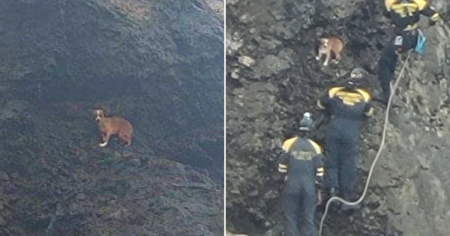
After weeks of uncertainty, public questioning, social media campaigns, and media attacks, Yoni, the little dog from Cauto, is alive.
This was confirmed by the organization Bienestar Animal Cuba (BAC-Habana) through their social media, with a video and testimonials that have completed the story of the dog that touched the hearts of all of Cuba during the evacuations due to Hurricane Melissa.
The confirmation came after an exchange via WhatsApp between BAC and Yeinier's wife - the first person to provide proof of life for the animal - and then directly with him.
Thanks to both of you, the missing part of the story has been reconstructed: when they evacuated his mentor, Yoni was left alone in the area of the Cauto River.
Later, he was picked up by the owner's brother, but he too had to be evacuated, leaving the animal completely alone once again.
Despite the adversities, Yoni survived, endured, and managed to reunite with his family. Today, he is well cared for, nourished, and loved.
“Yoni is a beloved community dog in his area, with identified guardians,” BAC assured in their update, where the little dog appeared shy in front of the camera, accompanied by a boy named Leonardo, who identified himself as the dog's owner.
"We obtained the proof of life that was requested from the beginning, and that was the most important thing. We are pleased that this story has a happy ending and that Yoni will never be alone again," concluded BAC HAbana.
The seven lessons from the Yoni case
Yoni's story not only ended with a happy ending but also with a reflection that transcends the dog himself.
For BAC-Habana, the case leaves at least seven fundamental lessons for Cuba regarding sensitivity, citizen mobilization, and animal protection.
They summarized them in a widely shared post:
The country has changed
"The times when animal abuse was met with indifference are behind us."
Cuban society has begun to strongly reject any form of animal cruelty. Although the laws are still ineffective, the change in mindset is already a victory: outrage is a step towards progress.
Animal abuse is no longer invisible
"Today, those who mistreat a living being bear social contempt, lose the respect of their family [...] and often even their job."
Social rejection has turned what was once a hidden act into something morally unacceptable. There is a new ethical consensus around respect for animal life.
3. The official media still avoid the topic
"State media prefer to discuss 'animal welfare' only in the context of livestock."
Affectionate or street animals remain invisible to the official media. Only pressure on social networks forces the visibility of uncomfortable realities, like that of Yoni.
4. Unity is key
"When we stop dividing ourselves, the message travels further and stronger."
The case united thousands of people around a common cause. The collective strength of the advocates and organized citizens was what kept the demand for truth alive.
5. The people have awakened when it comes to animal protection
"Nobody is fooled by smear campaigns anymore."
In the face of media attacks, the public supported the animal rights movement. It has been understood that its disappearance would leave animals unprotected and that attempts to discredit it are a threat to everyone.
6. Social media is the new megaphone
"Today they are the voice of those who cannot speak."
Facebook, WhatsApp, TikTok, and other platforms proved their power as tools for denunciation, empathy, and resistance. Without them, Yoni would not have had a name, a story, or a rescue.
7. Protecting animals is protecting ourselves
"Every time we protect an animal, we are also protecting the best of what is within us."
Yoni's story reminds us that animal welfare and human well-being are part of the same balance. His survival was also an ethical victory for those who do not renounce compassion.
A background that was not just a "post."
The story of Yoni began with an image shared by the state-run CMKX Radio Bayamo, depicting an abandoned dog left behind after the evacuations in Granma.
The text accompanying the images, titled "The Pain of Departure," employed a lyrical tone that many deemed insensitive and romanticizing of abandonment.
The reaction was immediate. Bienestar Animal Cuba launched a national campaign asking for proof of life, offering to rescue him and cover all veterinary expenses
The case sparked a national debate. Some questioned why there was more discussion about a dog than about political prisoners.
Others, like former spy René González, compared public outrage to the coverage of the Iraq war.
BAC responded firmly: "Our cause does not aim to compete with human suffering, but to remind that compassion is not measured by species."
In the midst of that tense atmosphere, the pro-government program Con Filo accused the organization of being part of the "counter-revolution." BAC responded that its only goal was the truth and animal welfare, and that the media attacks only strengthened the conviction that empathy cannot be criminalized.
Fortunately, the puppy survived, and beyond that, the echo of a deeper lesson remains: every life matters, every life is valuable. And that, and only that, is what humanity is.
Filed under: