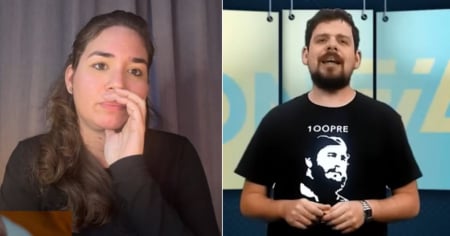
The Cuban doctor and activist Lucio Enríquez Nodarse, a critical voice against the Cuban regime, stated that his country needs international humanitarian and military intervention to save lives and restore order in a nation where, he claimed, the regime has turned the State into a weapon against its own people.
In a video published on his Facebook account, Enríquez Nodarse explained that many confuse the two types of intervention, but clarified that humanitarian intervention seeks to protect civilians, ensure access to medicine and food, and restore basic services, while military intervention has a security component that prevents authorities from blocking or stealing aid.
The activist physician stated that both actions can coexist under legal control and with precision, always within the framework of international law.
He believed that Cuba needs both: one to address the urgent health care shortages and another to ensure that aid reaches the people and does not remain in the hands of the regime.
Enríquez Nodarse rejected the notion that an international operation of this kind should be interpreted as an invasion or a massacre, asserting that it would be a controlled action aimed at neutralizing the violence of power, not punishing the unarmed populace.
He added that, once order is restored, those responsible for human rights violations should be tried in democratic courts, with procedural guarantees but also with justice, to prevent the country from falling back into the same misery.
Lucio Enríquez Nodarse, known for his denunciations regarding the health crisis and the lack of medical supplies in Cuba, reiterated that the population urgently needs medication, medical care, and freedom, amid a context of health system collapse and increasing political repression.
Amid the health crisis in Cuba, exiled doctors and activists have raised their voices against the regime, demanding an urgent response.
From Colombia, the Cuban Medical Guild in Exile sent a letter to the ruler Miguel Díaz-Canel and to the Minister of Health José Ángel Portal Miranda, holding the State responsible for the spread of diseases such as dengue and chikungunya, the lack of medications, and institutional neglect.
The situation has reached a point where a Cuban doctor revealed that there are no basic resources in hospitals, and described healthcare centers as “warehouses of diseases” where professionals can barely do anything for the patients.
At the same time, activists and citizens have reported a rapid increase in infections, accusing the regime of concealing figures and responding with repression instead of sanitary solutions.
Social pressure and public complaints compelled the government to take action. The Ministry of Health recently acknowledged the lack of control over arboviral diseases, including chikungunya and dengue, although it did not take direct responsibility.
The official strategy is now limited to strengthening fumigation measures and mobilizing health brigades, but without guaranteeing access to medications or ensuring minimum conditions in hospitals.
From exile, an open letter warned that the epidemic is out of control and that the population is left helpless. On social media, doctors and citizens agree that the regime's actions are insufficient, while the number of cases and unreported deaths rise along with widespread despair.
Filed under: