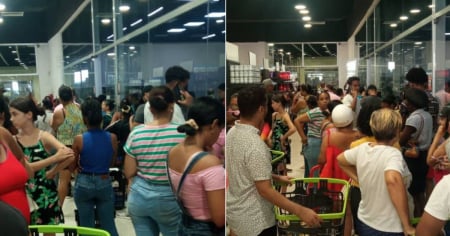
The former Cuban vice president Otto Rivero Torres sparked controversy on social media once again after posting a video denouncing mistreatment and inefficiency at Galerías Paseo, one of the few stores in Freely Convertible Currency (MLC) that remain open in Havana.
In his video, recorded at 9:25 AM on Monday, Rivero recounted that he went to the location to buy some products with the remaining balance his mother had, but he encountered a scene he described as "a disaster."
"This was supposed to open at nine. But it's just now that they are entering the store," he said, pointing to the line of people waiting in front of the closed door.
According to the details, there were only five products available: detergent, some "old cans of lentils," expensive rum, and Zuko soda.
"It seems to be an MLC clearance store," she stated.
"What’s surprising is that this place is full of people waiting for those five products, but they don’t open at nine; they open whenever they feel like it. This issue has nothing to do with the blockade," he emphasized.
In a critical tone, Rivero lamented the lack of respect towards customers and the normalization of everyday mistreatment:
"We are used to this, to mistreating each other. It's normal now for everything to open at any time. A store, a bodega. This Galerías Paseo is nothing like what I knew five years ago; it's a disaster," he said.
"This is not politics, it is ethics."
Hours later, in response to the avalanche of reactions prompted by his post, Rivero wrote a second message attempting to provide context for his complaint.
"It's a matter of sociological, psychological, and ethical complexity... concerning the functioning of the laws," he reflected.
The former leader, one of the most prominent faces of the regime in the early 2000s, explained that his criticism went beyond a specific incident and pointed to the loss of values and the culture of service in contemporary Cuban society.
"Tomorrow, the cruel blockade imposed by the United States will be lifted. As a country, we have economic solvency, and changing that established mindset will take years," he warned.
In the new post, he thanked everyone for their comments and stated that most of them came from people who, like him, do not understand the inefficiency.
"Others, 2%, remember that I, who 20 years ago was to blame. No, no, 20 years ago Galerías Paseo was perfect. And 10 years ago, and six years ago. I have never had anything to do with commerce," he said ironically.
The former vice president noted that almost all of his critics are outside the country, while he has no choice but to remain in Cuba, "in the struggle."
He revealed that he is currently dedicated to the professional care of his mother, a task for which he earns not a cent, and he expressed gratitude for his family's support.
Otto insisted that he did not intend to "solve the problem of Galerías Paseo," but to highlight a greater issue affecting all Cubans: structural inefficiency and the daily mistreatment in basic services.
"I had the courage, responsibly, to report something that is wrong and that people encounter every day," he emphasized, before concluding with a thought: "One must be a good person, that's all."
A declining store and a symbol of crisis
Galerías Paseo, where the complaint originated, is one of the last MLC stores remaining open in the capital.
According to the description given by the former leader, it appears to be in the process of closing down, with a limited selection and overall disorganization, reflecting the collapse of the foreign currency sales system implemented by the Cuban government in recent years.
For many young Cubans, the name Otto Rivero Torres may not mean anything.
But those who were already of a certain age in the first decade of the 2000s will remember that "leader" who, by the whim of Fidel Castro, went from leading the UJC to becoming the Vice President of the Council of Ministers in charge of the Battle of Ideas, the ministry with the most resources at that time.
He was ousted in 2009 along with Carlos Lage and Felipe Pérez Roque, in a purge ordered by Raúl Castro that rekindled the debate about the responsibility of the very political apparatus that he was part of.
At that moment, he shared an extensive text in which he recounted everything he had experienced, including his health issues and his difficulties in finding work.
Today, he claims to lead a modest life and emphasized that his only purpose in denouncing Galerías Paseo was to bring attention to the moral and structural deterioration of the country.
Filed under: