
Related videos:
In a new episode of the institutional offensive against the independent media outlet elTOQUE, the Central Bank of Cuba (BCC) publicly joined the accusations driven from the highest levels of the Cuban government.
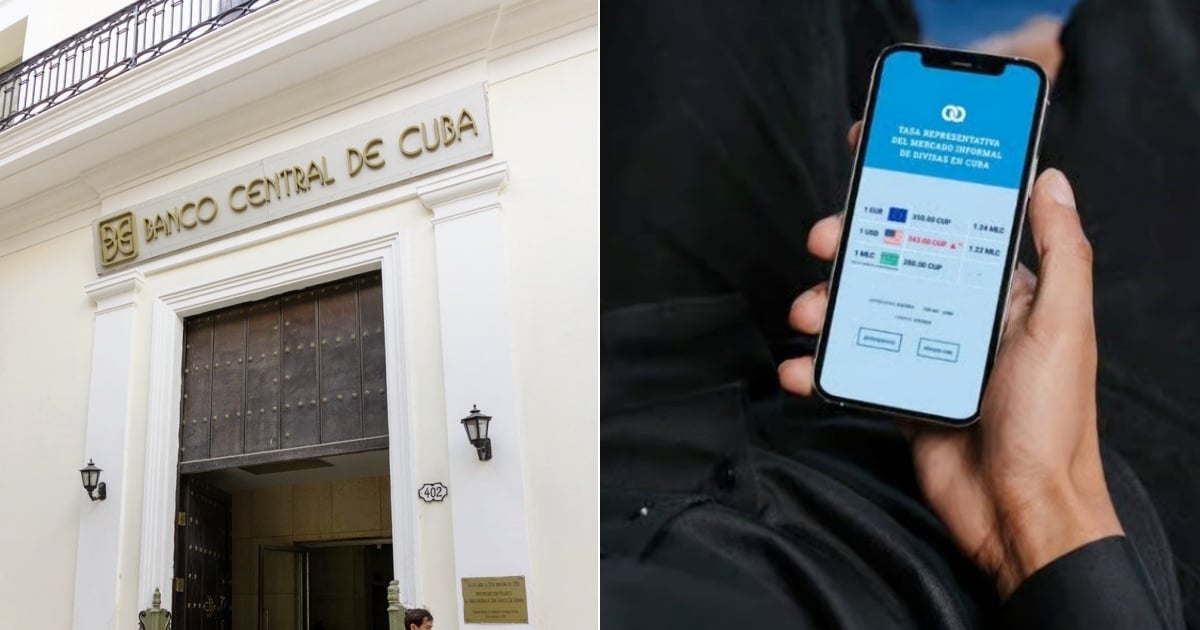
In a statement published this Friday on its Facebook page, the financial entity denounced the media outlet and questioned the legitimacy of its Informal Market Representative Rate (TRMi), while promising the establishment of an "orderly and transparent" official currency exchange market.
“El Banco Central de Cuba supports Prime Minister @MMarreroCruz, Foreign Minister @BrunoRguez, and the complaint made on national television. El Toque is part of the economic aggression against our country and is unacceptable. It lacks economic legitimacy by operating through non-transparent mechanisms that are concentrated and highly susceptible to the speculation of a few economic players who influence the valuation of our currency,” stated the official publication.
The message also criticized the so-called representative rate of the informal market disseminated daily by the independent media, describing it as a "distorted signal" that affects "prices, expectations, and decisions" of the citizens.
Finally, the BCC assured that it is working to establish a more representative official exchange system as part of the Government Program, "in coordination with other agencies of the Central State Administration."
Official promises vs. currency reality
The promise of "an orderly and transparent official exchange market" is not new.
In August 2022, the Central Bank itself announced with great fanfare the implementation of an official rate for the purchase of foreign currency by the public: 1 dollar for 120 Cuban pesos.
However, after applying the 8% banking commercial tax, the effective rate stood at 1x110.40 pesos, as explained at the time by the president minister of the entity, Marta Sabina Wilson González, on the government program Mesa Redonda.
This measure was presented as the beginning of a strategy to bridge the gap between the official value of the currency and the informal market. However, it faced severe criticism from the outset.
In August 2022, elTOQUE was already warning that the figure set by the government was almost identical to that of the black market (1x115 at that time), and that the measure did not provide any real incentives for selling foreign currency to the state.
The then Minister of Economy, Alejandro Gil, attempted to justify the strategy by stating that the goal was to achieve "an exchange rate that balances the economy."
However, practice showed that the new scheme was inefficient: the State was only selling a minimal fraction of what it collected, imposed limits on sales, and waiting lists became endless.
Thus, the official exchange rate ultimately became irrelevant in light of the real dynamics of the market.
In that context, the promised "orderly and transparent" market remains an unachieved goal, while the informal rate – the only one that accurately reflects the economic pulse of the street – continues to be compiled and published by elTOQUE, much to the government's discontent.
Accusations of "financial terrorism" and official propaganda
The statement from the Central Bank is part of a broader campaign of state harassment against elTOQUE.
The independent media is being accused by the regime of engaging in a supposed “financial terrorism” scheme aimed at causing the economic collapse of the country.
Everything began on October 29, when Chancellor Bruno Rodríguez denounced the existence of “evidence of speculative manipulation of the exchange rate.”
Days later, the official spokesperson Humberto López reiterated the accusation on his program Razones de Cuba, where he stated that elTOQUE is part of a "comprehensive economic warfare program" funded by the United States.
López accused the media of "depressing the income level of the Cuban population," of "promoting a scheme for currency trafficking," and of committing "tax evasion."
He even raised the possibility of initiating criminal proceedings against its members, suggesting that the media outlet be included on a list of entities "linked to terrorism."
ElToque responds: “The Earth is spherical and the elephant is still in the room.”
The response from the media came swiftly. With an ironic and defiant tone, elTOQUE dismantled the regime's accusations.
In it, he ridiculed the official propaganda narrative and defended his informational work as an exercise in transparency before a citizenry without access to reliable data.
"There is more rationality in those who believe the Earth is flat than in those who place their blind faith in Humberto López and the National News on Cuban Television," the article concluded with irony.
He also warned that the publication of the informal exchange rate "is not financial terrorism, it's a public service" and that blaming an independent media outlet for the structural crisis of the Cuban economy is a way of evading political responsibilities.
As a conclusion, the outlet warned of a possible official blockade of its website and offered alternatives to stay informed via mobile apps and social media.
A regime that fears transparency?
The attack on the Central Bank occurs amidst a severe economic and social crisis in Cuba, marked by rampant inflation, food shortages, collapsed services, and massive emigration.
In that context, the presence of independent sources like elTOQUE poses a threat to the state propaganda apparatus, which has lost credibility among large segments of the population.
The regime's strategy seems clear: discredit those who expose the reality, create an external enemy to blame for the disaster, and try to regain control over the economic variables that are no longer under its dominance.
Meanwhile, the Central Bank is trying to uphold the official narrative, insisting on the promise of an “objective” rate, even though in practice it has not managed to establish a functional mechanism for the buying and selling of foreign currency.
The informal market, fueled by distrust in the state, continues to be the only true reflection of the value of the Cuban peso.
In short, the Central Bank's attack on elTOQUE is not just a declaration of war against an independent media outlet: it is also a confession of institutional failure to control an economy that has spiraled out of its grasp.
Filed under: