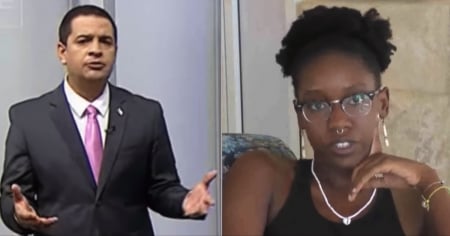
The Cuban activist Amelia Calzadilla outlined the state decisions that, in her opinion, pushed the value of the dollar in Cuba to unprecedented levels and dismantled the official accusation against El Toque, which the regime accused of participating in a supposed "financial terrorism" scheme aimed at causing the economic collapse of the country.
Calzadilla began by recalling that El Toque is solely focused on daily reporting of the behavior of the informal currency market in Cuba and that the rising value of the dollar is not due to any imposed algorithm, but rather to economic dynamics created by the state itself.
In an extensive video on his profile on Facebook, he pointed out that the turning point was the partial dollarization —which ended up being complete— driven during a global recession by the head of the Permanent Commission for the Implementation and Development of the Ordering Task Marino Murillo and the former Minister of Economy Alejandro Gil Fernández, a decision that forced the population to require foreign currency to purchase basic goods.
He explained that by placing food, essential items, and appliances in stores that accept freely convertible currency, the government has assigned a crucial value to the dollar for everyday survival. “If you don't have dollars, you won't be able to continue living,” he stated.
The crisis deepened when they stopped selling foreign currency at the Casas de Cambio (Cadeca), forcing citizens to turn to the informal market amid a decline in remittances and a decrease in the influx of hard currency into the country.
Calzadilla asserted that the fundamental economic law of lower supply and higher demand explains the increase; the dollar has become a scarce and necessary good, equivalent to any product subject to competition among buyers.
He stated that everything, from food to medicines acquired informally, ended up referenced in foreign currency. "The one who brought us to this point was the Cuban State," he declared.
He criticized the coercive measures aimed at curbing the informal market, stating that they would only lead to more fear, bribery, and a further increase in prices.
He added that the latest media offensive against El Toque aims to divert attention from the real causes and that their work merely exposes the country's "economic ailment."
Regarding the accusations of currency trafficking and tax evasion against the media outlet, Calzadilla described them as unfounded.
He recalled that El Toque neither buys nor sells currency and, furthermore, the independent press cannot legally establish itself as a business in Cuba.
He also recommended that citizens download the media's app in case the authorities attempt to block access.
Finally, he stated that as long as there is no economic freedom, labor incentives, and real production capacity, the exchange rate will remain out of control.
In a previous post, Calzadilla pointed out that “it was the State that created in the population the vital need to acquire dollars, because otherwise they would die of hunger,” referring to the establishment of dollar stores, a measure promoted by the also Deputy Prime Minister Gil, who was recently judged by the regime.
In recent weeks, Cuban authorities intensified the state harassment campaign against El Toque.
Spokespeople and institutions accuse the media of "depressing the income levels of the Cuban population," of "promoting a scheme for currency trafficking," and of committing "tax evasion."
They even raise the possibility of opening criminal proceedings against its members, suggesting that the outlet be included in a list of entities "linked to terrorism."
El Toque has ridiculed the official propaganda narrative and defends its informational work as an exercise in transparency before a citizenry without access to reliable data.
Filed under: