
Related videos:
The scene seems pulled from an impossible contrast: in the port of "Los Chinos" in Santiago de Cuba, trucks loaded with donations come and go under strict controls; just a few meters away, a family devastated by Hurricane Melissa continues to receive no assistance whatsoever.
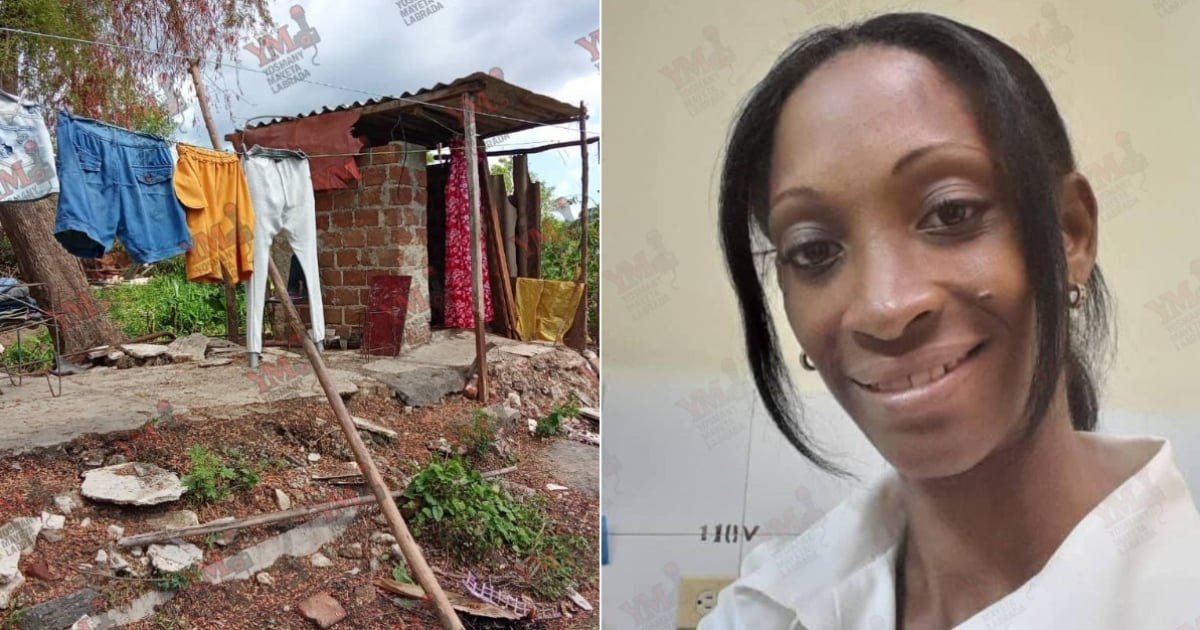
There lives Lizandra Estrada Mustelier, a nurse at the Frank País García Polyclinic, mother of two children, and also responsible for her sick mother.
Your case, reported on Facebook by independent journalist Yosmany Mayeta Labrada, has become a symbol of the neglect faced by hundreds of families following the cyclone that swept through the province.
Lizandra, 33 years old, lost almost everything when the river that runs along Mar Verde Road at kilometer 1 overflowed violently. The water flooded her home, destroyed her belongings, and as if that weren't enough, a mango tree fell on what remained standing.
Her 8 and 11-year-old children, her 67-year-old mother -retired due to illness- and she herself are surviving between damaged walls, muddy floors, and a home that is no longer a home.
Around him, the scene is equally devastating: five total collapses in the area, homes destroyed, single mothers, elderly people who have lost everything.
But what is most infuriating is the official silence.
No delegate from the constituency has shown up, no representative from the Party or the Government has visited them, the electric service has not been restored, and no state assistance has arrived.
Meanwhile, donations continue to arrive at the nearby port.
Trucks loaded with supplies pass by the affected families without stopping, while official credentials strictly control who accesses the humanitarian aid, ignoring the road where so many people wait for help that never arrives.
When Lizandra went to her workplace to explain her situation, the only thing they offered her was an unpaid leave. A humiliating response for a woman who dedicates her life to saving others and who today, in her own misfortune, is treated as if she does not exist.
The images sent by the neighbors, fearful of reporting possible reprisals, clearly depict a scenario that no one in the state has been willing to see: destruction, deprivation, and families left completely without support.
Real solidarity—the only kind that has taken action—comes from the nurse's colleagues and the neighbors themselves, who have organized to bring food, support, and basic supplies. No authority has done what it is supposed to do.
Other cases that confirm a pattern
What happened with Lizandra is not an isolated incident.
In the same Santiago de Cuba, Ulises Castro Reyes, a 75-year-old man from the impoverished neighborhood of El Resplandor, lost his home for the second time due to a hurricane.
In 2012, Sandy left him homeless; this time Melissa has reduced him once again to an improvised bed outdoors made of scraps of wood and cardboard. On that occasion, the so-called "state assistance" was limited to six poles, six black cardboard tiles, and a bag of cement.
Today, following the new collapse, no institution has come forward to provide a minimal solution.
His family asserts what many quietly repeat: aid is distributed based on political convenience or areas with media visibility, while entire communities are left off the institutional map.
They wonder -rightly- how aid is supposed to reach those who truly need it if the CDRs are not functioning, the inspectors are corrupt, and donations often get diverted or end up being resold.
Also in Songo, a pregnant woman with three young children faces extreme conditions: a dirt floor turned into mud, children without a dry mattress, no official assistance, and a delegate who barely recommended "putting the mattress in the sun."
Despite Prime Minister Manuel Marrero Cruz's assurance that "no one will be left helpless," the reality documented by numerous accounts is that of a province mired in neglect.
More than 95 thousand damaged homes, with less than half having their electricity restored and thousands of families unable to replace what they have lost in a country where salaries do not even cover the basics.
The solidarity that does exist: that of the people
While institutions fail, independent support networks are multiplying.
Caritas Santiago de Cuba, for example, activated its parish structure from the very beginning and distributed more than 4,400 rations of food, detergent, and soap among those affected.
Volunteers such as the Avilean jeweler Mijaíl García traveled hundreds of kilometers to deliver televisions, clothing, food, and hygiene items to families in Guamá who had lost everything.
It is these gestures that sustain devastated communities, not government promises. It is ordinary citizens who traverse muddy paths, raise makeshift walls, feed strangers, and support those who have lost everything.
A country stripped bare before every cyclone
Each hurricane exposes a poverty that is not a result of the weather, but rather of decades of decay and neglect.
Cuban families face the impact of weather events without savings, without resources to rebuild, without accessible materials, and relying solely on the help of other citizens, never on assistance from a government that only appears for the cameras.
The case of nurse Lizandra Estrada Mustelier encapsulates the experience of thousands of families: destroyed homes, at-risk children, vulnerable elderly individuals, and a country where solidarity comes from the people, while institutional aid remains stagnant… even when it is just a few meters away.
Filed under: