
Related videos:
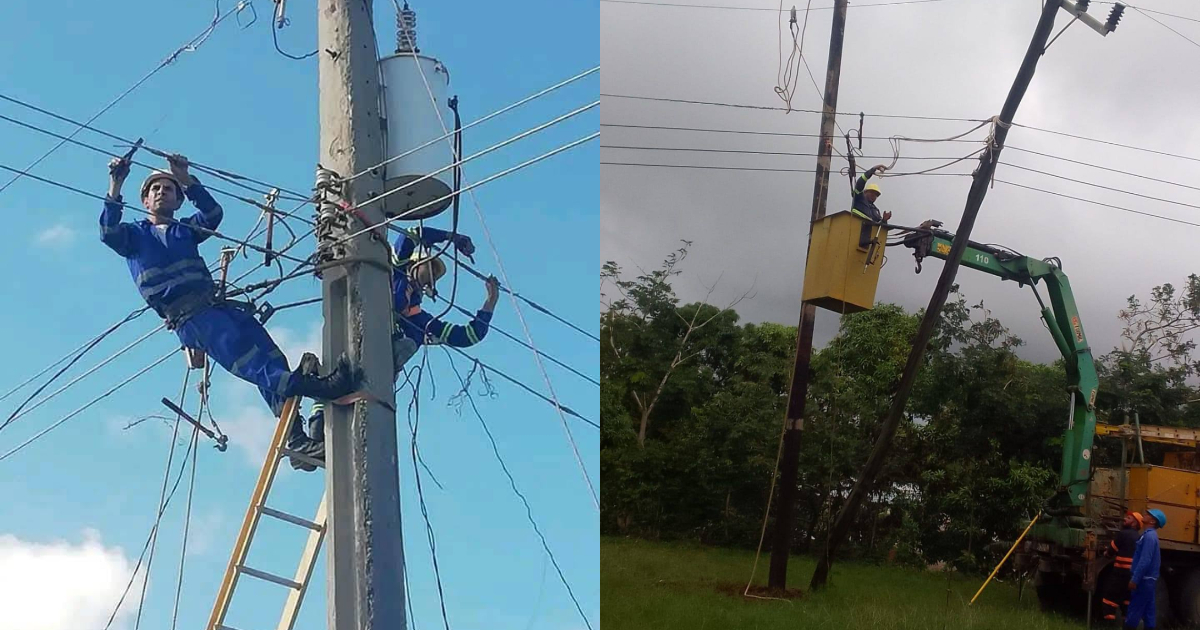
Although the province of Holguín has restored 86.2% of the electric service, more than 52,000 customers are still without power 17 days after the impact of Hurricane Melissa, with the most significant damage in Mayarí, Urbano Noris, Frank País, and Báguanos.
According to the president of the Provincial Defense Council and first secretary of the Communist Party (PCC) in the region, Joel Queipo Ruiz, out of the 204 circuits damaged by the cyclone, 188 are already operational.
He also stated that national support is being utilized to replace 30 affected transformers and expedite recovery, while three photovoltaic parks are already operational, reported the official newspaper ¡Ahora!
Thus, it was revealed the day before during the National Defense Council session broadcast from Santiago de Cuba, where the president of the body and first secretary of the PCC, Miguel Díaz-Canel Bermúdez, assessed the recovery in the provinces affected by Hurricane Melissa.
In addition to the situation in Holguín, the national monitoring of the restoration of electricity allowed for a comparison of progress by province.
Guantánamo demonstrates a recovery rate exceeding 98%, while Granma has restored 89% of its electrical infrastructure, although it still has 31,000 customers without service.
In parallel, Santiago de Cuba prioritized energizing all the circuits of the provincial capital and its municipal heads starting from November 14.
The plan anticipates an accelerated work pace to fully restore service in the main municipality within a period of seven days.
Other impacts in Holguín
Alongside the energy balance, information was provided regarding the assistance to the affected population in Holguín where more than 300,000 people required protection during the weather event; 29,244 in evacuation centers and over 247,000 in the homes of relatives or acquaintances, the source noted.
The rains associated with the recent cold front forced new evacuations in Sagua de Tánamo, Cacocum, and Jíbaro, as well as in Rafael Freyre, Antilla, and Urbano Noris. In total, 298 people are staying in five evacuation centers, and more than 1,010 are in the homes of family or friends in seven of the 14 municipalities.
In the hydraulic sector, 13 water trucks and 131 pumping stations have been recovered, leading to an 83.8% restoration of water supply through the network. Meanwhile, three municipalities are receiving more water today than before the hurricane due to the recovery of sources affected by the drought, the news outlet reported.
In the case of telecommunications, 196 telephone poles were restored, 89% of clients already have communication, and 187 radio bases and 33 damaged optical fibers have been reestablished.
Out of the 683 affected educational institutions, 121 have been restored, representing 17.7%. Of the 1,323 institutions in the province, 1,269 are operational with alternative modalities while the remaining centers are pending.
The province also faces significant damage to mattresses, with over 8,370 units lost or deteriorated. For their recovery, a productive front has been activated at the Jíbaro factory, and workshops in Holguín are repairing materials provided by the community, according to the newspaper.
In housing, 20,200 repair requests have been recorded and 58 homes have been recovered.
The official report includes 926 total collapses, 1,215 total roof damages, 2,735 partial collapses, and 14,446 roofing issues.
On the other hand, there are 191 affected health institutions, of which 54 have been restored. Out of 1,268, only four remain out of service in Báguanos due to access issues.
Queipo emphasized that “complex health interventions” are being carried out in municipalities such as Holguín, Cacocum, Urbano Noris, and Cueto, due to the “complex” hygienic and sanitary conditions following the floods.
The agri-food sector reported damage to 35,000 hectares, of which 910 (2.6%) have already been recovered, along with 2,384 organoponic beds.
Additionally, 13 bakeries and 57 warehouses have been recovered, while the basic basket is being distributed with the support of more than 500 productive entities.
Queipo emphasized the actions taken against abusive pricing, with over 4,700 seizures for forced sales. He also highlighted the national and international solidarity in the recovery process and the commitment to "leave a city more beautiful than before the hurricane and to make the land produce more."
Filed under: