
Related videos:
The authorities in Havana have deployed 77 street cleaning brigades, with around 600 workers, as part of a special cleaning operation for the capital in anticipation of the city's 506th anniversary, which is celebrated on November 16th.
The plan was proposed in a meeting with the authorities of Havana, led by the ruler Miguel Díaz-Canel, along with Prime Minister Manuel Marrero, Vice President Salvador Valdés Mesa, and other leaders.
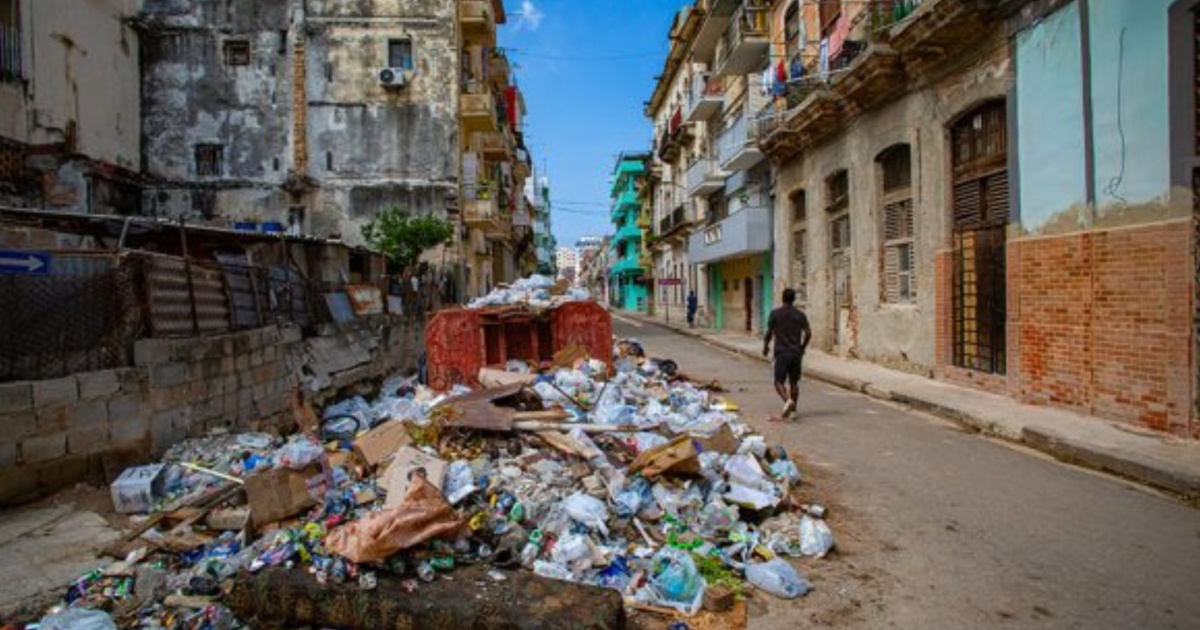
The stated goal is "to improve" the collection of urban solid waste and the cleaning of major avenues, plazas, and high-traffic areas, amidst a waste crisis that has led to strong public criticism.
In the meeting, it was highlighted that, in the last week, 93,043 liters of fuel were used to transport 96,500 cubic meters of waste, which, according to the official report, reflects a "greater efficiency" in resource use by reducing the consumption rate from 1.05 to 0.96 liters per cubic meter.
The new sweeping brigades will focus "initially" on the main avenues of the 15 municipalities, as well as in squares and areas deemed significant for transit and social life.
The recovery of the "emblematic profession of the street sweeper" includes, according to the report, the rehabilitation of their carts, salary reevaluation, and the guarantee of food, uniforms, protective equipment, and cleaning tools, as part of an effort to "dignify" this work in the capital.
Meanwhile, the authorities remarked as "encouraging" that in some local councils, a discipline is beginning to develop where families only take out the trash when the collection truck passes, although they noted that this habit relies on strictly adhering to the collection schedule.
Díaz-Canel emphasized that the stability of the service will only be possible if there is systematic organization and strict control of the routes, and he called for punctuality in the schedules to gain "understanding and sensitivity" from the public.
The report also included a chapter on the fight against crime and social indiscipline in major waste dumps: it was reported that 1,159 fines were imposed, amounting to over 500,000 pesos, the detention of individuals illegally engaged in collecting raw and processed materials due to the spread of epidemics, as well as home inspections and the demolition of shanties used to store items extracted from garbage “cans.”
Additionally, there was a report on the rehabilitation of crematories in Santiago de las Vegas and Guanabacoa, the operation of the equipment in Berroa, and the repairs in 22 out of 24 funeral homes in the capital, as well as cleaning activities in 16 municipal cemeteries, as part of a program to improve Necrological Services.
The deployment of 600 street cleaners comes in a context marked by the so-called "Clean-Up Operation," led by soldiers, officers, and civilian workers from the Revolutionary Armed Forces (FAR) to "improve" the hygienic conditions of the capital, and by the "Bell Operation," a pilot plan for nighttime garbage collection in areas with underground electrical service.
However, the lack of structural resources and accumulated inefficiency have so far hindered a sustainable solution to the urban waste problem in Havana.
While the official newspaper Granma has asserted that the capital is moving towards a "smart and sustainable city model," the people of Havana respond with images of overflowing containers, trash in streets and sidewalks, crumbling buildings, and chaotic transportation, contrasting official rhetoric with daily reality.
The announcement from the portal Cubadebate to celebrate the 506th anniversary of Havana sparked a wave of critical and sarcastic comments, where many residents recalled that they live in a city where the government "is unable to collect the trash, provide a minimally efficient transport system, or even supply a simple paracetamol."
In the health sector, the official report states that in the capital there is a decrease in fever cases and an increase in screenings, along with a rise in vector control actions: it is expected that more than 1,500 workers from the campaign against the mosquito will be engaged and that the number of fumigation "bazookas" will increase from about 450 to over 750, aiming to cover more than 82% of the premises in two weeks.
However, the environmental situation of the city—characterized by illegal dumps and stagnant water—has favored the spread of vectors and diseases, making sanitation an especially sensitive issue for residents.
Against the backdrop of the 506th anniversary of Havana, the announcement of the 77 cleaning brigades aims to convey the message that "when there is demand and control, results can be achieved."
However, for many city dwellers, the real challenge will be to see if this effort is sustained beyond the symbolic date and whether the cleaning of the city ceases to be an emergency operation and transforms into a stable and efficient service that meets the needs of a city that, despite its history and charm, has been grappling with a deep urban management crisis for years.
Filed under: